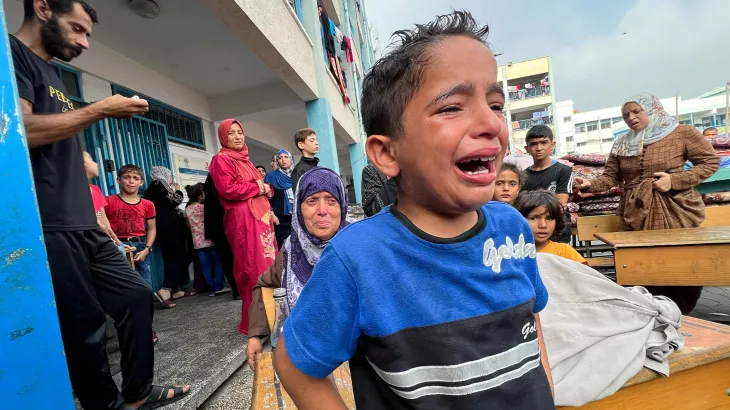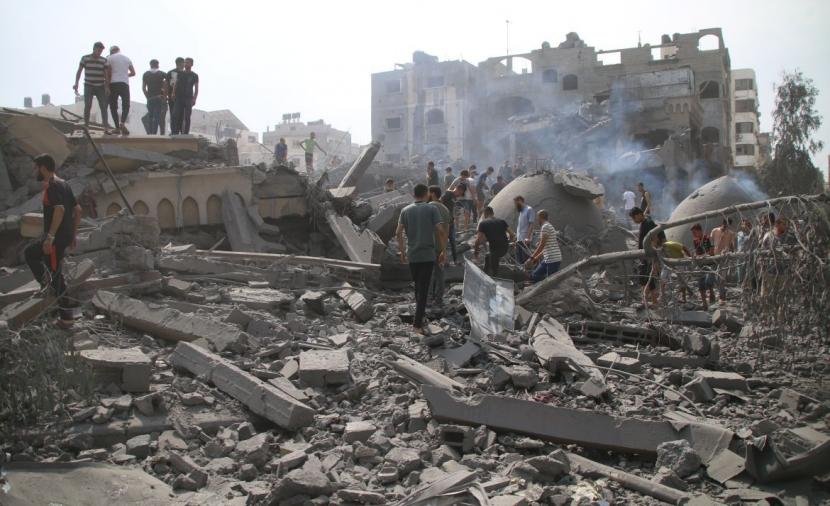
Gaza Herald — For tens of thousands of Palestinian families across the Gaza Strip, the agonizing search for missing loved ones has turned into an open-ended tragedy with no relief in sight. Beneath the mountains of pulverized concrete that mark former residential neighborhoods flattened during Israel’s ongoing genocidal war, thousands of bodies remain trapped under heavy debris. Families are left struggling in painful uncertainty, waiting to learn whether their relatives can ever be exhumed, forensically identified, and given a dignified burial in accordance with their faith.
The International Committee of the Red Cross (ICRC) has issued a grave warning emphasizing that recovering the remains of missing Palestinians and verifying their identities could take years. This staggering delay is driven by the vast scale of structural devastation, an enforced blockade on heavy excavating machinery, and a critical lack of forensic medical equipment across the besieged enclave.
An estimated 8,000 bodies remain buried under destroyed buildings throughout Gaza, according to figures cited in human rights and humanitarian reports. The challenge extends far beyond clearing rubble. Rescue and recovery teams must reach deeply buried remains, carefully document forensic evidence, preserve biological samples, and establish positive identities under catastrophic field conditions. Every single stage of this process demands specialized machinery, trained forensic personnel, and equipped laboratory facilities that Gaza currently lacks due to ongoing siege conditions and targeted infrastructure destruction.
Amani Al-Nawouq, the ICRC’s spokesperson in Gaza, confirmed that severe field constraints and technical blockades are crippling recovery operations. The resources currently available inside the Strip, she stressed, fall catastrophically short of what is required to address the unprecedented scale of this humanitarian crisis.
A Search Paralyzed by Systematic Destruction and Missing Equipment
To support overwhelmed local crews, the ICRC is assisting exhumation efforts by renting heavy machinery to help families and emergency services reach remains buried under multi-story structural collapses. The organization is also assisting local forensic authorities with documenting and tracking exhumed bodies, managing overcrowded burial sites, and developing basic cemetery infrastructure to preserve the dignity of the deceased.
These emergency interventions are vital in a territory where entire municipal districts have been reduced to wasteland. Without heavy excavators and specialized cutting tools, reaching trapped bodies manually is extraordinarily dangerous, agonizingly slow, and physically exhausting. Rescue workers must navigate unstable concrete slabs and multi-layered ruins while attempting to coordinate with forensic teams responsible for cataloging the victims.
For Palestinian families, the consequences of these delays are heartbreaking. The inability to recover a missing relative means families are denied closure, unable to confirm a death or hold a traditional Janazah burial. The absence of a marked grave leaves grief suspended indefinitely between shrinking hope and overwhelming horror.
Proper documentation remains the only safeguard against permanent loss of identity, particularly when remains cannot be visually identified upon recovery. The ICRC’s support includes efforts to standardize how recovered remains are logged and cataloged, preserving physical details that could lead to identification if advanced forensic capacity is eventually brought into Gaza.
Total Lack of DNA Testing Severely Blocks Identification
Even when search teams manage to retrieve remains from under the rubble, identifying them presents a monumental obstacle. Al-Nawouq pointed out that Gaza’s forensic infrastructure has been severely crippled, with zero functional facilities currently available to perform DNA analysis. Access to pre-war health databases and dental records is nearly impossible, while surviving laboratories lack the basic chemical reagents, refrigeration, and specialized equipment needed to preserve biological specimens.
These extreme limitations mean that physical exhumation alone cannot guarantee that a family will receive answers. In cases where severe physical trauma or prolonged decomposition renders visual identification impossible, the absence of laboratory testing leaves cases unsolved.
Effective forensic identification relies entirely on preserving evidence and systematically documenting every detail. In the absence of DNA testing, local authorities are forced to rely on physical descriptions, recovered personal belongings, and careful physical cataloging, preserving data in the hope that future laboratory testing or alternative forensic methods can be applied.
The exhumation chain involves multiple interdependent steps: locating the site, safely clearing concrete, retrieving remains, recording physical evidence, preserving biological samples, and cross-referencing family reports. A bottleneck at any point halts the entire process, leaving thousands of unidentified victims in temporary graves while their families continue to search.
Unexploded Israeli Ordnance Poses Constant Danger to Recovery Teams
The search for missing Palestinians is further complicated by the lethal presence of unexploded Israeli munitions buried within the rubble. Al-Nawouq warned that emergency workers and volunteers face constant life-threatening hazards while digging through ruined buildings, where unexploded shells, dropped bombs, and lingering hazard materials remain concealed under shattered concrete.
These explosive hazards force search teams to proceed with extreme caution, often halting work at suspected sites until clearance can be conducted. When combined with unstable structural ruins, a shortage of fuel, and a total lack of protective gear, the risk to recovery crews becomes immense.
The acute shortage of heavy excavators remains the primary physical bottleneck. Manual shovels and hand tools cannot replace heavy machinery when clearing collapsed concrete towers, and attempting to clear heavy debris without proper equipment routinely exposes rescue workers to secondary collapses.
Addressing this crisis requires far more than volunteer labor; it demands the immediate entry of heavy excavation machinery, specialized forensic tools, mobile testing units, biological preservation supplies, and equipment to neutralize unexploded ordnance. Without sustained international support and the lifting of entry restrictions, information will continue to be lost as remains degrade beyond recognition.
For Families, the Agony Continues Long After the Bombing Stops
The estimated 8,000 Palestinians still trapped beneath Gaza’s ruins represent a massive forensic challenge, but above all, they represent thousands of grieving families waiting for answers. Many have spent over three years searching through destroyed neighborhoods or waiting outside morgues, lacking even the basic confirmation of their loved ones’ fate.
The ICRC’s warning that identification could take years highlights the horrifying reality facing these families, who remain trapped in psychological torment as long as recovery efforts remain blocked. The fundamental human right of families to know the fate of their relatives is directly bound to the duty of treating the deceased with dignity and providing them with a proper burial.
International action is urgently required to force the entry of heavy machinery, forensic testing equipment, and protective gear into Gaza. Clearing rubble without forensic preservation risks erasing crucial evidence, just as exhuming bodies without the technical tools to identify them leaves families without the certainty they have sought for years.
For Gaza’s population, a pause in active bombardment cannot bring true relief while their relatives remain buried under the ruins of their homes. Until every missing Palestinian is recovered, identified, and honorably laid to rest, the devastation of Gaza remains an unclosed wound.