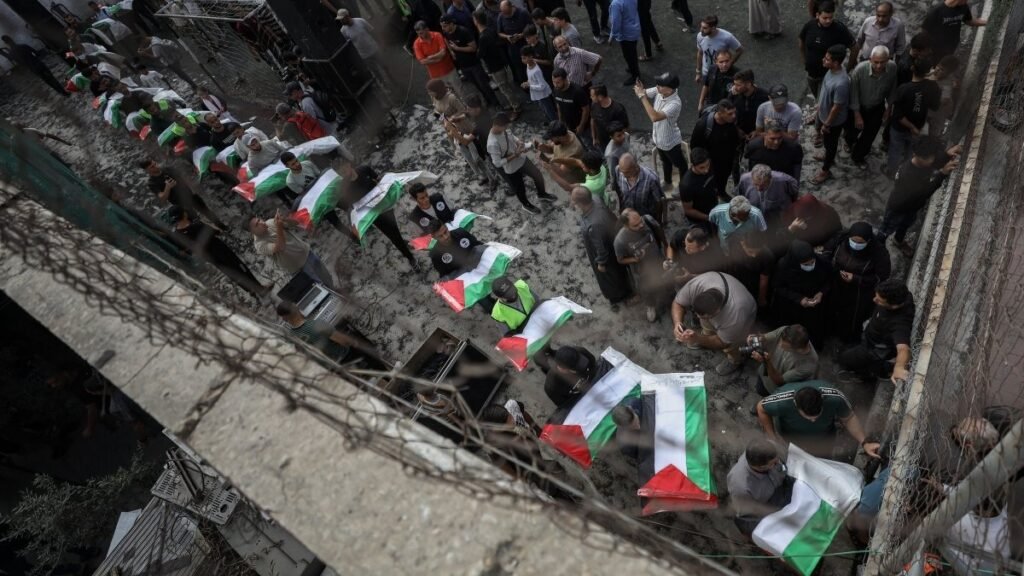
Gaza Herald— Palestinians in Gaza City held a mass funeral on Sunday morning for 75 people whose bodies and remains were recovered by Civil Defense teams from beneath the rubble of destroyed buildings in the Al-Daraj neighborhood, northeast of the city.
The funeral brought renewed attention to the suffering of families who have waited years to recover their loved ones and give them a dignified burial.
On Saturday evening, relatives gathered to say their final goodbyes after Israeli bombardment, repeated displacement, and a severe shortage of rescue equipment had prevented the recovery of many of the bodies for years.
Families Reunited With Their Loved Ones After Years of Waiting
Some of the losses mourned during the funeral date back to the earliest months of Israel’s genocidal war on Gaza.
Mohammad Atallah said he lost his father, brothers, sisters, and other family members when Israeli forces bombed the house where they were sheltering on December 13, 2023.
The only survivor was his niece, who was eight years old at the time.
Atallah said the pain of losing his family has never healed.
Another grieving Palestinian, Abu Haitham Hajjaj, described how he had been unable to recover the bodies of his relatives while he was displaced in southern Gaza.
Israeli bombardment and the lack of adequate rescue equipment made recovery impossible at the time.
After years of waiting, his family members’ remains were finally reached.
Thousands of Bodies Still Buried Beneath Gaza’s Ruins
In a statement issued Sunday, Hamas said the funeral of the 75 Palestinians recovered from Al-Daraj exposed the scale of the humanitarian catastrophe caused by Israel’s genocidal war and the lasting consequences of attacks on civilians.
The movement said approximately 8,000 bodies remain buried beneath the rubble of destroyed homes and buildings across Gaza.
It warned that the inability of Civil Defense teams to recover them because of severe shortages of equipment and heavy machinery has compounded the suffering of thousands of families still waiting to retrieve and bury their loved ones with dignity.
Hamas called on the United Nations, the international community, and mediators to intervene immediately and pressure Israel to allow the entry of all necessary recovery equipment.
It also urged the deployment of specialized rescue teams to support Gaza’s Civil Defense crews and accelerate the search for victims.
The movement further called for international investigations and accountability mechanisms to address Israeli crimes and ensure that those responsible do not escape justice.
Civil Defense Warns of Severe Equipment Shortages
The mass funeral took place as search operations continued beneath destroyed buildings across Gaza, with limited resources preventing rescue teams from removing massive concrete slabs and reaching buried remains.
Gaza Civil Defense spokesperson Mahmoud Basal previously estimated that between 8,000 and 10,000 bodies remain trapped beneath the rubble.
He warned that the agency’s operational capacity continues to deteriorate because of shortages of heavy machinery and ongoing Israeli restrictions on the entry of rescue and maintenance equipment.
Basal explained that the challenges do not end once remains are recovered.
Rescue teams also struggle to identify badly decomposed or burned bodies because Gaza lacks the DNA testing equipment needed for reliable identification.
For families who have waited years for news of missing relatives, these shortages create another painful obstacle to finding answers and arranging proper burials.
Repeated Mass Funerals Reveal the Scale of Gaza’s Losses
The funeral in Al-Daraj followed several other large-scale recovery operations across Gaza City.
In early October, Palestinians held a funeral for the remains of 105 people recovered from the Burj Al-Taj area of the Al-Yarmouk neighborhood.
In late September, Civil Defense teams recovered the remains of 28 people from beneath the ruins of a home belonging to the Abu Naama family in Al-Daraj.
Earlier, more than 130 people from the Abu Sharia and Al-Hasayneh families were recovered and buried in the Al-Sabra area of southern Gaza City.
These successive funerals reveal an enduring dimension of Gaza’s humanitarian catastrophe.
While some families are finally able to bury loved ones years after they were killed, thousands of others remain trapped in uncertainty, waiting for machinery capable of clearing the rubble, rescue teams able to reach the bodies, and forensic equipment that could identify the remains.
For those families, the search for their loved ones continues long after the bombardment that took their lives.