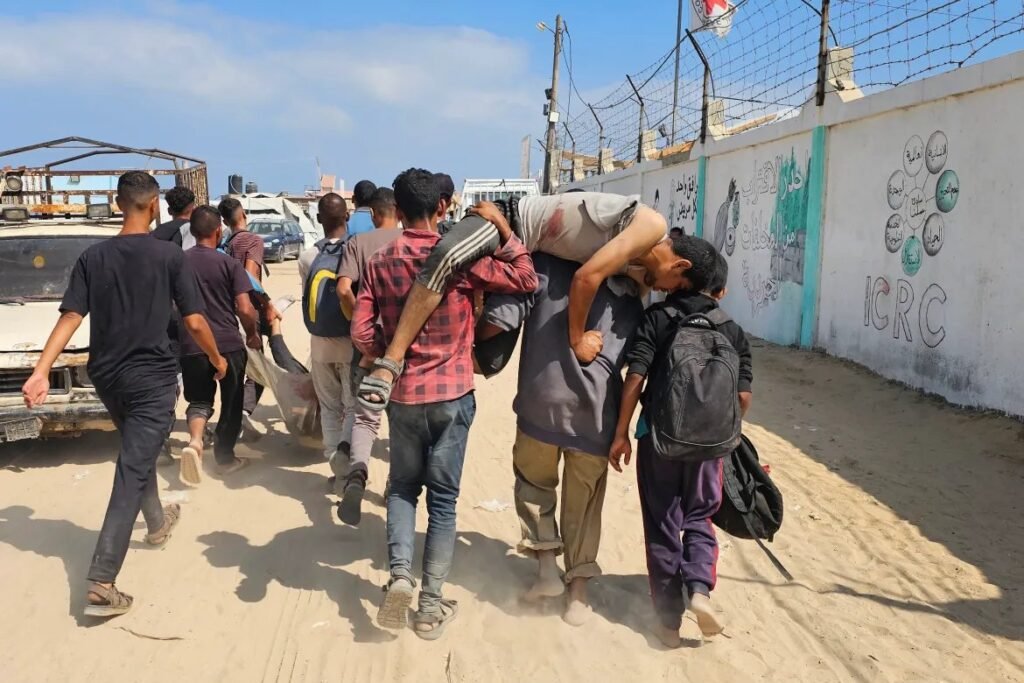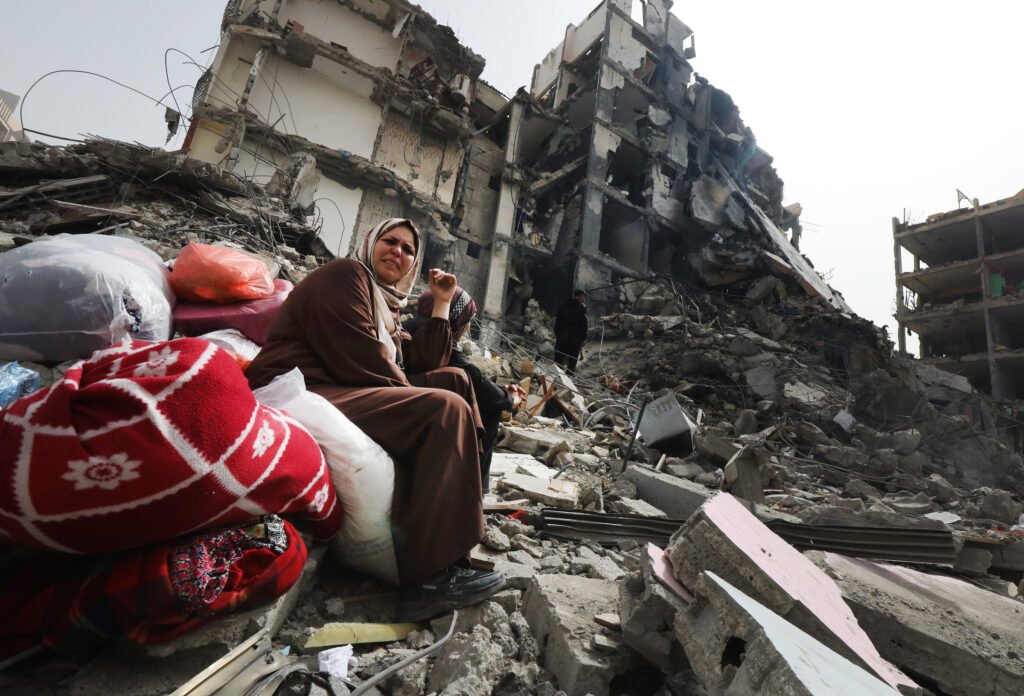
Gaza Herald — In Gaza, tragedy does not always end with human loss. While families continue searching for relatives lost during bombardments, other bodies remain trapped beneath the rubble of destroyed homes and buildings, while others have been buried in makeshift or mass graves, and some graveyards themselves have been bulldozed, desecrated, and destroyed.
Yet accessing the body of someone killed in war is not merely a humanitarian or familial concern, nor is burial solely a religious or social matter. International Humanitarian Law (IHL) establishes a clear framework of obligations toward the deceased, beginning with search and recovery, extending through identification and dignified treatment of remains, and encompassing the protection of graves and the return of remains to families.
The International Committee of the Red Cross (ICRC) classifies the search for, collection, treatment, return, and registration of the dead as rules of Customary International Humanitarian Law. These rules affirm that parties to a conflict are required to take all possible measures, whenever circumstances permit, to search for and collect the dead.
In Gaza, where entire neighborhoods have collapsed over their residents, a pressing question arises: What happens when rescue teams are denied access to the rubble, when the necessary heavy machinery for extraction is unavailable, or when cemeteries meant for final rest become sites of destruction and desecration?
The Dead Do Not Lose Their Right to Dignity
Rule 112 of Customary IHL states that each party to the conflict must, whenever circumstances permit and particularly after an engagement, take all possible measures without delay to search for, collect, and evacuate the dead.
This rule goes beyond the act of burial itself; it applies from the moment a person goes missing or is presumed killed.
Meanwhile, Rule 113 obligates parties to a conflict to take all possible measures to prevent the despoilment or mutilation of the dead. The ICRC clarifies that this customary rule is binding in both international and non-international armed conflicts.
Furthermore, Rule 115 dictates that the dead must be treated with respect and that their graves must be respected and properly maintained.
Under IHL, a human body is not viewed as mere biological remains once life ends, but as an entity commanding specific duties from parties to the conflict.
In the context of Gaza, this means that a body lying beneath the ruins of a home does not discharge the legal obligations owed to that individual. Whenever circumstances allow, search, recovery, collection, and respectful handling remain legally required.
The ICRC has operationally confirmed that this principle applies to Gaza. In the first half of 2026, the organization reported that it facilitated local efforts to recover bodies from under the rubble using heavy equipment, assisted in the transfer of the remains of over 130 individuals, and trained more than 100 specialists in search, recovery, and documentation.
When Rubble Becomes an Open Cemetery
Before the ceasefire, the United Nations warned of the catastrophic scale of bodies trapped beneath the ruins.
In May 2024, the UN Office for the Coordination of Humanitarian Affairs (OCHA) cited health authorities in Gaza estimating that over 10,000 people were believed buried under the rubble, at a time when civil defense teams faced critical shortages of bulldozers, excavators, equipment, and personnel. The UN warned that the recovery process could take years using the rudimentary tools available at the time.
However, the challenge went beyond the sheer volume of debris.
Accessing destroyed areas amid ongoing military operations, acute fuel shortages, lack of heavy machinery, and unexploded ordnance rendered search and recovery operations exceptionally dangerous.
Here, the legal distinction between an inability to access and a denial of access becomes critical.
While IHL accounts for security conditions, hence the phrasing “whenever circumstances permit” and “all possible measures” in Rule 112, this wording does not grant parties to a conflict free rein to abandon search and recovery simply because access is difficult.
The ICRC notes that the duty to search for and collect the dead can include granting permission to neutral humanitarian entities to assist in the task.
Consequently, if recovery is feasible through local truces, security coordination, suitable equipment, or neutral third-party intervention, ungrounded denial of such arrangements raises grave questions under IHL.
A Family’s Right Begins with Knowing the Fate
For a family searching for a son, father, mother, or child, recovering a body is more than just an end to waiting. It is proof of fate and a prerequisite for minimal mourning.
International Humanitarian Law explicitly recognizes this bond between the dead and their living relatives.
Rule 114 states that parties to the conflict must endeavor to facilitate the return of the remains of the deceased upon request of the party to which they belong or upon request of their next of kin, alongside their personal belongings. The ICRC ties this rule directly to the respect for family life and the right of families to know the fate of their missing relatives.
The ICRC highlights that thousands of families in Gaza remain unaware of what happened to their loved ones, with some waiting nearly three years to learn whether missing relatives are alive, detained, or buried under the rubble. Parties to the conflict are obligated to take all feasible measures to account for missing persons and provide their families with all available information.
Thus, a body left under the ruins is not merely an unburied corpse; it is a person whose fate remains unknown to their family. In this context, access to the rubble becomes an integral component of the family’s right to the truth.
When War Violates Not Just the Body, But the Grave
Legal protections do not end upon the recovery of a body; cemeteries themselves are protected spaces.
IHL mandates respect for the dead and the protection and maintenance of their graves—a requirement intrinsically linked to the right of families to know and visit the burial sites of their relatives.
Article 17 of the First Geneva Convention specifies that the dead must be treated honorably and, if possible, examined before burial to confirm death and establish identity. It mandates that graves be respected, properly maintained, and marked to enable future location.
Similarly, Article 130 of the Fourth Geneva Convention, in the context of detainees, stresses that burials must be carried out honorably and that graves must be respected, maintained, and marked for identification.
These provisions demonstrate that a grave is not ordinary terrain once occupied. It holds human remains and carries a direct line to human dignity and the rights of surviving family members.
Therefore, exhuming, bulldozing, tampering with, or moving remains without proper procedures that preserve identity and dignity raises severe issues under IHL, depending on circumstances, facts, and intent.
Gaza’s Cemeteries: When Final Rest Outlets Become Zones of Destruction
Throughout the war, UN reports emerged regarding the discovery of mass graves near Al-Shifa and Nasser medical complexes following the withdrawal of Israeli forces from surrounding areas.
In April 2024, the UN reported that hundreds of bodies had been exhumed from mass burial sites around the two hospitals. Reports indicated that some bodies were found bound or stripped of clothing, prompting the UN Human Rights Office to call for thorough investigations.
In May of the same year, UN Security Council members expressed deep concern over reports of mass graves at Nasser and Al-Shifa hospitals, calling for unimpeded access for investigators to conduct independent, comprehensive, transparent, and impartial inquiries, while emphasizing the imperative of enabling families to learn the fate and whereabouts of their missing kin.
In a subsequent report, the UN Independent International Commission of Inquiry noted that further investigations were required regarding the circumstances surrounding the discovered bodies, pointing to accounts of bound victims or gunshot wounds, while Israel denied burying bodies in mass graves and stated its forces had searched certain graves during efforts to locate hostage remains.
These facts elevate the issue of cemeteries from a purely humanitarian dilemma into a crucial legal matter.
When a grave is exhumed, remains moved, a cemetery bulldozed, or a burial site concealed, key legal questions arise: Was the identity of the deceased preserved? Were the remains handled with dignity? Were families informed? Was there a legitimate military or security justification?
Answering these questions in any given instance requires independent investigation and forensic evidence, particularly where conflicting accounts exist.
Desecration of Bodies Is Not Merely a Violation of Memory
The ICRC defines the looting or despoilment of human remains as prohibited under Customary IHL, while Rule 113 strictly forbids mutilation. The ICRC emphasizes that the mutilation of dead bodies in armed conflict can constitute a war crime relating to outrages upon personal dignity.
Disregarding a corpse after death is not a legal vacuum. Even when a body can no longer defend itself, legal protections for its dignity remain intact.
The severity increases when graveyards are transformed into operational zones, bulldozed, or exhumed, as such acts simultaneously infringe upon the sanctity of the dead, the rights of families to know the fate of their relatives, and the integrity of evidence necessary to investigate the circumstances of death.
For these reasons, the UN Secretary-General called in April 2024 for independent international forensic investigators to be granted access to mass grave sites in Gaza to determine the conditions under which hundreds of Palestinians died and were buried.
From the Rights of the Dead to the Family’s Right to the Truth
In Gaza, three distinct tragedies converge in one space:
- Those who died and were never recovered.
- Those who were recovered but remain unidentified.
- Those who were buried, only for their graves to be destroyed, exhumed, or rendered unreachable.
Across all three scenarios, International Humanitarian Law remains applicable. Customary rules require searching for and collecting the dead, prohibit outrages upon their dignity, mandate respectful treatment, call for facilitating the return of remains to families, and govern the registration of identity details.
Regarding the missing, responsibility does not cease by simply stating that a body has not been found.
The ICRC reports that thousands of families in Gaza continue to live in uncertainty, not knowing whether their loved ones are alive, detained, or dead under the rubble.
The ruins of Gaza conceal more than human remains; they conceal the answers an entire population needs to begin the process of mourning.
War May Claim a Life, But It Holds No Right to Erase Its Trace
Extracting a body from under a collapsed building is more than a duty for civil defense crews; burying the deceased is more than a religious rite; and preserving a grave is more than an act of remembrance.
They are integral components of a protective framework established by International Humanitarian Law.
In Gaza—where neighborhoods, homes, and graveyards lie in ruins, and where families wait for news—these rules are far more than legal text on paper. They represent the minimum baseline of dignity guaranteed to a human being after life is lost.
Even in war, the dead do not forfeit their dignity. Families do not lose their right to know where their loved ones lie. Bodies do not become military property, nor do graveyards become unprotected land.
Whenever access to a body is feasible, the question should not only be who can reach it, but who possesses the legal authority to deny that access.
A ceasefire may halt the bombing, but it does not retrieve bodies from beneath the rubble. Rebuilding Gaza begins not merely by clearing debris from roads, but by returning the dead to their families, documenting their identities, protecting their graves, and uncovering the fate of those buried within the ruins.
When this war finally ends, the count of those retrieved from beneath the rubble will not be a mere number in a victim registry. Every recovered body will be a name restored to a family, and every preserved grave a lasting testament to a life lived before war destroyed the ground in which they were laid to rest.
Bodies Without Names: When Gaza’s Dead Return Unidentified
Potential violations do not end with leaving a body beneath the rubble. Even when remains are returned to Gaza, identifying the victims and documenting their identities remain an essential part of respecting the dead and protecting the rights of their families.
In October 2025, Gaza received dozens of Palestinian bodies returned by Israel as part of ceasefire arrangements. However, medical authorities stated that a large number arrived unidentified, lacking sufficient information regarding their names or circumstances of death.
The Palestinian Centre for Human Rights (PCHR) reported that 165 bodies were delivered to the Ministry of Health in Gaza via the International Committee of the Red Cross (ICRC) across six batches, without any identifying data or details concerning the conditions of their deaths. The center noted that some bodies arrived decomposed or mutilated, with several placed in plastic bags mixed with dirt or rubble.
On October 31, 2025, the Associated Press confirmed that Israel handed over 30 Palestinian bodies to Gaza. A physician at Nasser Hospital stated that all arrived unidentified. Photographs showed the bodies inside white bags, while health authorities struggled to identify them due to the complete absence of DNA testing tools.
This pattern recurred. In February 2026, reports indicated that Israel again returned dozens of Palestinian bodies to Gaza without details regarding their identities or circumstances of death. Several arrived at Al-Shifa Hospital in white bags, leaving Gaza’s forensic teams attempting to establish their identities with severely limited resources.
Here lies a profound legal and humanitarian gap: returning a body does not automatically fulfill the obligation owed to the deceased if it is returned nameless, without context, and with no immediate means of identification.
Rule 116 of Customary International Humanitarian Law governs the recording of information regarding the deceased, while the ICRC stresses that parties are required to exert their best efforts to identify the dead, even when immediate identification is not possible. In Gaza, the ICRC noted that the absence of DNA laboratories, dental records, and accessible medical archives makes identification exceptionally difficult, yet reiterated the necessity of managing remains, documenting them, and preserving the possibility of future identification.
In Contrast: Israeli Detainees’ Remains Transferred Through Handover and Identification Mechanisms
On the other side of the remains repatriation process, a strikingly different mechanism emerges in cases involving the returned bodies of Israeli hostages from Gaza.
According to the ICRC, acting as a neutral humanitarian intermediary, the organization facilitated the transfer of hostage remains from Gaza to Israeli authorities under the ceasefire arrangements. The ICRC clarified that its role begins upon receiving the remains, which it then transfers to relevant authorities, while Israeli forensic and criminal institutions carry out identification and examination procedures.
Official Israeli records further demonstrate that bodies delivered via the Red Cross were transferred to the National Center of Forensic Medicine for identification, with deceased individuals’ families officially notified upon completion of the process.
In January 2026, the ICRC announced the conclusion of remains transfers under the ceasefire agreement, stating it had facilitated the return of the bodies of 27 out of 28 deceased hostages, in exchange for the return of hundreds of Palestinian bodies to Gaza.
This comparison does not imply that the law accords different rights to one party over another. On the contrary, the legal principle remains unified: every body must be treated with dignity, every family possesses a legitimate right to know the fate of their relative, and every party is obligated to exert all necessary efforts to identify the deceased, return their remains, and facilitate burial.
However, the disparity in mechanisms of delivery, documentation, and identification raises a fundamental question regarding how Palestinian dead returned to Gaza without names or sufficient data are treated.
For if identity is an essential element of a deceased person’s dignity and a family’s right to know their fate, returning an unidentified body traps an entire family in a fresh cycle of agonizing uncertainty.