Gaza Herald — German sportswear giant Adidas has found itself at the center of a growing boycott campaign after featuring former Israeli soldier Shalev Biton in an Israeli promotion for its “Single Shoe” service, an initiative allowing amputees and people with limb differences to purchase one shoe rather than a pair.
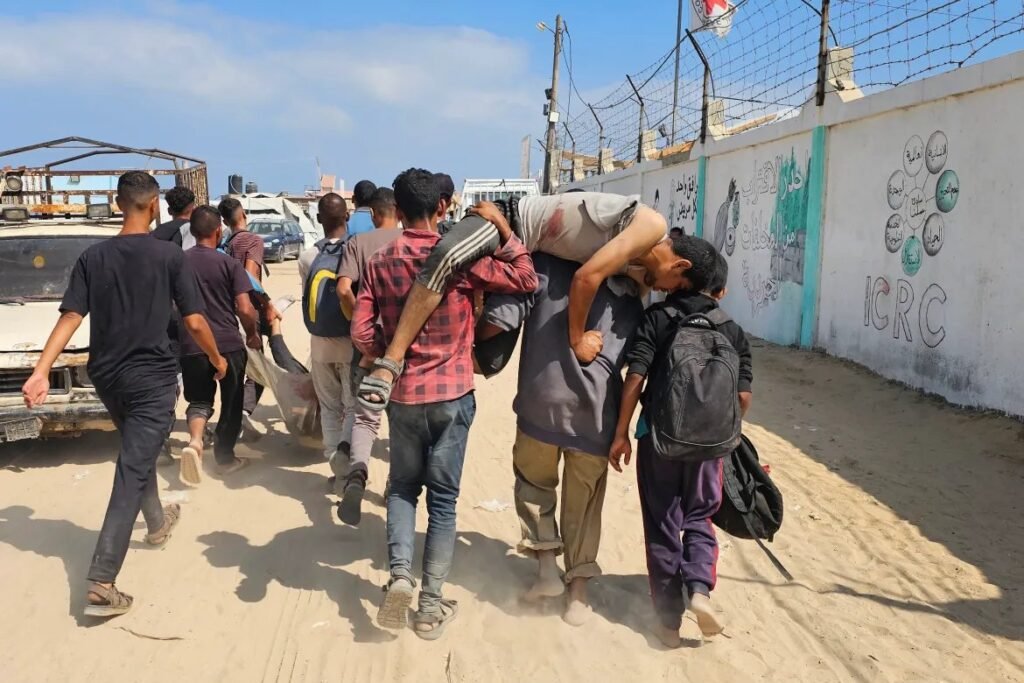
Biton lost his left leg after being wounded while serving in the Israeli military in 2021. His inclusion in the campaign has provoked particular anger because it comes as Palestinians in Gaza endure an extraordinary amputation crisis caused by Israeli attacks, with the United Nations reporting that Gaza has the highest per-capita rate of child amputees in the world.
Inclusion for Whom?
The controversy exposes an uncomfortable contradiction in corporate branding. Adidas presented the initiative through the language of accessibility and inclusion, yet critics argue that choosing an Israeli military veteran for such a campaign while Palestinian children are losing limbs in unprecedented numbers demonstrates precisely how selectively that language can be applied.
UN figures underline the scale of that contrast. A UN report estimated that Gaza had recorded between 3,000 and 4,000 amputations and between 13,000 and 17,000 major extremity injuries since October 2023 during the period it examined. Behind those numbers are Palestinians confronting permanent disability amid the destruction of hospitals, shortages of prosthetics and enormous obstacles to rehabilitation.
Against this reality, the Adidas campaign became about far more than a shoe. It raised a fundamental question about whose disability global corporations choose to humanize and whose suffering they allow to remain invisible.
An Apology That Avoided the Central Question
Following mounting boycott calls, Adidas apologized, saying a local campaign image had generated “concerns and strong reactions” and that causing offence had not been its intention. The statement appeared through its regional Adidas Arabia account, while reports noted that no equivalent public apology initially appeared on its other major regional and global social-media accounts.
For Palestinian BDS movement co-founder Omar Barghouti, that response amounted to “empty talk”. He argued that the fact Palestinians face the world’s highest rate of child amputations makes the choice particularly offensive and called for meaningful corporate accountability rather than damage control.
That criticism goes to the heart of the controversy. The question is not whether an Israeli amputee deserves accessible footwear; of course he does. The question is why a multinational corporation chose military service as part of the background to a story of resilience and inclusion while thousands of Palestinians living with amputations caused by Israeli attacks remain largely outside the corporate frame.
The Double Standard Behind the Brand
The backlash is particularly striking given Adidas’s previous controversy involving Palestinian-American model Bella Hadid. In 2024, the company removed Hadid from promotional material for its SL72 sneaker campaign following criticism over the shoe’s historical association with the 1972 Munich Olympics, an event that occurred more than two decades before Hadid was born.
That history makes the current controversy harder to dismiss as an isolated advertising mistake. Critics see a profound double standard: Palestinian identity was treated as sufficiently politically sensitive to trigger a corporate retreat, while an Israeli military veteran could be incorporated into a disability campaign despite the enormous number of Palestinians left amputated by Israeli military attacks.
The comparison illustrates a wider problem in global corporate culture. Branding does not exist outside politics when companies choose whose stories represent courage, inclusion and resilience. Those choices determine which lives are individualized and humanized and which are reduced to casualty statistics.
For Palestinians, this is why the Adidas controversy resonates beyond advertising. Gaza’s child amputees are not an abstract backdrop to a marketing dispute. They are children learning to live without limbs while hospitals, rehabilitation centres and medical infrastructure around them have been devastated.
A company cannot credibly celebrate inclusion while remaining indifferent to the political context surrounding the people it chooses to represent. When Gaza has the world’s highest per-capita rate of child amputees, centring an Israeli military veteran in an amputee campaign was never going to be perceived as politically neutral.
The resulting backlash is therefore about more than Adidas. It is about the power of corporate branding to decide whose suffering becomes an inspirational human story and whose suffering disappears from view.
In Gaza, thousands of amputees do not need a marketing campaign to make their experience real. They need the world to stop looking away.