
Gaza Herald | For many Palestinians in Gaza, the horrors of Israel’s war have extended far beyond the moment of loss. Families have not only watched relatives killed before their eyes, but have also been forced to remain trapped with their bodies for days because Israeli military operations made burial impossible.
During one of the deadliest sieges around Gaza City’s Al Shifa Hospital in March 2024, entire neighborhoods were sealed off by Israeli tanks, snipers, and drones. Ambulances could not enter, civilians could not leave, and even stepping outside a front door often meant risking death. Inside their homes, grieving families faced an unimaginable decision: how to preserve the bodies of their loved ones until it became possible to bury them.
One such family was that of Saida Abdulhadi Al Zaanin, whose husband and nine children spent six days living beside her body after she was fatally shot by an Israeli sniper.
A Mother Killed Before Her Children
Twenty-year-old Haneen, Saida’s eldest daughter, still keeps videos recorded during those traumatic hours. The footage shows her mother’s body lying on the floor of the family home while her husband and children surround her, taking turns kissing her forehead, hands, and face as they struggled to comprehend what had happened.
Even now, Haneen cannot bring herself to tell the story.
“I can’t,” she says quietly. “I simply can’t.”
Instead, the family’s grandmother, Umm Ali Abdulhadi, recounts the events that unfolded on March 18, 2024, when Israeli forces launched a major assault around Al Shifa Hospital, trapping civilians inside residential buildings in western Gaza City.
Nearly forty members of the extended family crowded into a single ground-floor apartment near Haidar Abdel Shafi Square after Israeli tanks surrounded the neighborhood. Snipers took positions overlooking the streets while quadcopter drones hovered overhead, cutting residents off completely from the outside world.
The Last Morning
According to Umm Ali, Saida began baking bread early that morning.
When asked why she was rushing, she explained that she feared the fighting would soon make it impossible to cook or even light a fire.
After preparing the dough, she sat down to breastfeed her youngest son, Ahmed, who was only four months old.
It would be the final time she ever held him.
Moments later, Saida walked toward the balcony beside the kitchen to hang freshly washed clothes outside.
Umm Ali remembers calling out to warn her.
Before Saida could respond, a sniper’s bullet struck her in the chest.
A second shot followed almost instantly, sending her collapsing to the ground.
A Rescue Under Fire
Family members rushed toward the balcony entrance but froze.
Israeli quadcopter drones circled above while snipers watched every movement, making any rescue attempt potentially fatal.
At first, relatives believed Saida had injured her legs after falling because she quietly repeated that she could not move but did not complain of severe pain.
Her husband threw a rope toward her and urged her to pull herself back inside.
With tremendous effort, she slowly crawled across the balcony until he managed to drag her to safety.
Only then did the family realize the severity of her wounds.
One bullet had passed completely through her chest.
Another had exploded near her heart.
Desperate to save her, her husband ran from window to window calling for an ambulance.
No one came.
Israeli forces had sealed off the neighborhood entirely. Ambulances could not enter, and leaving the building meant almost certain death.
“She Has Passed Away”
For nearly thirty minutes, the family searched desperately for a way to save Saida.
Then their neighbor, Mahmoud Al Hindi, a nurse, climbed from the adjacent building despite the danger.
After checking her pulse and examining her eyes, he turned toward her husband with heartbreaking words.
“May God give you strength. She has passed away.”
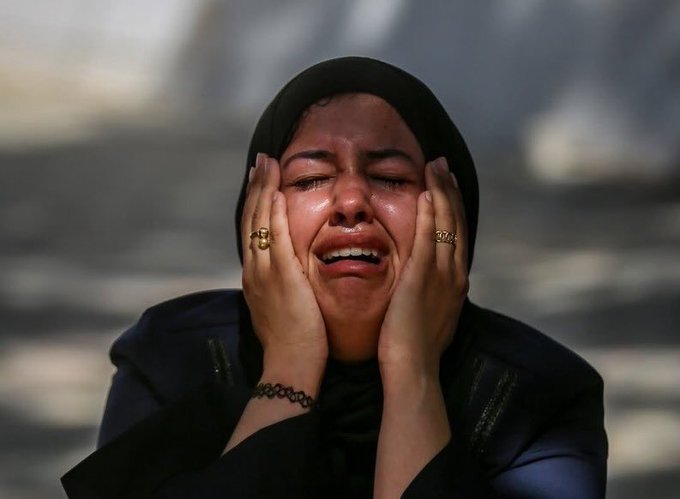
The apartment erupted in grief.
All nine of her children cried out together, begging their mother to wake up.
While the family mourned, baby Ahmed continued crying from hunger, unaware that the woman who had fed him only minutes earlier was gone forever.
Unable to soothe him, one of his aunts, who had recently given birth herself, breastfed the infant until he finally settled.
An Impossible Decision
As the first shock faded, another painful reality emerged.
The family could not bury Saida.
Israeli snipers still controlled every street outside. Her husband gathered digging tools, hoping to prepare a nearby grave, but quickly realized leaving the house would almost certainly cost him his life.
Hours of discussion followed as relatives searched for any solution.
Finally, they reached a decision that none of them had ever imagined making.
To prevent her body from decomposing before her children, they emptied a large household freezer powered by the family’s solar panels. They removed its shelves, carefully wrapped Saida in a blanket, gently placed her inside, sealed the door, and returned the freezer to its upright position.
“It felt unimaginable,” Umm Ali recalls.
“But we had no other choice.”
The freezer would become Saida’s resting place for the next six days while her family remained trapped under siege, waiting for the moment they could finally give her a proper burial.

