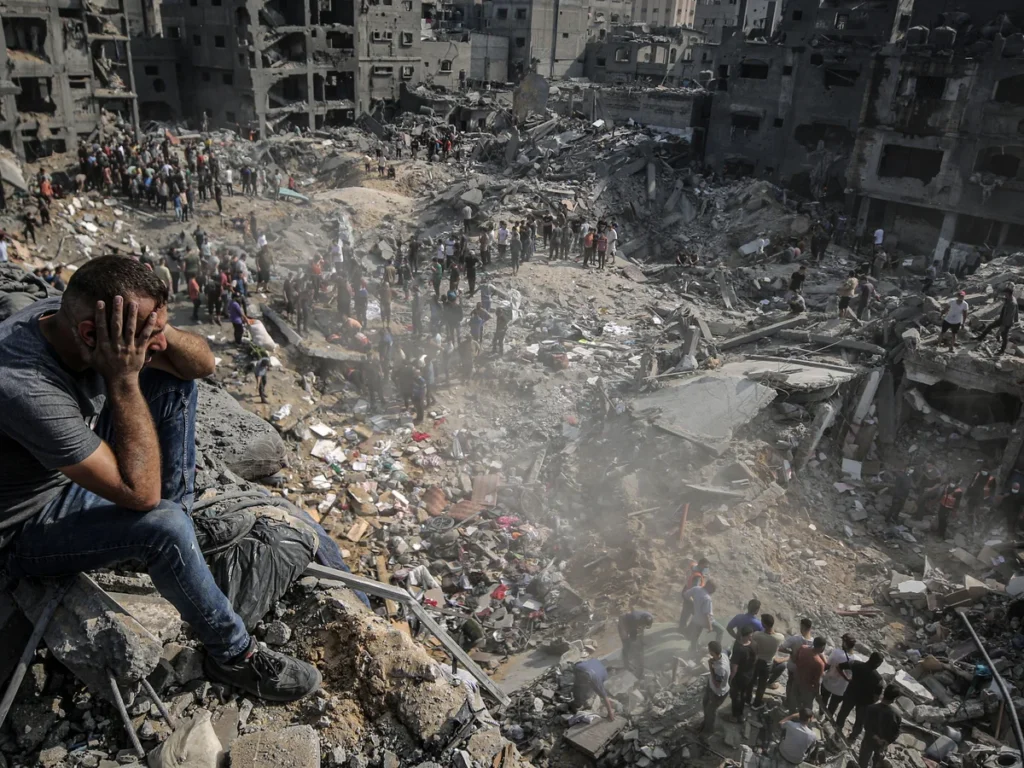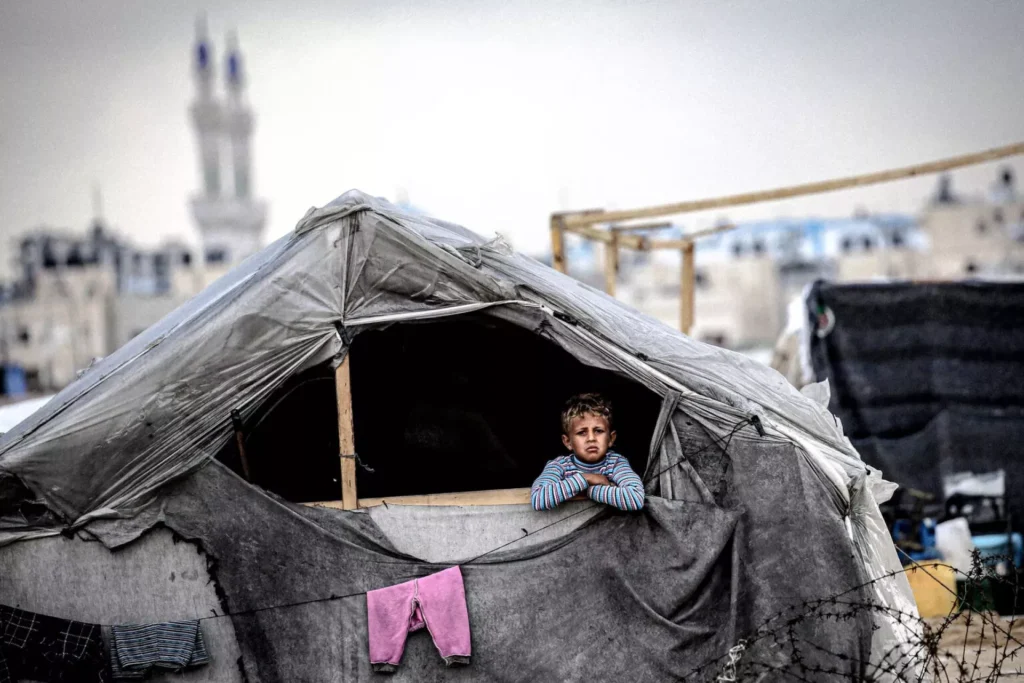
Gaza Herald_ Euro-Med Human Rights Monitor has warned that Israel continues to impose its unlawful blockade on the Gaza Strip, deliberately crippling the transportation and shipping system by destroying trucks and transport companies’ warehouses, targeting and detaining drivers, and preventing the entry of replacement trucks, spare parts, and essential operating materials. These measures are choking the flow of food, medicine, and humanitarian aid from the crossings to Gaza’s population and threatening to push the Strip back into famine.
In a statement, the Euro-Med Monitor said Israel is implementing an integrated policy aimed at dismantling the supply chain from the moment goods and aid enter through the crossings until they reach civilians. The mere entry of trucks into the Strip—when they are allowed to enter at all—does not mean their cargo reaches those in need, particularly amid the destruction or disruption of the transportation, storage, and distribution systems.
Nahidh Shuhayber, head of the Private Transport Association in the Gaza Strip, told the Euro-Med Monitor that before the start of Israel’s genocidal war, Gaza had a fleet of approximately 1,200 trucks covering the population’s needs for food, medicine, fuel, animal feed, construction materials, and other essential goods.
However, only around 400 trucks survived Israeli bombardment and destruction. Of these, approximately 100 have been rendered inoperable because Israel has prevented the entry of spare parts, tires, oil, and batteries. This means that only around 300 trucks are currently operational—just 25 percent of the fleet that existed before the war.
The Euro-Med Monitor said Israel’s arbitrary and total ban on the entry of materials required for maintenance has placed the remaining fleet at imminent risk of complete shutdown. Workers have been forced to dismantle disabled trucks and use their parts to keep other vehicles operating.
Meanwhile, the cost of changing the oil in a single truck has risen from approximately 450 shekels, or around $150, before the war to approximately 100,000 shekels, or around $33,000, today. This comes amid an extreme shortage of operating materials, with the price of a kilogram of oil reaching approximately $1,100 when it is available at all.
The Euro-Med Monitor said the restrictions are disrupting the primary means of transporting food, medicine, and fuel to the entire population of a territory whose infrastructure and local production capacity have been largely destroyed by Israel, leaving its residents almost entirely dependent on aid and supplies coming from outside.
According to field data, Israeli attacks have destroyed or disabled more than 150 trucks while they were carrying out their duties, particularly on roads leading to and around the Kerem Shalom crossing. More than 20 drivers have been killed, including four since the ceasefire in October 2025, while another 15 have been detained. Some of those drivers have reportedly remained in detention for nearly two years.
The Euro-Med Monitor said several drivers who were targeted or detained were working as part of convoys that had undergone prior coordination and notification through United Nations and international organizations, including the World Food Programme and the United Nations Office for the Coordination of Humanitarian Affairs.
This, it said, confirms that Israeli authorities were aware of their identities, the nature of their work, and their routes. At the same time, the organization stressed that Israel’s obligations under international humanitarian law remain in force regardless of such coordination arrangements. These obligations include refraining from targeting civilians and civilian objects, respecting and protecting humanitarian workers and vehicles used for relief operations, taking all feasible precautions to spare them from the effects of military operations, and allowing and facilitating the rapid and unhindered passage of humanitarian relief.
The Euro-Med Monitor further said that the destruction of the headquarters and warehouses of approximately 150 transport companies, combined with the lack of secure storage facilities and refrigerated warehouses, has dismantled the logistical infrastructure needed to preserve and distribute supplies.
Delays of between 24 and 72 hours in transporting individual shipments, slow inspection procedures, and truck breakdowns have also resulted in quantities of frozen food, medicines, and essential goods spoiling and being destroyed before reaching those who need them.
According to information reviewed by the Euro-Med Monitor, Israeli forces routinely stop truck drivers at military checkpoints and inside the Kerem Shalom crossing, force them to strip completely, and subject them to severe beatings and humiliation, despite the drivers having received prior security approval to work and enter these areas.
The Euro-Med Monitor also documented another mechanism that has disrupted dozens of trucks recently brought into the Gaza Strip. After approximately 100 trucks entered through special commercial coordination arrangements, it emerged that they were subject to ownership restrictions and registered security interests in favor of Israeli banks, allowing the trucks to be seized upon reaching the crossings.
Twenty-three trucks have already been confiscated, prompting operators of the remaining vehicles to stop using them out of fear that they, too, could be seized.
The organization stressed that simply counting the number of trucks crossing into Gaza provides a misleading picture of the scale of humanitarian assistance. The real measure is the quantity of goods that safely and consistently reaches civilians throughout the Strip.
Aid cannot be considered available when its cargo remains stranded, spoils, or cannot be transported to areas where hunger and humanitarian need are most severe.
The Euro-Med Monitor recalled a warning by Justin Brady, head of the United Nations Office for the Coordination of Humanitarian Affairs in Palestine, that Gaza is facing a food emergency that could deteriorate into Phase 5 of the Integrated Food Security Phase Classification if the flow of aid declines.
Phase 5 represents the highest level of food insecurity. At the household level, it indicates extremely severe food deprivation that threatens lives. An area is classified as experiencing famine when these conditions are combined with the required thresholds for malnutrition and mortality.
Speaking at a press conference in Ramallah on August 3, 2026, Brady said the analysis was based on technical work involving more than 60 experts from 20 organizations, along with a scientific assessment of surrounding conditions and dedicated food security field surveys.
The analysis projects that more than 1.4 million people—67 percent of Gaza’s population—will face crisis-level or worse acute food insecurity between July and December 2026. This compares with approximately 1.6 million people, or 77 percent of the population, at the end of last year, when Israel imposed a policy of mass starvation that resulted in civilian deaths.
According to the analysis, approximately 212,000 people, or nearly 10 percent of the population, will remain in Phase 4 food emergency conditions, the stage immediately preceding the most severe Phase 5.
Many of these people live near areas of Israeli control along what is known as the “Yellow Line,” where access to humanitarian aid and essential services is extremely difficult.
The governorates of northern Gaza, Gaza City, Deir al-Balah, and Khan Younis are also expected to remain at the “alert” level for malnutrition, corresponding to Phase 2. Some areas adjacent to the Yellow Line could not be classified because assessment teams were unable to reach them.
The analysis found that approximately 83 percent of households have no source of income, while around 1.9 million people—90 percent of the population—would face high levels of acute food insecurity without food assistance through December 2026.
This means that the relative improvement recorded does not represent a recovery in the population’s ability to produce or purchase food. Rather, it is a direct result of humanitarian assistance, meaning that even a limited disruption in the entry, transportation, or distribution of aid could rapidly reverse the improvement.
The Euro-Med Monitor said comparisons with data from last year and the end of the previous year confirm that the humanitarian situation in Gaza remains extremely dangerous. Any decline in the volume of aid reaching the Strip would lead to a rapid and severe deterioration in humanitarian conditions amid the continued fragility of the population’s living conditions.
The organization said Israel, as the occupying power, is obligated under Articles 55 and 59 of the Fourth Geneva Convention to ensure the provision of food and medical supplies to the population when local resources are insufficient, and to approve and facilitate relief plans through all means available to it.
Customary international humanitarian law also requires Israel to allow and facilitate the rapid and unhindered passage of humanitarian relief. This obligation extends to enabling the actual transportation and distribution of supplies to civilians, rather than merely permitting their entry through crossings.
The Euro-Med Monitor stressed that Israel is violating these obligations by deliberately destroying the logistical capacity required to transport food and medicine and preventing its repair or replacement, despite being aware of widespread hunger, disease, and the population’s near-total dependence on humanitarian aid.
It said these actions constitute another element of Israel’s ongoing genocidal campaign in the Gaza Strip.
The organization said the transportation system has become a direct component of the population’s survival amid the spread of disease and malnutrition, the collapse of employment and income sources, the destruction of agricultural land, livestock, and food-production facilities, and the disruption of fishing.
These developments have undermined local food sources and deprived the vast majority of residents of the ability to purchase their basic needs, making the arrival of food and medicine from outside Gaza essential to their survival.
The Euro-Med Monitor stressed that Israel cannot claim ignorance of these realities or their consequences. Israel controls the crossings and supply routes and continuously receives notifications and warnings regarding hunger, disease, and the population’s near-total dependence on humanitarian assistance.
Yet it continues to destroy the means of transporting food and medicine and prevents their repair or replacement.
The organization said this conduct fulfills the material element of genocide by deliberately inflicting on Palestinians conditions of life calculated to bring about their physical destruction, in whole or in part. It said the specific intent is reflected in Israel’s continued imposition of these conditions after their consequences became evident and after Israeli authorities were aware of them, as part of a broader pattern of genocidal acts and statements by Israeli officials indicating an intent to destroy Palestinians in the Gaza Strip.
The Euro-Med Monitor emphasized that the prohibition on starving civilians is a firmly established rule of international humanitarian law. Deliberately depriving civilians of objects and materials indispensable to their survival, including through the intentional obstruction of humanitarian relief supplies, may constitute a war crime under Article 8(2)(b)(25) of the Rome Statute.
It recalled that the International Criminal Court’s Pre-Trial Chamber previously found reasonable grounds to believe that the deprivation of food, water, and medicine in Gaza constituted the use of starvation as a method of warfare.
The organization added that commercial and civilian trucks remain protected civilian objects unless, in each individual case, they meet the strict requirements for classification as military objectives under international humanitarian law.
Drivers and trucks involved in humanitarian relief operations, meanwhile, enjoy special protection. Intentionally directing attacks against them, so long as they remain protected as civilians and civilian objects, constitutes a war crime under Article 8(2)(b)(3) of the Rome Statute.
The Euro-Med Monitor said these actions also represent a continuation of Israel’s failure to comply with the binding provisional measures issued by the International Court of Justice in 2024, particularly its orders requiring Israel to ensure the provision of basic services and humanitarian assistance on a large scale and without obstruction, increase the capacity and number of crossings, and keep them open.
The organization called on the international community to take immediate and binding measures to end Israel’s ongoing genocide, halt all hostilities, lift the comprehensive and unlawful blockade imposed on the Gaza Strip, guarantee freedom of movement for people and goods, and restore residents’ ability to access food, water, medicine, and livelihoods without being dependent on shifting Israeli decisions.
It urged states to move beyond statements of concern and impose a comprehensive ban on the supply of weapons, equipment, military services, and security services that could be used to continue the blockade or obstruct humanitarian relief.
It also called for the suspension of forms of cooperation that contribute to ongoing violations, targeted sanctions against those responsible, implementation of the International Court of Justice’s orders, and support for International Criminal Court investigations rather than providing political protection to Israeli officials.
In particular, the Euro-Med Monitor called on the Israeli occupation authorities to immediately and unconditionally lift all restrictions on the entry of new trucks, spare parts, tires, oil, batteries, fuel, maintenance and diagnostic equipment, cranes, and power generators.
It also called for allowing the private and humanitarian sectors to bring in a transportation fleet proportionate to the population’s actual needs.
The organization demanded that all land crossings be opened to regular humanitarian and commercial flows and operated according to clear and publicly announced schedules.
It called for an end to quantitative restrictions and arbitrary inspection procedures, the establishment of a binding time limit for inspection and customs clearance, and the publication of detailed daily data on the number of trucks, their cargo, their entry times, and their actual arrival at their destinations.
The Euro-Med Monitor also called for an immediate halt to attacks on drivers and trucks, guarantees of freedom of movement for drivers throughout the Strip, and the establishment of safe and permanent routes rather than temporary or merely formal coordination arrangements.
It demanded disclosure of the fate and whereabouts of detained drivers and the legal basis for their detention, the immediate release of anyone who has not been charged with a recognized criminal offense, and the right of detainees to communicate with their families and lawyers.
It further called for confiscated trucks to be returned or for their owners to receive full compensation, as well as an investigation into the circumstances surrounding the entry of trucks subject to restrictions in favor of Israeli banks.
It also called for guarantees that crossings and banking systems would not be used as tools to seize or obstruct Palestinian property.
The organization urged the United Nations and donor states to finance an emergency plan to rebuild Gaza’s internal logistical capacity. The plan should include purchasing or leasing replacement trucks, establishing mobile maintenance centers, bringing in temporary storage facilities, warehouses, refrigerated containers, and emergency stocks of spare parts and operating materials.
Priority should be given to isolated areas and locations near areas under Israeli control.
The Euro-Med Monitor also called for the establishment of an independent UN mechanism to monitor truck movements from the moment they enter Gaza until their cargo reaches civilians.
The mechanism should document cases of delay, refusal, attack, or confiscation, while ensuring that it does not become a substitute for Israel’s direct legal responsibility or a means of legitimizing its unlawful control over humanitarian relief.
The organization further called on the International Criminal Court to accelerate its investigations into all international crimes committed in the Gaza Strip and expand prosecutions to include all those responsible.
It called for additional arrest warrants to be issued against anyone for whom there are reasonable grounds to believe they bear responsibility for such crimes.
The Euro-Med Monitor urged states parties to immediately and without selectivity enforce arrest warrants issued by the Court, refrain from receiving wanted individuals or providing them with protection or facilitating their movement, and urged all states to activate universal jurisdiction mechanisms to investigate these crimes and prosecute those responsible before their national courts.
The Euro-Med Monitor concluded by emphasizing that humanitarian assistance must be measured by what actually reaches civilians, not by the number of trucks Israel permits to cross.
Food that remains stranded at a crossing or spoils before reaching hungry people does not alleviate hunger and cannot be counted as humanitarian assistance.
The organization condemned Israel’s claim that it facilitates aid based on the number of trucks entering Gaza while simultaneously destroying the trucks transporting their cargo, preventing their repair, and targeting their drivers.
By doing so, it said, Israel strips the entry process of any meaningful humanitarian impact and controls how much food and medicine reaches civilians, where it goes, and when it arrives, making the disruption of transportation a direct tool for managing deprivation and starvation.