
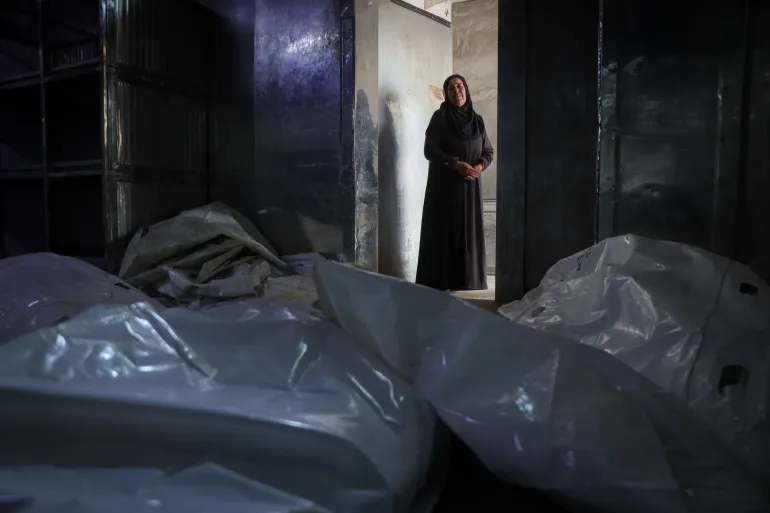
Gaza Herald_In February 2024, Tahani Hamdan remained trapped inside the besieged Nasser Medical Complex in Khan Younis while the bodies of her sons lay in the street just outside the hospital walls.
“I kept looking at my sons through a small hole in the hospital wall,” Hamdan recalled. “All I could do was pray that stray cats or dogs would not reach them.”
Her testimony forms part of a new investigation by the Geneva-based Euro-Med Human Rights Monitor, which documents what it describes as the deliberate targeting of the Al-Aweini family by Israeli forces during the siege of Khan Younis.
According to the report, the incident involved a drone strike on the family home, sniper fire targeting wounded civilians, the obstruction of rescue efforts and burial procedures, and the detention and torture of surviving family members.
Euro-Med Monitor is calling on the International Criminal Court (ICC) to treat the case of the Al-Aweini family as a representative example of Israeli crimes committed in Gaza.
Drone Strike Followed by Sniper Fire
The attack began late in the morning on 11 February 2024, when an Israeli drone struck the Al-Aweini family home without warning. The strike critically injured 29-year-old Abdullah Al-Aweini.
When his father, Ibrahim, rushed upstairs to check on him, a quadcopter drone hovered nearby, recording him from close range before launching fragmentation munitions that wounded him in the head and back.
Several of Abdullah’s brothers, Husam, Saad, Hassan, and Anas, immediately ran to help him. They attempted to carry their wounded brother toward the nearby Nasser Medical Complex, located roughly 100 meters away.
But as they approached the hospital grounds, Israeli snipers positioned on nearby rooftops opened fire.
Husam and Saad were shot and collapsed near the hospital wall alongside Abdullah, who the earlier drone strike had severely wounded.
Witnesses reported that the brothers attempted to crawl away from the gunfire, but the snipers continued shooting at them.
Anyone who tried to reach them, relatives, neighbors, or even medical personnel, was forced back by sniper fire. Unable to receive help, the three brothers slowly bled to death in the street outside the hospital.
Two others survived the immediate attack: Anas, who was only 16 years old, and his brother Hassan, who managed to escape the gunfire.
Forced to Watch Their Bodies for Days
Despite the danger, Tahani Hamdan decided to try to reach the hospital to call for an ambulance.
“I took side streets to avoid the shooting,” she said. “When I reached the hospital gate, I felt something strike my leg. I realized
I had been shot, but I ignored the pain and kept running.”
Inside the hospital, she begged doctors to help her sons lying outside.
But the medical staff told her that snipers would likely kill anyone leaving the hospital.
“They told me not to go out again,” she said. “It was too dangerous.”
For four days, Hamdan could see the bodies of her sons lying exposed in the street, unable to reach them.
“All I wanted was for them to be buried with dignity,” she said.
On 14 February 2024, Israeli forces ordered the evacuation of the hospital ahead of a military raid. During the assault, bulldozers tore through the surrounding area, further complicating efforts to recover and identify the dead.
One of the brothers was later buried hurriedly in a mass grave without the presence of his family. Their father eventually returned and personally exhumed the burial site to confirm his son’s identity.
The fate of the other two bodies remains unknown.
Detention and Torture of Survivors
The suffering of the Al-Aweini family did not end with the killings.
Israeli forces later raided the family home and detained the wounded father along with the two surviving sons.
Testimonies collected by Euro-Med Monitor describe severe abuse during detention, including beatings, starvation, sleep deprivation, and prolonged solitary confinement.
“After they tied us and blindfolded us, I was taken with my sons Hassan and Anas to a nearby location,” Ibrahim Al-Aweini said.
He was then transferred between multiple detention sites. At one point, he briefly saw his son Anas, who Israeli soldiers had earlier told that his father had been killed.
The two were soon separated again.
Ibrahim described brutal beatings by Israeli soldiers, including what he believes was the deliberate breaking of his leg.
Although he was eventually taken to a hospital, he said Israeli guards deprived him of basic necessities.
“I stayed in the hospital for nine days,” he recalled. “During that time, a nurse secretly gave me one meal of kofta and potatoes. I only drank water two or three times.”
Anas was released in Rafah, far from his home, after just over a week in detention alongside a group of elderly detainees.
“Those eight days were filled with humiliation,” he said. “There was no food, no water, and no access to a bathroom.”
His brother Hassan Al-Aweini, a paramedic working at Nasser Medical Complex, spent nearly 20 months in Israeli detention without charge before being released in a prisoner exchange in October 2025.
“The abuse was not only physical,” Hassan said. “There was constant psychological torture.”
“I desperately wanted to know if my father, mother, or brother Anas were alive,” he added. “But the soldiers kept telling me that my father had been killed.”
A “Killing Zone”
Euro-Med Monitor concluded that the Al-Aweini family home was a purely civilian residence, with no military presence or legitimate target that could justify the attack.
The organization says the case reflects a broader pattern seen in areas seized by Israeli forces in Gaza, where neighborhoods are transformed into “killing zones” in which anyone present is treated as a potential target.
According to the report, the attack on the Al-Aweini family during the siege of Nasser Medical Complex represents a stark example of what it describes as the material and psychological elements of genocide unfolding in Gaza.
Euro-Med is urging the International Criminal Court to include the case prominently in its investigations into Israeli crimes.
Beyond the ICC process, the organization is calling on countries that have signed the Genocide Convention to support South
Africa’s genocide case against Israel at the International Court of Justice, impose comprehensive sanctions, enforce an arms embargo, and hold Israeli political and military leaders accountable.
The group is also demanding that independent international investigators be granted access to Gaza to document violations, mass graves, and other evidence of war crimes.
A Family Destroyed
Tahani Hamdan remembers the life her family once had.
“God blessed us with five sons and three daughters,” she said. “We devoted our lives to raising them and educating them as best we could.”
“We never imagined that we could be killed or imprisoned simply because we are unarmed civilians,” she added, stressing that no one in the family belonged to any political faction.
But in a genocide, even that offers no protection.
Because the aim of the perpetrators is not merely to attack individuals, but to destroy an entire people.

