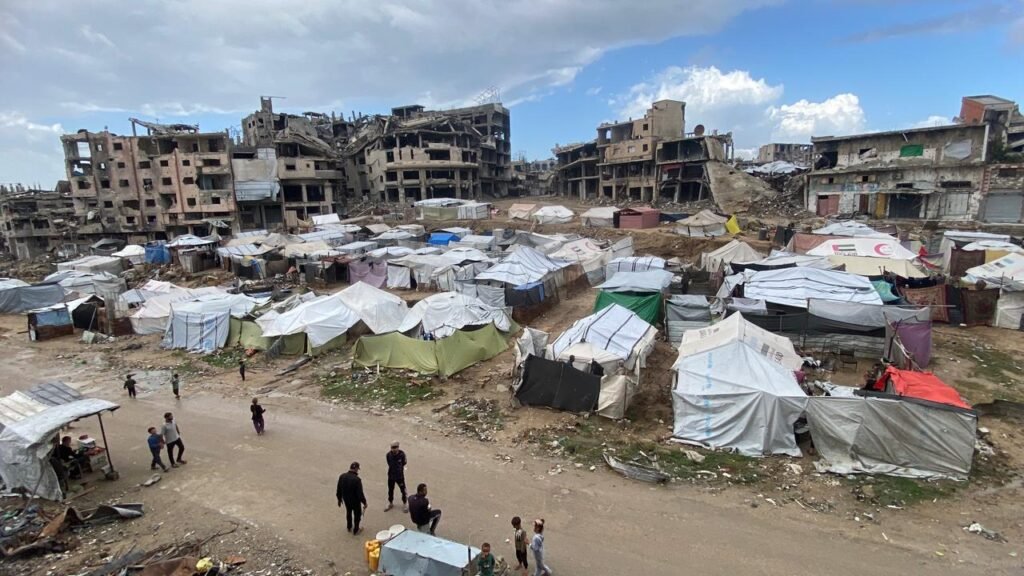
Gaza Herald — As Gaza’s displaced population struggles to survive in overcrowded camps following months of devastating war, a silent health crisis is spreading quietly through the tents. Contaminated water, collapsing sanitation systems, and severe shortages of medical care have created fertile ground for disease, leaving thousands vulnerable to infections that thrive in conditions of displacement and poverty. Among the growing threats is hepatitis A, a virus now affecting tens of thousands across the besieged enclave, particularly among children living in makeshift shelters.
Inside Al-Wahda displacement camp in central Gaza City, Kholoud Hammad, 38, sits in front of her worn-out tent, holding her exhausted young son in her arms.
Speaking quietly, she says, “I never realized that his constant fatigue and the yellowing of his eyes meant something serious. At first, I thought it was simply malnutrition, until a doctor told us that he had contracted hepatitis A.”
Hammad recalls the early days of her six-year-old son Mohammad’s illness.
“It started with a mild fever and nausea. Then he stopped eating and began complaining about stomach pain. We barely had access to clean water, and hundreds of families were sharing primitive bathrooms. After about a week, I noticed his skin and eyes turning yellow.”
Healthcare facilities across Gaza are suffering from severe shortages of laboratory testing equipment and essential medications. Although hepatitis A usually resolves on its own with rest and proper nutrition, malnutrition and weakened immunity can prolong the illness and increase the risk of complications.
According to an article published by The New York Times, citing the World Health Organization, more than 100,000 people in Gaza have developed acute jaundice syndrome, or suspected hepatitis A infections, since Israel’s assault on Gaza began.
Data released by UNRWA’s health program indicates that between 800 and 1,000 new hepatitis cases are reported weekly in its health centers and shelters across Gaza. Before the war, only 85 cases had been recorded. Since the start of the war, however, the number has surged to nearly 40,000 reported cases.
Reports from Gaza’s Government Media Office indicate that roughly 1.5 million people in the enclave are currently homeless after widespread destruction of residential areas during the Israeli assault. Humanitarian agencies say these displaced families urgently need about 288,000 temporary housing units or caravans, which could offer safer shelter than the overcrowded tents that are no longer adequate for the scale of the crisis.
A Perfect Environment for Infection
Hammad describes the exhausting journey to find medical care.
“We waited for hours just to reach a small field clinic several kilometers from where we live. That’s where doctors told us my child had hepatitis, a disease that usually spreads through contaminated water or unclean food.”
She pauses, then adds with frustration:
“How can we protect our children when we can barely find drinking water?”
She explains that families try to disinfect water with chlorine whenever it is available, and sometimes boil it. But firewood is scarce, cooking gas is nearly nonexistent, and even soap has become difficult to find compared to the time before the war.
“If we had known earlier, we would have taken more precautions with hygiene and isolation,” she says. “But how can you isolate a sick child when seven people are living inside one small tent?”
Doctors advised her to make sure her son drinks plenty of fluids and eats healthy food.
“But what healthy food?” she asks. “We barely survive on canned goods and limited aid.”
A Social Stigma
Hammad says the anxiety goes beyond health concerns.
“Some neighbors became afraid their children would get sick, so they stopped them from playing near my son. For a moment, it felt as if the illness itself had become a stigma.”
After several exhausting weeks, Mohammad slowly began recovering. Still, his mother believes the crisis is much bigger than her child’s case.
“What happened to us isn’t rare. Many people here are experiencing the same symptoms. If water and sanitation conditions don’t improve, the disease will keep spreading.”
She adds firmly:
“We don’t want pity. We want clean water, proper sanitation, and disinfectants. We want to protect our children from a disease that could be prevented.”
“The war has already taken our homes and our sense of safety,” she says. “We cannot allow it to take our children’s health too.”
Fatigue Beyond Displacement
In another crowded displacement site, Al-Qadisiyah camp in the Sabra neighborhood of southern Gaza City, Ahmad Hijazi, 24, sits on an overturned plastic crate outside his tent.
Before the war, Hijazi was a university student studying mathematics at Al-Azhar University in Gaza. Today his life revolves around searching for water and food. Recently, he added another struggle to the list, hepatitis A.
“It’s the illness that sneaks up on you,” he says.
“At first, I thought the exhaustion I felt was just the exhaustion of displacement. Everyone here is tired. But when the nausea continued and the stomach pain got worse, I realized something wasn’t right.”
He describes the early symptoms.
“I would wake up more exhausted than when I went to sleep. I completely lost my appetite and started vomiting after meals. I thought contaminated water had simply caused temporary food poisoning.”
A few days later, his friends noticed the color of his eyes changing.
He pauses briefly.
“When I looked in the small mirror inside the tent and saw the yellowing, I was terrified. Here, any illness can quickly become a disaster.”
Hijazi eventually reached a field clinic, where doctors confirmed he had hepatitis A, amid a growing number of cases throughout the camp.
Fear Beyond the Illness
Hijazi describes daily life in the camp.
“Dozens of families live in a very small space. Water arrives in tanks that aren’t disinfected, and sometimes it’s cloudy. We stand in long lines to fill our containers, and no one really knows where the water comes from.”
Temporary bathrooms and makeshift sewage systems worsen the situation.
“In winter, sewage water mixes with rainwater. Diseases spreading in these conditions is almost inevitable.”
When doctors told him he was infected, Hijazi said he was shocked.
“I didn’t know much about the disease except that it affects the liver. My first thought was, will I recover?”
Doctors advised him to rest, drink fluids, and avoid fatty foods.
“But what rest can you find inside a crowded tent?” he asks. “And what healthy diet is possible when food itself is scarce?”
He worries most about infecting his family members. He tries to wash his hands frequently and use separate utensils, but admits true isolation is nearly impossible.
The psychological toll is also heavy.
“I felt like a burden. I couldn’t help my family the way I used to. My mother was constantly worried, as if the illness might take me away from her.”
A Silent Virus
Dr. Khairi Al-Bazm, an internal medicine specialist, explains that viral hepatitis is an infection that inflames the liver.
“Hepatitis A typically spreads through contaminated food or water,” he says. “Hepatitis B and C are usually transmitted through blood or bodily fluids. In displacement settings like Gaza, hepatitis A is the most common because of contaminated water and failing sewage systems.”
He explains why the disease is sometimes called the silent virus.
“The early symptoms often seem ordinary, fatigue, loss of appetite, abdominal pain, and nausea. Many people don’t realize they’re infected until jaundice appears, causing yellowing of the skin and eyes.”
Severe overcrowding, the lack of clean water, broken sewage networks, and shortages of disinfectants all accelerate the spread of infection.
“In theory, patients should reduce direct contact with others during the early stages, use separate eating utensils, and wash their hands thoroughly,” he says. “But in reality, full isolation is almost impossible when an entire family lives in a single tent.”
There is no specific antiviral treatment for most hepatitis A cases. Recovery generally depends on rest, hydration, and proper nutrition.
“In displacement camps, however,” Al-Bazm adds, “these conditions are extremely difficult to achieve.”
While most patients recover within weeks, severe liver failure can occur in rare cases, particularly among the elderly or severely malnourished.
“If the current conditions persist, lack of clean water, failing sanitation systems, and overcrowding, infections will likely continue to rise,” he warns.
Since October 7, 2023, Israel, with U.S. backing, has carried out what Palestinians and international observers describe as a campaign of genocide in Gaza, involving mass killings, starvation, widespread destruction, forced displacement, and mass arrests, despite repeated international calls and orders from the International Court of Justice to halt the assault.
The war has left more than 72,000 Palestinians dead, the majority women and children, over 171,000 injured, and around 11,000 missing, while hundreds of thousands have been displaced amid the near-total destruction of entire cities and neighborhoods across the Gaza Strip.