
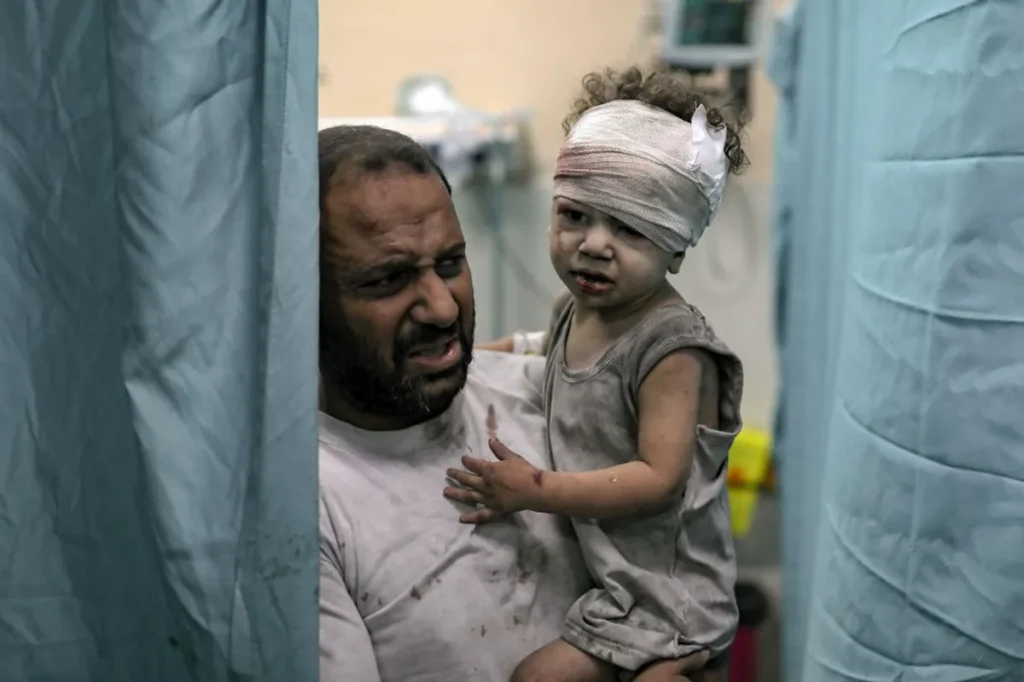
Gaza Herald _In Gaza, children who narrowly escaped death now gather around a counselor during their first day at a specialized care home created for what is known as the sole survivor, the only remaining member of a family killed in Israeli airstrikes.
Their memories are filled with scenes no child should ever witness. Israeli missiles tore through their neighborhoods, killing parents and siblings and leaving them to endure the horrors of a relentless war alone.
Twelve-year-old Mahmoud recalls leaving his family’s tent at the beginning of the war to buy bread, only to return to devastation. A massive explosion struck the camp where his family was sheltering in Deir al Balah, in central Gaza. He ran toward the blast site and found that his parents and three siblings had been killed. He was the only survivor.
Comprehensive Care
Mahmoud spent difficult days in a displacement camp before another family took him in temporarily. As his psychological condition deteriorated, his case reached the team behind the Sole Survivor project. He was later enrolled in its care and education programs in an effort to restore stability to his shattered life.
Ahmad Abu Zahri, director of Dar Khadija for Orphans, said the Sole Survivor initiative is the first of its kind in Gaza. It focuses on children who lost both parents during the war and seeks to provide a safe, integrated environment that addresses their emotional, educational, and humanitarian needs.
The center offers services in one location, including classrooms, a central kitchen that prepares meals, a library, recreational areas, dormitories, and a Quran memorization center with a prayer space. The aim is to rebuild the children’s sense of security while strengthening their psychological and social well-being.
According to Abu Zahri, the primary goal is to move these children, especially sole survivors, from dangerous and marginalized displacement settings into a more stable and protective environment supervised by trained specialists experienced in caring for deeply traumatized youth.
A New Chapter
At the start of the war’s second year, ten-year-old Haneen was living with her family in a displacement camp in central Gaza when Israeli warplanes bombed the area, killing several displaced civilians, including her parents. She sustained moderate injuries and underwent treatment before moving in with her aunt, where she continued to struggle with trauma and grief.
After her case was reviewed by the Sole Survivor team, she was admitted into the program and began receiving psychological and educational support. When journalists visited the center, Haneen was drawing alongside other girls who had also lost their families, expressing through colors what words could not convey.
Nine-year-old Yahya now lives in the same home. He did not realize that the trip he took with his family from Khan Younis toward central Gaza would be their last together. Israeli warplanes struck the road while they were traveling, killing his four family members instantly and leaving him seriously injured. After receiving treatment at Al Aqsa Martyrs Hospital, he moved in with relatives in a displacement camp. Harsh living conditions prevented him from receiving proper care, and he was out of school for months. Attending the orphanage’s opening day marked a turning point, helping him regain some of the energy he had lost after his family’s death.
Special Attention
According to official statistics from Gaza’s Ministry of Health, Israeli attacks have erased 2,700 families from the civil registry after killing all 8,574 of their members. The data further indicate that 6,020 families were devastated, with a total of 12,917 people killed, leaving behind only one surviving member in each case.
Abu Zahri explained that the scale of the war has created an unprecedented number of orphans in Gaza, prompting the institution to prioritize this vulnerable group. The project targets children between the ages of six and twelve, with current capacity ranging from 80 to 100 children. Plans are underway to expand services through alternative systems, such as rotating attendance schedules, to reach as many children as possible.
The center operates with support from a Turkish charitable organization and under the supervision of specialized staff, in coordination with official bodies including the Ministry of Religious Endowments and Religious Affairs, the Ministry of Education, and the Ministry of Social Development. Together, they oversee religious instruction, academic programming, and social welfare services.
Abu Zahri said the initiative represents the first phase of a broader vision to create larger projects in the future, including dedicated orphan towns or villages capable of sheltering hundreds of children. Plans are also in progress to establish a similar facility in northern Gaza, expanding support for children who lost their families in the war.

