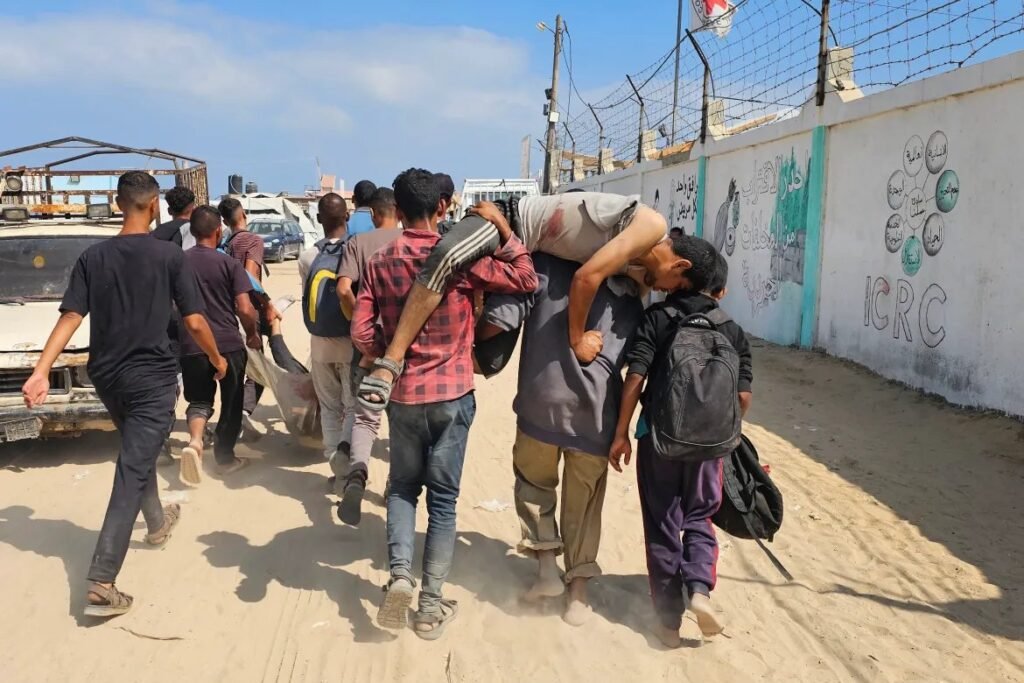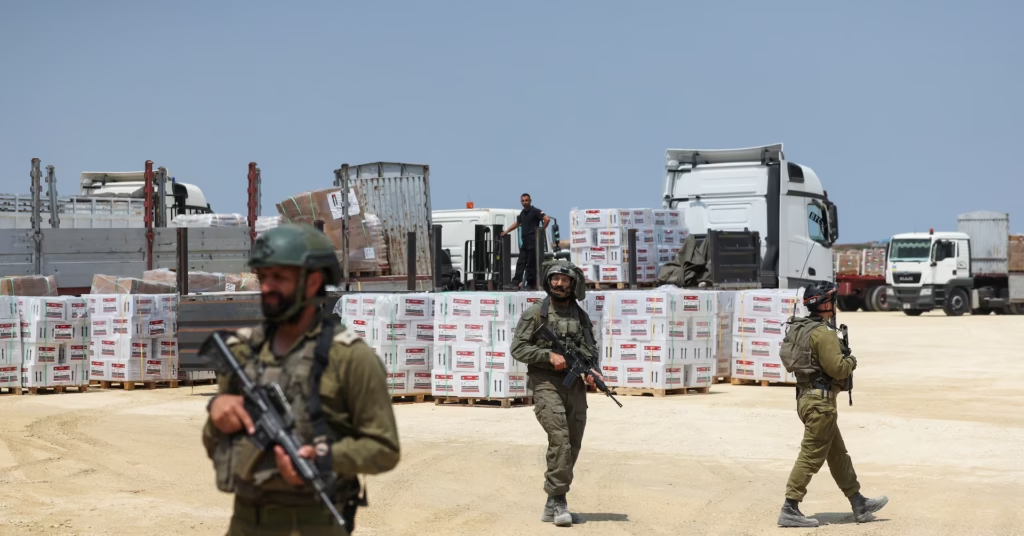
Gaza Herald_ As Israel and the United States launched attacks on Iran, fear quickly spread across the Gaza Strip. Palestinians remembered all too well what followed similar escalations in the past: sealed crossings, strangled supplies, and hunger. Panic buying swept through local markets as families rushed to secure whatever food and necessities they could afford. Prices soared within hours. Soon after, confirmation arrived that the border crossings had indeed been closed.
This escalation coincided with the expiration of an Israeli-imposed “grace period” granted to 37 international humanitarian organizations, which were ordered to halt operations in Gaza for allegedly failing to comply with new registration requirements. Among those targeted were Doctors Without Borders (MSF), Medical Aid for Palestinians, Handicap International, ActionAid, and CARE, organizations that form the backbone of Gaza’s remaining humanitarian lifelines.
At the very last moment, a ruling by Israel’s Supreme Court temporarily allowed these NGOs to continue operating while their legal appeal against the ban is considered. But this ruling changed little on the ground. The Israeli occupation continues to block humanitarian supplies and prevent foreign staff from entering Gaza, rendering full operations impossible.
According to the NGOs themselves, these organizations collectively provide around half of all food assistance in the Gaza Strip and nearly 60 percent of services in field hospitals. Their partial paralysis translates directly into hunger, job losses, and the erosion of what little remains of Gaza’s humanitarian infrastructure.
This crisis is not about paperwork, compliance, or security, just as the closure of border crossings is not about safety. These measures represent another deliberate form of collective punishment inflicted on a besieged population.
Even if the Supreme Court were to ultimately rule against the NGO ban, there is little doubt that the occupation would simply deploy new tactics to force these organizations out. That reality became clear this month with revelations concerning World Central Kitchen, an organization not included on the ban list and which operates dozens of soup kitchens across Gaza.
According to Gaza’s Government Media Office, World Central Kitchen has been forced to consider suspending its operations after Israeli authorities blocked the majority of its supply trucks. Without ingredients, cooking has become impossible. The organization previously stated it was providing one million meals per day, a lifeline now hanging by a thread.
As the war with Iran threatens to drag on for weeks or even months, the consequences for Gaza are devastating. Hundreds of thousands of families now face the prospect of renewed hunger, layered on top of an already engineered famine.
This unfolds alongside Israel’s relentless campaign against UNRWA, the UN agency that has served as the backbone of international support for Palestinian refugees since late 1949. UNRWA possesses the largest emergency response capacity and offers the broadest range of services in Gaza, yet Israel has banned its operations and blocked its supplies.
Through sustained political pressure, Israel has succeeded in slashing UNRWA’s funding. Last month alone, 600 employees were dismissed, while the salaries of the remaining staff were cut by 20 percent. The NGO ban is expected to push thousands more Palestinians into unemployment at a time when joblessness in Gaza has surpassed 80 percent.
My own family will be among those affected. We have previously relied on NGO food distributions, and my brother managed to secure temporary work as a driver for one of these organizations. The potential collapse of international humanitarian operations threatens not only livelihoods but survival itself.
The closure of crossings and the expulsion of aid organizations pose a direct threat to hundreds of thousands of civilians who depend on both assistance and employment. Another hunger crisis is not a possibility; it is a looming certainty.
And yet, these acts of collective punishment will likely pass with little international attention. Israel continues to invent new methods to make life in Gaza ever more unbearable, ever more impossible.
After two and a half years of genocide, Gaza’s hospitals, schools, universities, roads, sewage networks, water treatment plants, electricity grid, generators, and solar systems lie in ruins. The vast majority of the population survives in tents or makeshift shelters that offer no protection from extreme heat or winter cold. Water is contaminated. Food is scarce. Agricultural land has been destroyed and poisoned.
Now, even the limited international support that has sustained us is being stripped away.
And to what end? To push Palestinians toward despair and ultimate surrender. To make life so unlivable that leaving one’s homeland feels like the only remaining option, ethnic cleansing by coercion, dressed up as voluntary departure.
All of the organizations Israel seeks to expel are foreign, most based in Western countries. Yet condemnation from Western governments has been negligible. There has been no outrage that Israel is dismantling international humanitarian assistance to monopolize and weaponize aid.
Collective punishment is a clear violation of international law. States are obligated to move beyond empty statements and impose real consequences, including sanctions. Until that happens, Gaza’s population will remain trapped under an ever-tightening regime of deprivation, punished not for what we have done, but for who we are.