
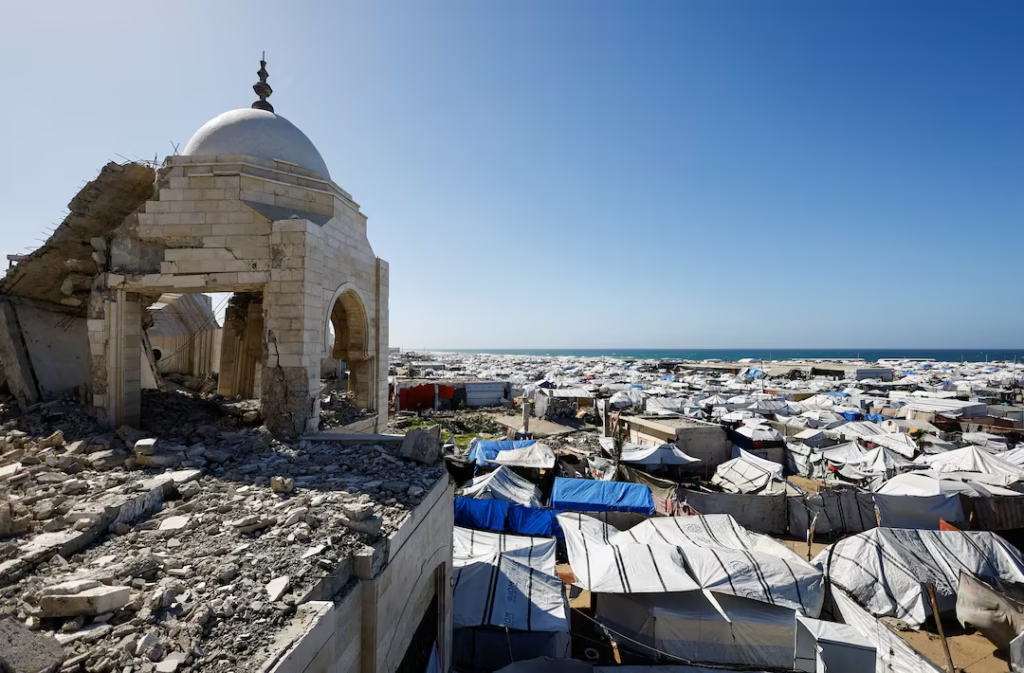
Gaza Herald_ This year, the holy month of Ramadan arrives in the Gaza Strip under the heavy shadow of loss, marked by the absence of hundreds of imams, preachers, and religious guides who were killed during Israel’s genocidal war, and amid massive destruction that has struck mosques and places of worship. The devastation has fundamentally altered the character of a month that Palestinians traditionally welcomed with deep spiritual and communal rituals.
Palestinians in Gaza are mourning religious figures who once led prayers, delivered Friday sermons, and offered guidance and comfort, playing an influential role in both spiritual and social life. With hundreds of mosques destroyed, worshippers now perform prayers inside makeshift tents made of wood and plastic, erected atop the ruins of mosques or beside their rubble, or within the cracked walls of partially damaged buildings.
According to Gaza’s Ministry of Awqaf and Religious Affairs, Israel killed 312 preachers, imams, religious guides, and Quran teachers during the months of genocide. In the same period, 1,050 mosques were destroyed and 191 were partially damaged, out of 1,275 mosques that existed in Gaza before the war.
Backed by the United States, Israel launched its genocidal war on Gaza on October 8, 2023. The assault continued for two years, killing more than 72,000 Palestinians and wounding over 171,000, most of them women and children, while destroying around 90 percent of Gaza’s civilian infrastructure.
Although a ceasefire agreement came into effect on October 10, 2025, Israel has continued to violate it daily, resulting in the killing of 611 Palestinians and the injury of 1,630 others since then.
Religious and Social Figures Targeted
Ismail al-Thawabteh, Director General of the Government Media Office in Gaza, said Israel deliberately targeted “religious and social figures who played a central role in preaching, guidance, strengthening social cohesion, and reinforcing spiritual values.”
He added that Palestinians are missing during Ramadan “dozens of voices that once revived its nights and filled its mosques with faith and humility.”
Al-Thawabteh also noted that Gaza’s Christian communities suffered losses as well, with 20 Christians killed when churches and Christian places of worship were targeted during the genocide. He explained that the initial direct losses to the religious sector are estimated at around $1 billion, and pointed out that cemeteries were also bulldozed and attacked.
“Despite the immense losses, Palestinians continue to perform prayers and observe religious rituals in the remaining mosques, shelters, and tents,” al-Thawabteh said, “affirming their right to worship and practice their faith as guaranteed under international humanitarian law.”
He described the targeting of clergy and places of worship as “a blatant violation of international law and a direct assault on the special protection granted to religious sites,” stressing that attacks on Gaza’s religious and symbolic foundations “will not succeed in breaking the will of the Palestinian people or erasing their cultural and religious identity.”
Prominent Religious Figures Killed
Anadolu Agency documented several of the most prominent imams, preachers, and scholars targeted by Israel during the genocide, including:
Sheikh Yousef Salama
One of Palestine’s most prominent religious scholars, Salama served as a teacher and imam before holding senior positions within Gaza’s Ministry of Awqaf, eventually becoming minister in 2005–2006. He was also a preacher at Al-Aqsa Mosque in occupied Jerusalem for ten years (1997–2007) and served as vice president of the Supreme Islamic Council there. He was killed in an Israeli airstrike on his home in Al-Maghazi refugee camp on December 31, 2023.
Sheikh Wael al-Zarad
Known for leading prayers at the Great Omari Mosque in Gaza City and Al-Mahatta Mosque in the Al-Daraj neighborhood, al-Zarad was also a university lecturer. He holds a master’s degree in Hadith studies and a PhD from Ain Shams University in Egypt. He was wounded when his home in Gaza City was targeted on October 13, 2023, and died two days later.
Sheikh Walid Oweida
A member of the Palestinian branch of the International Union of Muslim Scholars and Director General of Quran Memorization at Gaza’s Ministry of Awqaf, Oweida holds a PhD in Hadith sciences and left a lasting mark on religious education. He was killed when Israeli forces bombed his home in the Sabra neighborhood of Gaza City on November 12, 2024.
Sheikh Nayel Masran
Renowned for his powerful sermons calling for patience and steadfastness throughout 600 days of genocide, Masran was killed along with his family when an Israeli strike hit their tent in Khan Younis on May 30, 2025. He held a bachelor’s degree in civil engineering before pursuing Islamic studies and earning a PhD in the principles of Islamic jurisprudence.
In Gaza, Ramadan arrives without full minarets and without many of the voices that once guided its nights. Yet it does not arrive without faith. From beneath the rubble and inside fragile tents, Palestinians continue to observe the holy month, affirming that the targeting of mosques and imams will not silence Gaza’s spirit or extinguish its enduring light.

