
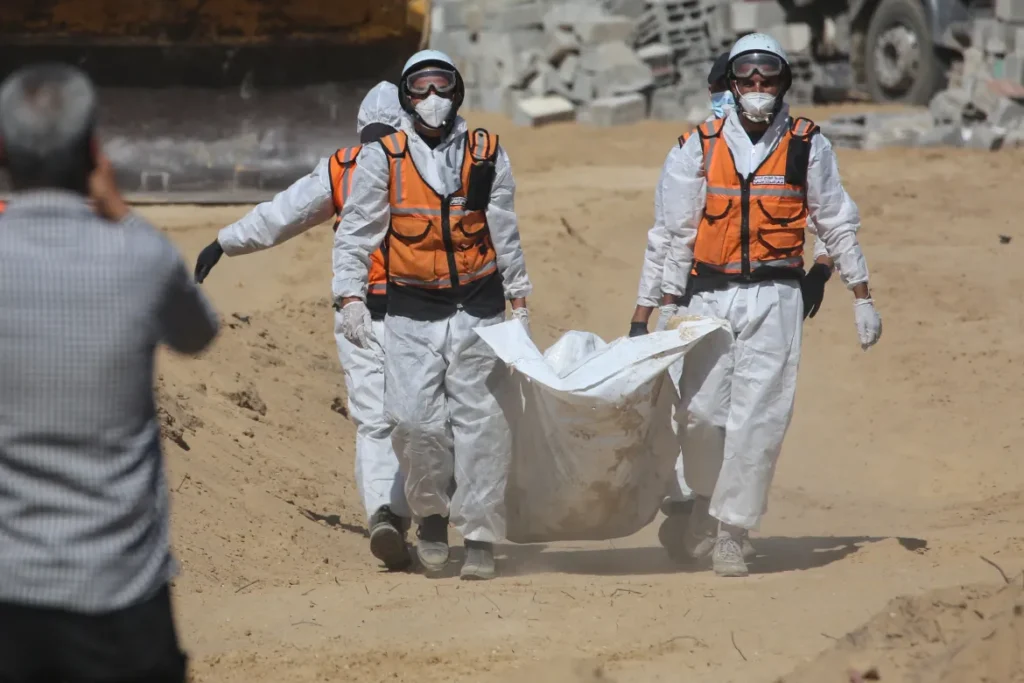
Gaza Herald_As the dust of war slowly settles over northern Gaza, another painful chapter begins, one not of airstrikes, but of recovery. Beneath collapsed homes and shattered neighborhoods lie thousands who have yet to be laid to rest. Now, Palestinian civil defense teams are undertaking a solemn mission to retrieve the remains of those still buried under the rubble, seeking to restore dignity to families who have waited for months, and in some cases years, for closure.
A Campaign to Restore Dignity to the Dead
On Sunday, civil defense crews in Gaza launched a formal initiative aimed at recovering the bodies of Palestinians still trapped beneath destroyed buildings in the northern part of the Strip. The campaign, named “Dignifying the Martyrs,” began at the site of the devastated Abu Nasr family residence in Beit Lahia. It marks the first coordinated effort to systematically retrieve remains from locations where Israeli bombardment buried entire households during the two-year war.
The Abu Nasr home, a five-story building that had been sheltering nearly 200 people, including relatives and displaced residents, was hit in an airstrike on October 29, 2024. According to survivor Aya Abu Nasr, approximately 150 people were killed in the attack, with dozens injured and many others still believed to be under the debris. More than a year later, families continue to wait for the chance to recover their loved ones and provide them with proper burials. Holding photographs of her missing brother, Mohammed, Aya described the prolonged anguish of not knowing where his remains lie.
Civil Defense official Mohammed Tamous explained that the operation will gradually extend to other sites across northern Gaza, prioritizing homes thought to contain large numbers of victims. Authorities estimate that around 9,500 Palestinians remain missing beneath rubble across the Strip. However, recovery efforts are severely hindered by a lack of heavy equipment. Tamous noted that teams currently rely on limited machinery, including a single vehicle supplied by the International Committee of the Red Cross, and appealed to humanitarian organizations for additional support.
Dangerous Conditions and a Continuing Human Toll
Rescue teams face significant risks as they work in unstable and hazardous environments. Decomposing bodies remain in exposed areas, while crews operate with minimal protective gear and without adequate biological testing tools, shortages that officials attribute to ongoing restrictions. The conditions complicate both identification and recovery efforts.
According to Gaza’s Health Ministry, 726 bodies have been retrieved since the ceasefire that took effect on October 10. The broader impact of the two-year conflict has been catastrophic: more than 72,000 Palestinians have been killed, over 171,000 wounded, and roughly 90 percent of civilian infrastructure destroyed. Despite the ceasefire, violence has not fully subsided. At least 601 Palestinians have reportedly been killed and more than 1,600 injured in Israeli attacks since the truce began.
For many families in Gaza, the campaign is not only about numbers or statistics, but it is about reclaiming the remains of loved ones, preserving memory, and restoring a measure of humanity in the aftermath of immense loss.

