
Gaza Herald _For thousands of families across Gaza, searching for food has become a life-threatening ordeal rather than a daily necessity. As Israel’s war and blockade continue to devastate the territory, civilians risking everything for humanitarian aid have repeatedly found themselves caught in deadly violence. For the Dabour family, a desperate attempt to find flour ended in a tragedy that shattered three brothers’ lives and left lasting scars that no passage of time has healed.
On the morning of July 19, 2025, Mohammed, Mousa, and Hussein Dabour left home with one goal: to bring back a bag of flour to help feed their family of 13. Instead, their trip to an aid distribution point ended in catastrophe. Hussein was killed, Mohammed was permanently blinded, and Mousa lost one of his eyes while trying to rescue his brothers amid intense gunfire.
A Desperate Search for Food
With famine spreading across Gaza, food supplies nearly exhausted, and flour prices soaring to levels far beyond what ordinary families could afford, the three brothers saw no alternative but to seek humanitarian assistance.
Mohammed Dabour, 25, recalled that morning in an interview with Palestine Newspaper, explaining that his family had reached a point where buying food was no longer possible after the price of a single kilogram of flour climbed to around 250 Israeli shekels.
“We went to get flour and food for our family. There are 13 of us. The situation was unbearable. There was no food or water, and sometimes we went two or three days without eating. We had no choice but to go to the aid distribution center.”
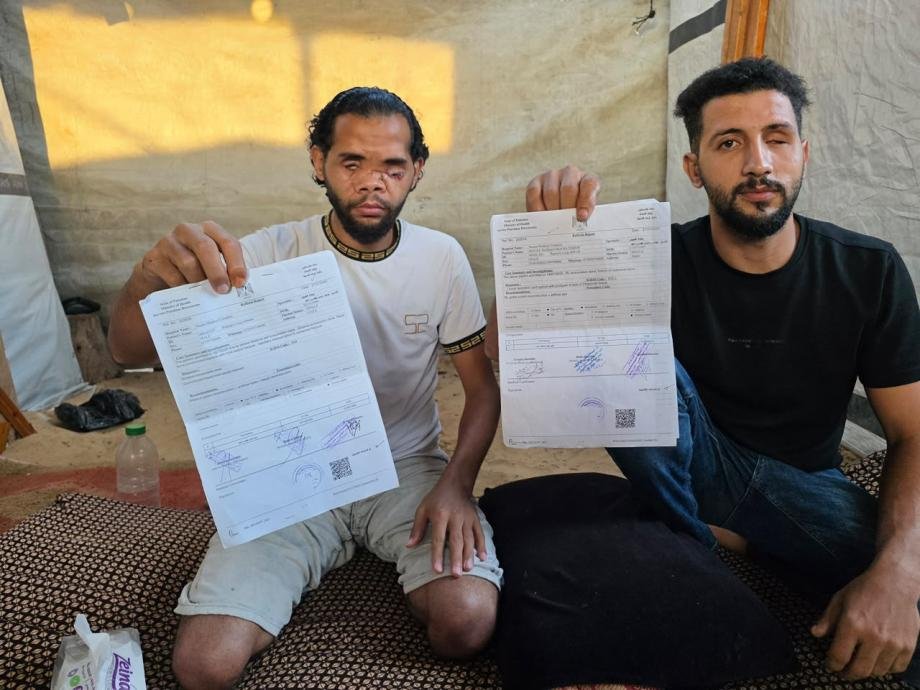
Their search for food ended in horror. Mohammed was struck in the face by an explosive round that devastated both of his eyes, leaving him permanently blind. He also suffered a fractured jaw and injuries that robbed him of his senses of smell and taste.
He was first taken to Nasser Medical Complex before undergoing surgery at the Jordanian Field Hospital. Although doctors later issued him a referral for specialized treatment, he says every attempt to secure medical evacuation has failed.
“I’ve been going from one hospital to another and contacting every authority I can, but nothing has happened. An eye specialist told me there’s still hope if I can receive surgery outside Gaza. That’s all I want, to get treatment, escape this pain, and see again.”
Doctors have told Mohammed he requires highly specialized retinal reconstruction and corneal transplant procedures, operations that are unavailable inside Gaza because of the collapse of the healthcare system and the severe shortage of specialized medical services.
He Lost an Eye Trying to Save His Brothers
Standing beside Mohammed is his older brother, Mousa Dabour, 29, who lost his left eye while attempting to rescue his wounded brothers.
Mousa said the three brothers had managed to collect food assistance before coming under heavy gunfire as they tried to leave the distribution area.
“There were three of us, but only two came back. Hussein was killed right before my eyes. When we tried to pull him to safety, Mohammed was shot, and then I was hit too. The shooting came from every direction.”
Even as he struggled to evacuate the wounded, the gunfire continued.
“I found a tuk-tuk and loaded Mohammed, Hussein, and several other wounded people onto it. As we drove away, the tank kept firing at us until it hit the vehicle, and I lost control.”
Mousa eventually reached Nasser Medical Complex while bleeding heavily. But with hospitals overwhelmed by mass casualties, he waited nearly nine hours before undergoing surgery.
“From seven in the morning until four in the afternoon, I waited. They gave me first aid, and then I was taken into surgery. That’s where I lost my eye.”
The Pain That Remains
Nearly a year later, Mousa says the emotional pain has become even harder to bear than the physical injury. The question he dreads most comes from his two-year-old daughter.
“Every time she sees me, she asks, ‘Daddy, where did your eye go? Why don’t you have two eyes?’ That hurts me more than losing the eye itself.”
Like his brother, Mousa hopes to leave Gaza for treatment, whether to restore what vision may still be possible or, at the very least, to undergo reconstructive surgery and receive a prosthetic eye.
The Dabour brothers’ story mirrors the suffering of hundreds of Palestinians who have been killed or wounded while attempting to reach humanitarian aid amid Gaza’s deepening hunger crisis. Many of the injured remain trapped inside the Strip, unable to access the specialized medical care they urgently need as hospitals struggle under the weight of war, repeated attacks, and severe shortages of equipment, medicine, and personnel.
Nearly a year after the attack, Mohammed still lives in complete darkness. Mousa continues adjusting to life with one eye while carrying the emotional scars of the day he watched his brother die. Their family continues to mourn Hussein, who left home in search of food and never returned. Their story has become one of countless Palestinian families whose pursuit of the most basic necessity, something to eat, has come at an unimaginable human cost.
Three Brothers Went Looking for Flour. Only Two Came Home
Gaza Herald _For thousands of families across Gaza, searching for food has become a life-threatening ordeal rather than a daily necessity. As Israel’s war and blockade continue to devastate the territory, civilians risking everything for humanitarian aid have repeatedly found themselves caught in deadly violence. For the Dabour family, a desperate attempt to find flour ended in a tragedy that shattered three brothers’ lives and left lasting scars that no passage of time has healed.
On the morning of July 19, 2025, Mohammed, Mousa, and Hussein Dabour left home with one goal: to bring back a bag of flour to help feed their family of 13. Instead, their trip to an aid distribution point ended in catastrophe. Hussein was killed, Mohammed was permanently blinded, and Mousa lost one of his eyes while trying to rescue his brothers amid intense gunfire.
A Desperate Search for Food
With famine spreading across Gaza, food supplies nearly exhausted, and flour prices soaring to levels far beyond what ordinary families could afford, the three brothers saw no alternative but to seek humanitarian assistance.
Mohammed Dabour, 25, recalled that morning in an interview with Palestine Newspaper, explaining that his family had reached a point where buying food was no longer possible after the price of a single kilogram of flour climbed to around 250 Israeli shekels.
“We went to get flour and food for our family. There are 13 of us. The situation was unbearable. There was no food or water, and sometimes we went two or three days without eating. We had no choice but to go to the aid distribution center.”
Their search for food ended in horror. Mohammed was struck in the face by an explosive round that devastated both of his eyes, leaving him permanently blind. He also suffered a fractured jaw and injuries that robbed him of his senses of smell and taste.
He was first taken to Nasser Medical Complex before undergoing surgery at the Jordanian Field Hospital. Although doctors later issued him a referral for specialized treatment, he says every attempt to secure medical evacuation has failed.
“I’ve been going from one hospital to another and contacting every authority I can, but nothing has happened. An eye specialist told me there’s still hope if I can receive surgery outside Gaza. That’s all I want, to get treatment, escape this pain, and see again.”
Doctors have told Mohammed he requires highly specialized retinal reconstruction and corneal transplant procedures, operations that are unavailable inside Gaza because of the collapse of the healthcare system and the severe shortage of specialized medical services.
He Lost an Eye Trying to Save His Brothers
Standing beside Mohammed is his older brother, Mousa Dabour, 29, who lost his left eye while attempting to rescue his wounded brothers.
Mousa said the three brothers had managed to collect food assistance before coming under heavy gunfire as they tried to leave the distribution area.
“There were three of us, but only two came back. Hussein was killed right before my eyes. When we tried to pull him to safety, Mohammed was shot, and then I was hit too. The shooting came from every direction.”
Even as he struggled to evacuate the wounded, the gunfire continued.
“I found a tuk-tuk and loaded Mohammed, Hussein, and several other wounded people onto it. As we drove away, the tank kept firing at us until it hit the vehicle, and I lost control.”
Mousa eventually reached Nasser Medical Complex while bleeding heavily. But with hospitals overwhelmed by mass casualties, he waited nearly nine hours before undergoing surgery.
“From seven in the morning until four in the afternoon, I waited. They gave me first aid, and then I was taken into surgery. That’s where I lost my eye.”
The Pain That Remains
Nearly a year later, Mousa says the emotional pain has become even harder to bear than the physical injury. The question he dreads most comes from his two-year-old daughter.
“Every time she sees me, she asks, ‘Daddy, where did your eye go? Why don’t you have two eyes?’ That hurts me more than losing the eye itself.”
Like his brother, Mousa hopes to leave Gaza for treatment, whether to restore what vision may still be possible or, at the very least, to undergo reconstructive surgery and receive a prosthetic eye.
The Dabour brothers’ story mirrors the suffering of hundreds of Palestinians who have been killed or wounded while attempting to reach humanitarian aid amid Gaza’s deepening hunger crisis. Many of the injured remain trapped inside the Strip, unable to access the specialized medical care they urgently need as hospitals struggle under the weight of war, repeated attacks, and severe shortages of equipment, medicine, and personnel.
Nearly a year after the attack, Mohammed still lives in complete darkness. Mousa continues adjusting to life with one eye while carrying the emotional scars of the day he watched his brother die. Their family continues to mourn Hussein, who left home in search of food and never returned. Their story has become one of countless Palestinian families whose pursuit of the most basic necessity, something to eat, has come at an unimaginable human cost.

