
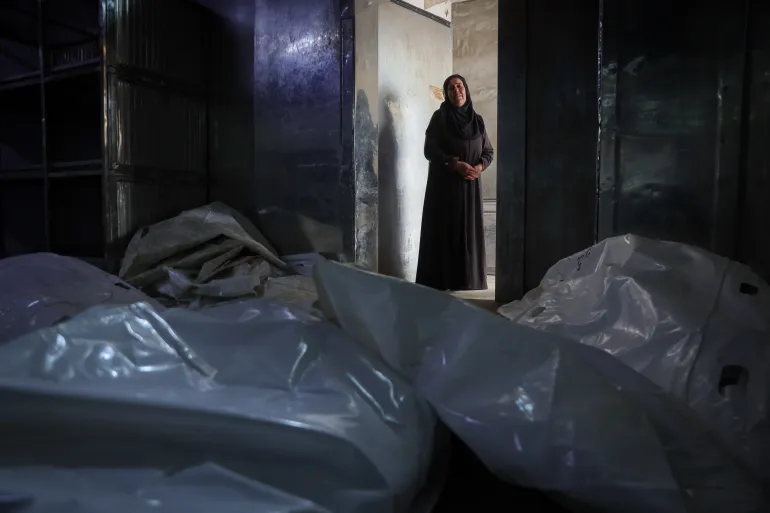
Gaza Herald_With weary steps and tear-filled eyes, Hanaa al-Mabhuh moves back and forth between a hospital hall displaying photographs of recovered bodies and the morgue at al-Shifa Hospital, searching desperately for any sign of her missing son.
The 56-year-old mother wipes her face with the back of her hand as she studies images of decomposed bodies on a screen. She is torn between the need to uncover her youngest child’s fate and the fear that he may be among the dead returned by Israel under a ceasefire agreement brokered by the United States.
Since the war erupted following the October 7, 2023, attack by Hamas, thousands of Palestinians in Gaza have been trying to trace relatives who vanished amid the violence. For Hanaa, uncertainty has become a daily torment.
Compelled by the need for answers, she repeatedly returns to the hospital to examine the photographs.
“My son is part of me,” she says of Omar, her 18-year-old youngest child, who disappeared last June along with his cousin Alaa after they went to inspect the remains of their destroyed home in Jabaliya refugee camp in northern Gaza. Omar, a high school student preparing for his final exams, was the youngest of seven siblings.
“Every child is precious, but he is a piece of my heart,” she says, her voice breaking as she heads toward the morgue once more.
The family sought help from the International Committee of the Red Cross and multiple human rights organizations, hoping to uncover what happened to the two young men. They received no definitive answers.
“The waiting is unbearable,” Hanaa says. “We don’t know if they are prisoners, if they were killed and their bodies taken, or if they are among those whose remains are being returned in groups.”
“It feels like we are chasing an illusion,” she adds quietly.
A Relentless Search
Since Israel began transferring Palestinian bodies back to Gaza through the Karem Abu Salem (Kerem Shalom) crossing, Hanaa has joined hundreds of other relatives circulating between hospitals and reception centers, seeking any clue about their loved ones.
On February 4, Gaza’s Health Ministry reported receiving 54 bodies and 66 boxes containing human remains, delivered via the Red Cross. The remains were taken to Al-Shifa Hospital, where medical teams conducted preliminary examinations and documentation before showing them to families for potential identification.
Although international protocols require the Red Cross to facilitate such transfers, human rights groups say documentation is often incomplete. Details about the circumstances of death are frequently absent, placing immense pressure on Gaza’s limited forensic teams to classify and identify bodies without sufficient tools, including DNA testing.
Since the most recent handover, Hanaa has visited repeatedly to review names and photographs. “I have searched everywhere,” she says. “I even traveled to Khan Younis in the south to look at more photos.”
The body transfers fall under a ceasefire arrangement brokered in October 2025, stipulating that the remains of 15 Palestinians would be exchanged for each Israeli body held in Gaza.
Israeli authorities are still believed to hold more than 770 Palestinian bodies in what are known as the “cemeteries of numbers” and military morgues, according to the National Campaign for the Recovery of Martyrs’ Bodies and Disclosure of the Fate of the Missing.
Hanaa’s ordeal does not end with the returned bodies. She also monitors lists of Palestinian prisoners periodically released by Israel, calling the Red Cross repeatedly to check whether her son’s name appears.
“The Red Cross staff recognize my voice now,” she says. “They tell me, ‘Sister, you called before.’ I tell them I cannot help it. It is not in my hands.”
Despite her relentless efforts, she has received no confirmation.
“As a mother, my heart wants him to be alive,” she says. “But I try to prepare myself for the worst. Even preparing myself has brought no peace.”
Living in Uncertainty
For Hanaa, the pain is not only the possibility of loss but the endless uncertainty shared by hundreds of other families.
“Why are we left in this confusion?” she asks. “We don’t know where they went or what happened to them.”
Adding to her anguish is the condition in which many bodies are returned. “The features are completely erased. I cannot recognize my son’s face,” she says.
She believes the state of the remains deepens families’ suffering. “It feels like they want us to grieve forever,” she says through tears.
“My son was at the beginning of his life, like a flower. He was preparing for his exams. What could he have done to disappear like this?”
A Broader Humanitarian Issue
Since October 2023, the issue of bodies held by Israel has become a significant humanitarian and legal concern. Israel does not publish a comprehensive list of the named bodies it retains.
The Red Cross states it has facilitated the transfer of 360 Palestinian bodies to Gaza since the war began. It has also supported the return of 195 Israeli captives, including 35 who were deceased, and the release of 3,472 Palestinian prisoners alive.
According to Gaza’s Health Ministry, only 99 of the returned Palestinian bodies have been definitively identified. Many others remain unrecognized or are still undergoing examination.
Officials say some bodies bear gunshot wounds to the head and chest, shrapnel injuries, broken bones, and advanced decomposition, complicating forensic work.
Limited Forensic Capacity
At Gaza’s forensic department, a small team faces overwhelming challenges without access to advanced identification tools. Ahmed Abu Taha, who oversees the ministry’s file on bodies and missing persons, says 120 corpses recently arrived via the Red Cross. Some were intact; others consisted only of bones and fragments.
Only two were identified, and even those identifications lacked scientific certainty.
Abu Taha explains that confirmatory methods such as DNA analysis, forensic anthropology, and forensic odontology are unavailable due to the devastation of Gaza’s healthcare infrastructure. Instead, teams rely on presumptive identification, examining clothing, physical traits, gender, estimated age, scars, amputations, or tattoos.
Such methods, he says, carry a significant risk of error.
When Mistakes Deepen the Tragedy
The consequences of misidentification can be devastating. Abu Taha recounts a case in which one family identified a body as their missing son based on similarities. The forensic team agreed, and the body was released. The family conducted funeral rites and burial.
Days later, another family presented stronger evidence proving the remains belonged to them.
Incidents like this have occurred more than once, reopening wounds for grieving relatives and compounding trauma in a community already overwhelmed by loss.
Abu Taha is calling for international pressure to allow forensic equipment and DNA testing tools into Gaza, describing the matter as both ethical and humanitarian.
“The issue of the bodies is not just about numbers,” he says. “It is about families who need certainty.”
A Mother’s Appeal
Hanaa, like many others, appeals to international organizations to intervene.
“We cannot find psychological or social stability,” she says. “The pressure is unbearable.”
She contrasts the intensive efforts made to locate Israeli remains with what she describes as insufficient attention to Palestinian missing persons.
“They dug up land and searched graves with advanced equipment looking for Israeli bodies,” she says. “But our children, who asks about them?”
Until she receives a definitive answer, Hanaa continues her painful routine between photographs and morgues, clinging to hope while bracing for heartbreak, suspended between life and death, certainty and doubt.

