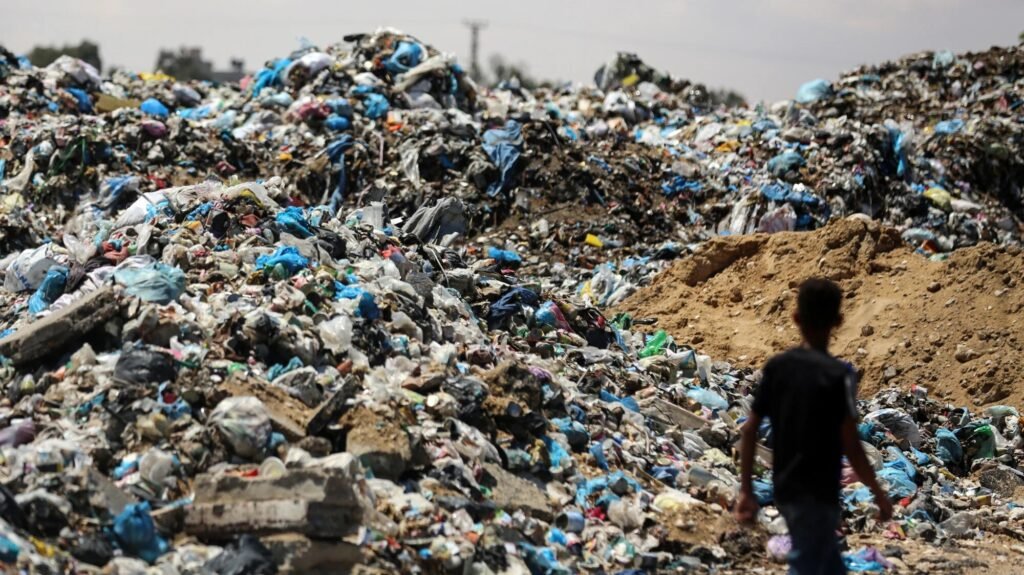
Gaza Herald_ In a scene that reflects the depth of environmental and health collapse in the Gaza Strip after more than two years of ongoing genocidal war, burning plastic for cooking and heating has shifted from an improvised behavior to a forced necessity imposed by the shortage of fuel and cooking gas supplies. This reality has not only created a severe livelihood crisis but has also opened the door to dangerous air pollution that threatens residents’ lives, particularly displaced families living in overcrowded tents.
Unprecedented Air Pollution
Islam al-Habil, a PhD holder in environmental and chemical engineering, said that burning plastic for cooking and heating in Gaza transformed after the 2023 war launched by Israel into a “forced behavior imposed by the disruption of fuel and cooking gas supplies.” She warned that this situation has exacerbated direct air pollution levels to an unprecedented degree, especially around displacement camps and surrounding areas.
Al-Habil, a specialist in microplastics, explained that open burning of plastic releases a complex mixture of pollutants, most notably fine particulate matter (PM2.5 and PM10) and soot, or black carbon, substances strongly linked to increased risks of cardiovascular and respiratory diseases.
She clarified that such burning also produces highly toxic compounds such as dioxins and furans, particularly when plastics containing chlorine compounds like PVC are burned, or when combustion occurs without proper temperature control and oxygen availability.
She added that emissions also include polycyclic aromatic hydrocarbons (PAHs), some of which are classified as carcinogenic, such as benzo[a]pyrene, in addition to volatile organic compounds (VOCs) and toxic and irritating gases like carbon monoxide and nitrogen oxides, as well as other trace gases that increase significantly during open burning.
Long-Term Impact
Al-Habil noted that open burning can raise concentrations of fine particulate matter to extremely high levels near the source, while PAH concentrations can multiply many times above normal background air levels.
She emphasized that the danger of plastic pollution does not remain confined to a neighborhood or camp. Pollutants can travel through the wind over regional distances depending on weather conditions. They can also settle onto soil surfaces and later be washed away by rainwater or accumulated wastewater into the sea.
She warned that ash and hydrocarbon compounds may enter various food chains, worsening the long-term cumulative impact.
Regarding attempts to convert plastic into fuel, the environmental and chemical specialist explained that the processes currently taking place in Gaza are carried out through primitive methods lacking control and purification systems, making them an additional source of pollution.
She said the resulting oil is “an unstable mixture of aliphatic and aromatic compounds and impurities,” and when burned in simple stoves or old engines, it releases larger quantities of soot, fine particles, and carcinogenic compounds compared to refined fuels. “Residents are not burning conventional fuel,” she added, “but a complex chemical mixture.”
Health Consequences
On the health implications, she stressed that the first effects appear in the respiratory system, including worsening asthma, bronchitis, and irritation of the eyes, nose, and throat. She also noted an increased risk of cardiovascular diseases among the elderly due to high exposure to fine particles.
As for dioxins, she described their danger as “chronic and cumulative,” as they may affect the immune system, endocrine glands, fertility, and neurological development.
She pointed out that women and children are the most affected groups. Children inhale larger amounts of air relative to their body weight, and their respiratory and nervous systems are still developing, making them more sensitive to pollutants. Women, especially those who spend more time near cooking or burning areas inside tents, are exposed to higher levels of smoke and toxic emissions.
Possible Solutions
Regarding potential solutions, al-Habil acknowledged that current conditions do not allow for ideal responses. However, she suggested realistic steps to reduce harm, such as avoiding burning within residential clusters, sorting materials to prevent burning chlorine-containing plastics or those mixed with chemicals and oils, improving ventilation during cooking, keeping children away from smoke sources, and avoiding burning in enclosed spaces.
She added that supporting waste collection services, establishing managed collection points or temporary landfills, and preventing random burning in densely populated areas are essential steps to reduce the health and environmental burden.
Al-Habil stressed that addressing the crisis ultimately requires the provision of fuel and allowing its entry into Gaza. She described this not as an environmental luxury but as a humanitarian and health priority, as it would reduce the need to burn plastic and enable municipalities to resume waste collection and remove waste from displacement camps.
She concluded that pollution resulting from plastic burning is no longer merely an environmental issue but a comprehensive health and economic crisis, forcing residents to “pay for their food with their health” amid the continuing collapse of the environmental and healthcare systems.