
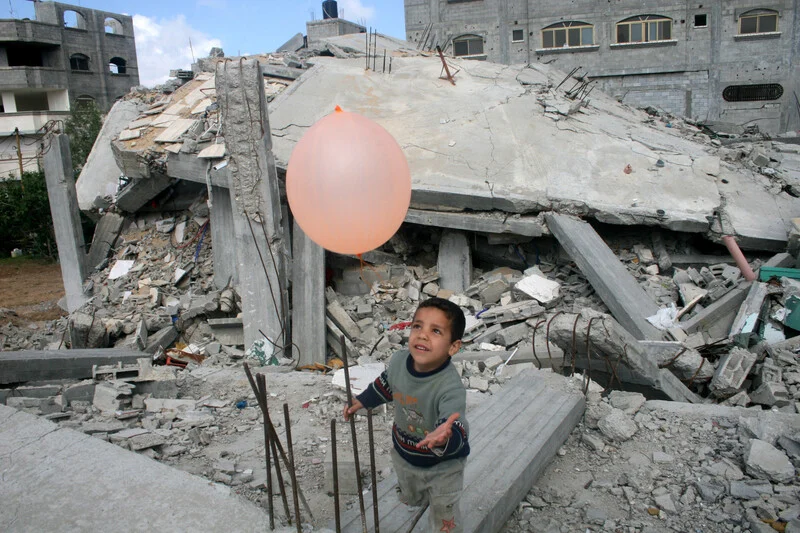
Gaza Herald _Children with autism spectrum disorder (ASD) in Gaza, and their families, are facing compounded hardships inside displacement camps that lack even the most basic conditions for life. These families are struggling under severe living conditions, the near-total collapse of the healthcare system, and the absence of medical care, rehabilitation services, and psychological support.
The displacement camps offer none of the calm, structured environments that children with autism rely on to feel safe and stable. Overcrowding, constant noise, and the daily disruption of routine dominate life in these camps, deeply affecting the children’s behavior and mental well-being.
Autism spectrum disorder refers to a range of neurodevelopmental conditions that affect brain development, influencing social communication, behavior, and sensory processing in varying degrees from one child to another.
Families report the absence of even the most basic necessities: safe spaces, appropriate educational tools, and access to specialized support sessions. The lack of trained professionals and rehabilitation services has emerged as a major obstacle. Behavioral therapy, individualized educational support, and social skills development programs are either extremely rare or entirely unavailable, threatening to erase the progress some children had achieved before displacement.
The burden does not fall on children alone. Families are enduring escalating psychological and economic pressure, struggling to balance the basic needs of the rest of the household with the specialized care their autistic children require, all while resources are scarce and support networks are virtually nonexistent.
The Loss of Safety
Abdulrahman al-Shami, the father of a child with autism, explains that every new displacement feels like a fracture in his son’s daily life.
“Each time we are forced to flee from one area to another, it is as if Abdulrahman’s entire day is broken,” he says. “The constant movement, noise, and overcrowding strip away his sense of comfort. He tries to adapt to every new place, but the effort overwhelms him.”
Speaking to Safa News Agency, al-Shami adds that children with autism depend heavily on fixed routines—specific times for sleeping, eating, and playing.
“With every displacement, every detail of his life changes,” he explains. “That has pushed Abdulrahman into severe panic attacks, intense crying, and screaming that can last for hours. No one around us knows how to help or calm him.”
“These constant moves, the instability, and the changing faces around him take away the feeling of safety from his heart,” he continues.
Al-Shami says he has tried various methods to soothe his son, but the chaos and noise of the camps overpower every attempt. Children with autism, he explains, need predictability to feel secure. When routines collapse, they interpret every change as a potential threat.
Fear and Noise
A similar story is told by Norhan al-Saadi, who describes her struggle with her autistic son.
“My child has extreme sensitivity to sound,” she says. “Especially the sounds of bombing, aircraft, and even the noise of the water trucks arriving at the camp.”
Speaking to Safa, al-Saadi explains that since October 7, her son Louay’s life has steadily deteriorated.
“He has lost every sense of safety,” she says. “Fear, constant change, and unfamiliar faces have taken over his world.”
She adds that the suffering goes beyond fear alone. “The sensory pain caused by sudden changes is unbearable for him.”
“I tried using noise-canceling headphones and finding a relatively quiet corner inside the tent,” she continues, “but the noise seeps in from everywhere.”
Psychological Trauma
Islam Barakat, director of the Al-Irada Program and School for Autism Rehabilitation in Gaza, confirms that children with autism are profoundly affected by continuous trauma.
“The sounds of explosions and constant shelling cause children to cover their ears, scream, cry, and run aimlessly,” Barakat explains. “This leaves parents feeling completely helpless as they watch their children unravel.”
Barakat tells Safa that children on the autism spectrum are extremely sensitive to their surroundings, and even minor changes in routine or environment can trigger severe distress.
According to him, the realities of war, repeated displacement, and life in camps have erased much of what these children learned over years of rehabilitation.
Most children with autism, across different levels of severity, have experienced a sharp decline in their health and behavior, Barakat says. Some have lost previously acquired speech and eye contact skills, while others have seen an increase in the frequency and duration of seizures.
He stresses that the closure of rehabilitation centers and specialized schools, whether due to direct destruction or the displacement of professionals, has left children without any psychological support or behavioral therapy.
“These children are living through a double trauma,” Barakat explains. “The direct trauma of war, and the trauma of losing the rehabilitation and educational services that once gave them balance, stability, and a sense of safety.”

