
📅 February 11, 2026
Gaza Herald _Israel’s genocidal war on the Gaza Strip is not limited to mass killing or the large-scale destruction of civilian and urban infrastructure. It extends into a deeper and far more enduring assault: the systematic targeting of education, culture, collective memory, and Palestinian identity itself.
This conclusion lies at the heart of a study by American scholar Henry Giroux, titled Scholasticide: Waging War on Education from Gaza to the West, in which he introduces the concept of “epistemicide”, the deliberate destruction of knowledge systems, as a framework for understanding the war not as a temporary military campaign, but as a structural project aimed at erasing Palestinian society physically, culturally, and intellectually.
Giroux, one of the leading figures in critical pedagogy, presents this concept in his research published in the Journal of Holy Land and Palestine Studies, arguing that epistemicide represents a core dimension of the ongoing assault on Gaza.
State Terror and the Normalization of Violence
According to Giroux, what is unfolding in Gaza cannot be understood as a series of isolated military operations. Rather, it is a comprehensive project designed to reshape Palestinian reality by destroying the material and intellectual conditions necessary for survival. The target is not only human bodies, but also the institutions that preserve history, transmit knowledge, and shape the consciousness of future generations.
The study argues that state terror does not always appear in its most overt or brutal form, nor is it necessarily exercised outside the law. In many cases, it is reproduced within institutional frameworks and cloaked in legal, security, and moral rhetoric that renders violence both acceptable and necessary.
Giroux explains that Israeli violence is presented as an integral part of state logic and governance rather than as an exception or deviation. The most dangerous form of state terror, he argues, lies not in the excessive use of military force alone, but in the normalization of that force within society, transforming it into a routine practice that escapes ethical scrutiny or accountability.
When the state legalizes violence and reframes it as “self-defense” or “security,” it does more than suppress the victim, it conditions society itself to accept, internalize, and symbolically participate in that violence.
Giroux distinguishes between direct military violence and state terror, which he defines as violence carried out in the name of law and security and granted political and moral legitimacy through coordinated official and media discourse. Under this framework, the widespread bombing of civilians, the targeting of schools and hospitals, mass arrests, and home demolitions are not aberrations but components of a systematic policy embedded in the political structure of a state that works to normalize violence socially, ethically, and culturally.
He further notes that Israel is not only waging war on Gaza, but also simultaneously waging war on criticism and dissent—both inside Palestine and globally. Any attempt to describe the unfolding reality as war crimes or genocide is met with organized smear campaigns and ready-made accusations, most notably antisemitism.
From Exceptional Violence to Structural Violence
The study draws on international human rights reports indicating that Israel dropped more than 25,000 tons of explosives on Gaza within a few months—an amount comparable in destructive capacity to two nuclear bombs. Giroux argues that such unprecedented firepower, particularly in one of the world’s most densely populated areas, makes claims of “mistakes” or “collateral damage” untenable.
Under international humanitarian law, the repeated use of this level of destructive force in civilian areas constitutes a clear war crime, especially when directed at non-military infrastructure.
One of the study’s central findings is the deliberate targeting of educational institutions. According to United Nations data:
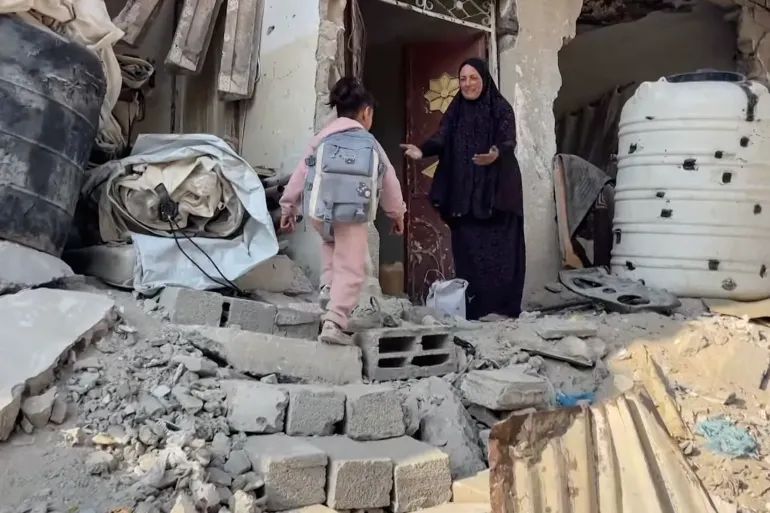
•Approximately 90 percent of Gaza’s schools have been damaged or destroyed.
•All 12 universities in the Strip have been bombed or vandalized.
•Around 90,000 university students have been forced to suspend their studies.
•Thousands of students and hundreds of teachers and university professors have been killed.
Giroux rejects the notion that these outcomes are accidental byproducts of war. Instead, he situates them within a broader policy aimed at severing the knowledge chain that links past, present, and future—making social recovery extraordinarily difficult.
The study highlights repeated attacks on schools that had been converted into shelters for displaced civilians, including the Al-Tabaeen School, which was struck while hundreds of civilians were inside. Human rights investigations found no evidence of military activity in these locations, reinforcing the conclusion that the attacks were intentional.
Giroux argues that the repetition of such incidents reflects a shift in which schools are no longer protected spaces, but have been transformed into military targets—an egregious violation of international norms requiring the protection of educational facilities.
Epistemicide: Meaning and Implications
Giroux defines epistemicide as the systematic destruction of education, culture, and a society’s intellectual infrastructure with the aim of erasing collective memory and the capacity to produce and transmit knowledge. It is a form of advanced genocide that targets not only the present, but the future.
This process includes:
•Destroying schools and universities
•Killing or forcibly displacing educators and intellectuals
•Erasing archives and libraries
•Destroying museums and cultural sites
•Stealing or obliterating historical artifacts
The analysis extends to the targeting of public libraries, publishing houses, cultural centers, cemeteries, and historical landmarks. Giroux argues that this pattern reflects an effort to forcibly rewrite history by erasing the material evidence of continuous Palestinian presence.
He warns that destroying memory is no less dangerous than destroying bodies, because it seeks to eliminate the Palestinian narrative altogether.
According to Giroux, epistemicide does not stop at Palestine’s borders. It also extends into universities across the United States and Europe, where academic freedom has increasingly come under attack. He documents cases of professors being dismissed or suspended, students punished, and peaceful protests suppressed for expressing solidarity with Gaza or criticizing Israeli policies.
This, he argues, reflects a growing alliance between political power, economic interests, and mainstream media to silence critical discourse under the pretext of security or combating hate.
Israeli Universities and Their Role
Giroux cites Israeli academics, including voices from within the system itself, who warn of a growing erosion of academic independence. Universities, he argues, have ceased to function as neutral educational institutions and have become hubs for military knowledge production, surveillance technologies, and legal and ethical justification for occupation policies.
In fields such as artificial intelligence, drones, and biometric surveillance systems, Israeli universities operate in close partnership with the military, arms manufacturers, and intelligence agencies.
The study emphasizes that universities contribute not only through research collaboration, but also by producing a knowledge framework that dehumanizes Palestinians. When Gaza is studied as a “hostile environment” and Palestinians are framed as “potential security threats,” knowledge itself becomes an instrument of violence.
This academic normalization of violence makes brutality socially acceptable by presenting it as the logical outcome of scientific or security-based analysis. Education, meant to be a tool of liberation, thus becomes a mechanism of domination, turning killing and destruction into actions that can be rationalized.
More dangerously, this entanglement is promoted as a national duty, creating a university culture that integrates research directly into the machinery of military dominance. Universities lose their role as critical spaces and become part of the infrastructure of occupation, where research priorities, funding decisions, and academic success are measured by their contribution to national security.
In such a context, academic silence regarding crimes in Gaza and the West Bank becomes a predictable outcome of long-term structural integration.
Why Is Knowledge Targeted?
Giroux moves beyond institutional analysis to examine why Palestinian education itself is targeted. He argues that the destruction of schools and universities, the killing of educators, and the displacement of students in Gaza constitute a deliberate strategy aimed at the very core of society, not collateral damage.
One of the most alarming aspects of state terror, he notes, is the targeting of children and education without provoking sustained global outrage. When children are killed or denied schooling, crimes are emptied of their human meaning through normalization.
In Israeli official discourse, such actions are framed as part of dismantling “enemy infrastructure,” a term that reduces human life to security calculations and strips violence of moral accountability.
Giroux warns that this normalization extends beyond Israel to the international system, which responds with legal coldness or fleeting expressions of concern, reinforcing impunity and encouraging the repetition of violence.
In colonial contexts, Giroux argues, education is always perceived as a threat. Knowledge generates skills, awareness, organizational capacity, and political imagination that exceed imposed realities. Denying education is therefore a long-term strategy of domination.
In the Palestinian case, this logic is especially clear. Gaza, despite years of siege, maintained a vibrant educational system, active universities, and high enrollment in higher education. This reality posed a structural threat because knowledge in Gaza was inseparable from questions of identity, memory, rights, and continuity.
From this perspective, the destruction of universities, laboratories, and the killing of academics sends a political message: to break the chain of consciousness by attacking the present and devastating the future.
Children Between War and Deprivation
Giroux pays particular attention to children as both direct victims of bombardment and the group most affected by the simultaneous collapse of education and psychological stability. War, he argues, is not measured only by death tolls, but by the depth of the wound it inflicts on future generations.
Schools are not merely places of learning, but spaces of safety, routine, social connection, and meaning. When they are destroyed, children are left in an existential void where violence becomes the primary framework for understanding the world.
The accumulation of trauma, bombing, loss, displacement, hunger, combined with educational deprivation produces deep psychological scars. Children raised without stable education and a clear horizon face heightened risks of depression, anxiety disorders, cognitive decline, and the erosion of trust in the future.
Most dangerously, Giroux argues, this outcome is not accidental. A generation deprived of education is less capable of demanding rights and rebuilding society after war.
The Violence That Goes Unseen
In one of the study’s most forceful arguments, Giroux describes epistemicide as a form of slow violence, a process that dismantles a society’s intellectual and cultural foundations over years or decades. Unlike airstrikes, it receives less media attention, yet it is more devastating in the long term.
Ignoring this dimension, he warns, means accepting a crime whose consequences will surface later, when society finds itself unable to recover, not due to lack of resources, but because its intellectual capital has been destroyed.
From this standpoint, rebuilding schools after the war, if it happens at all, is insufficient unless accompanied by protecting knowledge, supporting educators, and restoring faith in education as a path to life.
Giroux concludes that what is happening in Gaza is not merely a local tragedy, but a global test of whether education truly matters as a non-negotiable human right. When schools are destroyed, memory erased, and children denied learning, it is not only one people under attack, but the very idea of justice.
Defending education, he insists, is an act of moral resistance against raw power. Silence in the face of epistemicide is complicity in an ongoing crime, and acceptance of a future built on ignorance and oppression.
In a world that claims to uphold human rights, Giroux poses a final question: What value do those rights hold if education becomes the first casualty when they are put to the test?

