
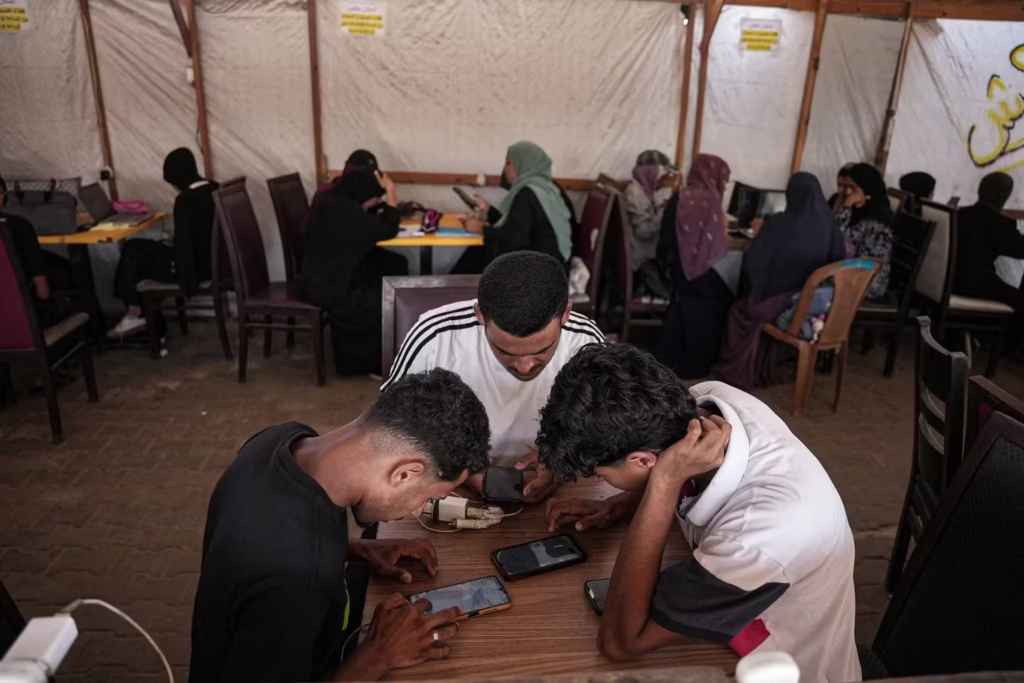
Gaza Herald_ Education in Gaza is no longer a pathway to the future—it has become an act of resistance. In a place where schools are reduced to rubble, classrooms replaced by tents, and books outnumbered by bombs, the simple act of learning has turned into a daily struggle for survival. Israel’s war did not only target buildings and infrastructure; it systematically dismantled the foundations of Palestinian education, forcing an entire generation to fight for knowledge under conditions designed to extinguish hope. Yet despite displacement, darkness, and loss, Gaza’s students continue to study, not because the path is clear, but because surrender is not an option.
In a dimly lit tent in central Gaza, Nibal Abu Armana tries to recreate a classroom for her seven-year-old son, Mohammed. With only a battery-powered LED lamp to illuminate their space, the 38-year-old mother of six teaches him basic reading and arithmetic. After a couple of hours, both their eyes are strained with exhaustion.
For many families in Gaza, this is what education has been reduced to. Widespread displacement has forced most Palestinians into temporary shelters that offer little protection, let alone an environment conducive to learning. After more than two years of Israel’s war on Gaza, which has killed over 70,000 Palestinians, the prospect of meaningful reconstruction remains distant.
Schools and universities have been among the hardest-hit institutions. Most educational buildings have been damaged or destroyed, while many that remain intact have been repurposed as shelters for displaced families. As a result, children and university students alike have been deprived of regular schooling since October 2023.
Before the war, Nibal’s children followed a structured daily routine built around school and homework. That rhythm has since disappeared. Today, their days revolve around survival: securing water, waiting for meals from charity kitchens, and gathering fuel for cooking and warmth. By the time these needs are met, there is little energy left for study.
Displacement has taken a heavy toll on Nibal’s older children. Her eldest son, Hamza, now 16, has completely abandoned the idea of returning to school. After months of interruption and life in displacement, he has taken on adult responsibilities, working alongside his father as a porter to earn money for food and basic needs.
“He grew up too fast,” Nibal said, explaining that Hamza now thinks like a parent, carrying responsibility for his younger siblings.
Her 15-year-old son, Huzaifa, still wants to continue his education, but worries about the years of learning he has lost. For now, he studies in makeshift tent classrooms, sitting on the ground for hours at a time. “My back and neck hurt from writing and trying to see the teacher,” he said.
Education Under Attack
Since the war began, an estimated 745,000 students in Gaza have been cut off from formal education, including 88,000 university students. Despite a nominal ceasefire that Israel continues to violate, UNESCO assessments show that more than 95 percent of damaged schools require major rehabilitation or complete reconstruction. Nearly 80 percent of higher education institutions and 60 percent of vocational centres have also been damaged or destroyed.
Ahmad al-Turk, dean of public relations at the Islamic University of Gaza, said the assault on education has been systematic. He warned that the targeting of academics threatens future generations, as experienced professors cannot easily be replaced. The loss of faculty undermines both student achievement and long-term research capacity.
Raed Salha, a professor of urban and regional planning, echoed these concerns. He stressed that academic expertise is built over years and its loss, through death, displacement, or prolonged disruption, represents a devastating blow to society.
Online education has offered little relief. Most families cannot afford laptops or smartphones, and electricity and internet access remain unreliable. “Teachers are trying, and students are trying,” Salha said, “but the tools are almost nonexistent.”
Beyond academics, students have lost the social and cultural dimensions of education. University life, libraries, laboratories, campus courtyards, and shared activities, once played a central role in shaping identity and belonging. That experience, Salha noted, has largely vanished.
Choosing to Continue
For university students like 20-year-old Osama Zimmo, adapting has been an uphill battle. Once enrolled in computer systems engineering at al-Azhar University, he completed his first year before the war disrupted everything. When classes moved online, the lack of a laptop, stable electricity, and reliable internet made continuation nearly impossible.
Faced with uncertainty about the war’s duration and concerns about the future of his field, Osama eventually changed his major to civil engineering at the Islamic University, which resumed limited in-person classes in December.
“We became names on screens instead of students with real lives,” he said. Still, he chose to continue rather than abandon his education altogether.
“We study not because the road is clear,” Osama explained, “but because giving up is exactly what this reality is trying to force us to do.”

