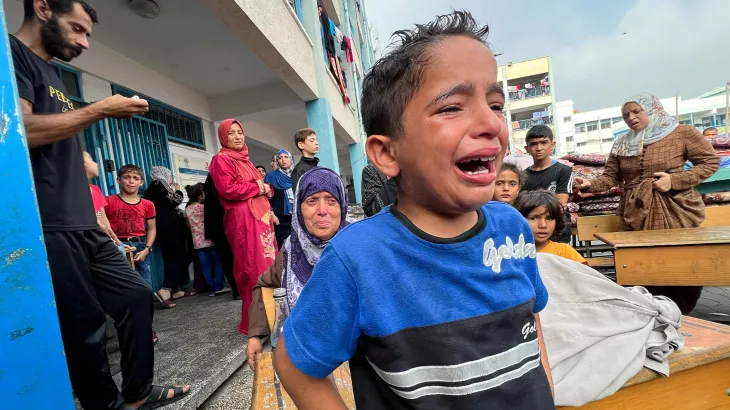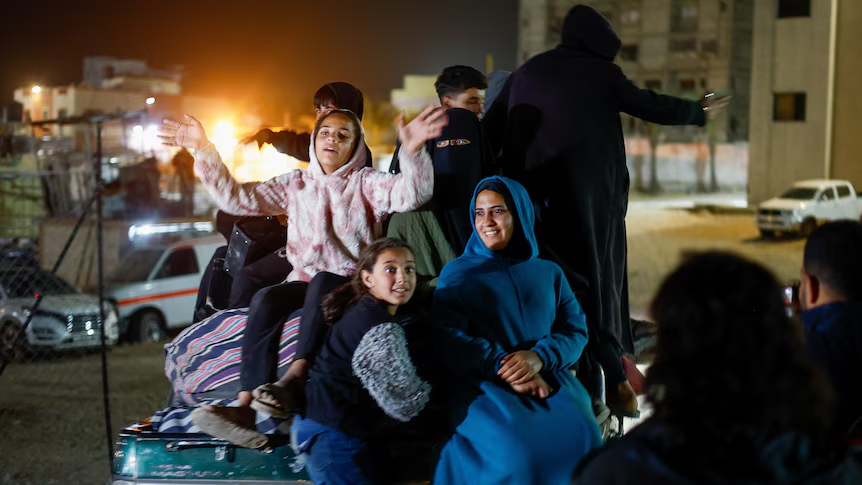
Gaza Herald _Despite the relentless bombardment and the vast destruction left by Israel’s war, a small number of Palestinians are expressing profound joy as they return to the Gaza Strip, driven by an unbreakable attachment to home and family. For those allowed to cross through Rafah following its limited reopening, the journey back is not merely a physical return but an emotional reclamation of belonging, undertaken with full awareness of the devastation awaiting them yet fueled by a refusal to remain in exile.
Palestinian woman I’tidal Rayan waits eagerly for the moment she will reunite with her family in the Gaza Strip after nearly two years of separation. Despite the vast devastation left by Israel’s war, she says the longing for her family and homeland has never faded, insisting that returning to Gaza, even in ruins, is an act of life itself.
I’tidal, 29, left the Strip with her mother and her three children after sustaining a serious leg injury. Doctors warned that without urgent treatment, she could face amputation. She thus became one of tens of thousands of Palestinians who fled to Egypt during the early months of Israel’s assault on Gaza.
After months of medical treatment in Egypt, I’tidal gradually regained the ability to walk. Yet her body healed faster than her sense of exile, as she remained suspended between recovery and longing, waiting for the chance to go home.
That moment finally arrived on Thursday, when I’tidal, her mother, and her children were among a small number of Palestinians permitted to return to Gaza following Israel’s limited reopening of the Rafah crossing. The crossing had remained largely closed since the start of the war in October 2023.
Speaking to Reuters in Egypt shortly before crossing the border, I’tidal said, “I miss my country. I want to go back despite everything that happened, despite the bombing, even if I return to live in a tent.”
Reuters accompanied the family from the Egyptian city of Arish, which has hosted thousands of displaced Palestinians. There, joy was evident on the faces of her children, Hanan, eight; Ezz, five; and Mohammed, four, as they packed their small bags with blankets and winter coats. Hanan tied a ribbon in her hair in anticipation of seeing her father, while the three children repeated excitedly, “We’re going to Gaza,” as they prepared to head toward the border.
On Thursday afternoon, I’tidal and her children began the journey to the Rafah crossing, about 50 kilometers from Arish. Upon arrival, they were required to pass through three checkpoints: one operated by Egyptian authorities, a second overseen by Palestinian and European officials, and a third controlled by Israeli security forces.
From Rafah, largely destroyed and depopulated after Israeli forces took control following the ceasefire agreement in October, the family was transported by bus to Khan Younis in southern Gaza.
It was nearing midnight when they arrived. I’tidal’s husband, Ahmed, had been waiting anxiously. The couple embraced in a long, emotional reunion. Ahmed kissed and held his children, while Hanan clung tightly to her father’s leg, reluctant to let go.
I’tidal said she knew that most of Gaza had been devastated by the war, but seeing the destruction firsthand upon her return was deeply shocking. Still, the pain of witnessing the ruins did not outweigh the meaning of coming home.
For many Palestinians, returning to Gaza is not a denial of devastation but a declaration of belonging. Even amid rubble, displacement, and loss, the act of return remains a form of resistance, an insistence that life, family, and attachment to the land endure beyond bombardment and destruction.