
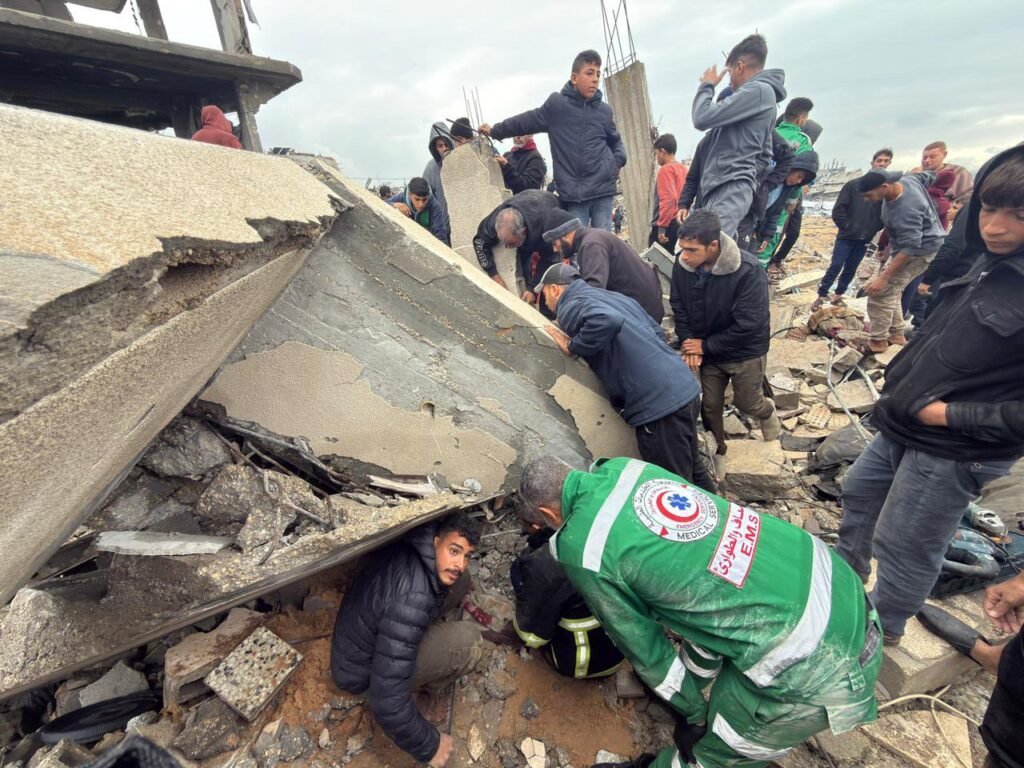
Gaza Herald_ Rebuilding Gaza should never be treated as a political concession or a security prize. Conditioning reconstruction on demilitarization does not promote peace; it entrenches collective punishment and legitimizes the destruction of an entire civilian society. According to Euro-Med Human Rights Monitor, tying Gaza’s recovery to political or military demands amounts to a grave violation of international law and risks normalizing the genocidal conditions imposed on Palestinians for more than two years.
Reconstruction as a Political Weapon
Euro-Med Human Rights Monitor has warned that linking Gaza’s reconstruction to demilitarization transforms a fundamental civilian right into a bargaining tool. This approach, the organization argues, ignores Israel’s responsibility for the widespread destruction of civilian infrastructure and shifts the burden onto a population already subjected to mass killing, displacement, and deprivation.
As an occupying power, Israel is legally obligated under international humanitarian law, particularly the Geneva Conventions, to protect civilians and ensure their basic needs without imposing conditions. Euro-Med stresses that reconstruction is not a favor granted by political actors but a legal duty owed to victims of unlawful destruction. Conditioning this right undermines the very foundations of humanitarian law and strips civilians of protections designed to shield them from political coercion.
Complicity and the Failure to Prevent Genocide
Euro-Med Human Rights Monitor has strongly criticized European political positions that endorse conditional reconstruction, describing them as part of a broader pattern of political, military, and economic complicity. The organisation notes that despite overwhelming evidence of mass atrocities, European states have largely failed to impose accountability measures or meaningful pressure to halt the destruction.
Delaying or obstructing reconstruction, Euro-Med explains, may fall under Article II(c) of the Genocide Convention, which prohibits deliberately inflicting conditions of life calculated to bring about a group’s physical destruction. As a peremptory norm of international law, the prohibition of genocide allows no exceptions. Any attempt to make survival contingent on disarmament or political compliance is therefore legally void and morally indefensible.
Collective Punishment Disguised as Policy
Euro-Med further warns that conditioning reconstruction opens the door to concrete measures that deepen civilian suffering, including blocking building materials, restricting financial flows, undermining humanitarian agencies, and disrupting aid mechanisms. Such actions, the organization argues, go beyond political bias and may amount to active participation in sustaining genocidal conditions.
The organization stresses that denying housing, healthcare, water, and essential infrastructure constitutes collective punishment, which is explicitly prohibited under the Fourth Geneva Convention. Children and women, in particular, bear the heaviest consequences of these policies, as deprivation directly threatens their right to life and dignity.
Euro-Med Human Rights Monitor concludes that reconstruction must be recognized as an inalienable right and an essential form of reparation, not a tool of negotiation. Separating humanitarian obligations from political and security agendas is not optional—it is a legal necessity. Until the blockade is lifted and reconstruction proceeds unconditionally, the international community remains complicit in prolonging Gaza’s destruction.
=

