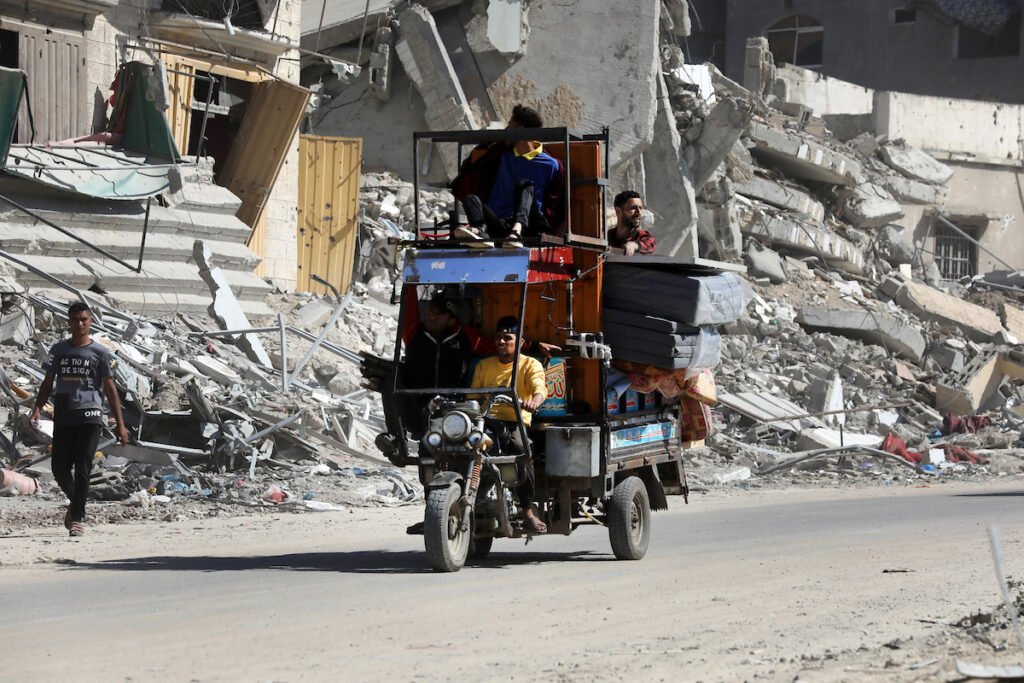
Gaza Herald_ As Gaza endures one of the most devastating genocidal campaigns of the modern era—its cities flattened, its hospitals destroyed, and its people starved under siege—some states have chosen not to distance themselves from accountability but to deepen military alignment with Israel. Greece is one of them.
Greek officials have openly signaled their interest in expanding defense cooperation with Israel, including the joint development and co-production of weapons systems, even as Israel stands accused of committing genocide against Palestinians in Gaza.
Angelos Syrigos, chair of the Greek parliament’s Defence Affairs Committee, confirmed that Greece already relies heavily on Israeli military technology and sees co-production as the next step. According to him, Greece has long been a major buyer of Israeli systems, and the relationship is now moving toward shared planning and manufacturing.
This deepening partnership comes at a time when Gaza has been subjected to relentless bombardment, with mass civilian casualties and widespread destruction drawing international condemnation.
On December 4, Greece’s Defence Affairs Committee approved the purchase of 36 PULS rocket artillery systems from Israel, at a cost of approximately $760 million—the largest single Israeli weapons acquisition in Greek history.
These systems are intended to form part of Greece’s so-called “Shield of Achilles,” a layered air-defense program valued at roughly 2.8 billion euros, announced last year. Syrigos indicated that if co-production agreements move forward, much of the remaining budget could be channeled into additional Israeli systems.
Although Greece is nominally part of the European Sky Shield Initiative, a Germany-led framework promoting mostly European air-defense technologies, it has shown little interest in acquiring those systems. Instead, Athens has focused its efforts almost exclusively on Israeli weaponry.
In January, Greece’s Ministry of National Defence established negotiating committees to pursue the direct purchase of three additional Israeli missile defense systems, Spyder, Barak, and David’s Sling, produced by Israel’s state-linked defense firms. The potential value of the deal is estimated at 3.1 billion euros, and would complete Greece’s multi-layered air-defense umbrella.
Rather than opening the contracts to international bidding, Greece is pursuing a government-to-government agreement with Israel, deliberately bypassing competitive tender processes. Defense analysts say this approach allows Greece to secure what it considers a technological “edge” without prolonged negotiations.
Greek military advisory committees are also discussing a broader “360-degree” defense concept with Israeli counterparts, encompassing unmanned aerial, surface, and underwater systems. Ballistic missile capabilities have reportedly also been explored with multiple partners.
Greek Defence Minister Nikos Dendias confirmed in January that Athens intends to move beyond buyer status toward joint development. He praised Israel’s transformation into a global defense technology powerhouse and said Greece aims to emulate that model by co-producing “low-cost, dual-use, innovative systems.”
Moral cost amid genocide
Not everyone in Greece views this growing intimacy with Israel as acceptable—particularly amid the mass killing and displacement of Palestinians in Gaza.
Human rights advocates warn that prioritizing strategic partnerships over accountability for war crimes reflects a profound moral failure. Greece, they argue, is ignoring one of the gravest human rights crises of the century in favor of militarization.
Critics have also warned that Greece appears to be adopting Israel’s security doctrine wholesale, positioning itself as one of the most heavily armed states in the eastern Mediterranean while remaining silent on Gaza’s devastation.
Political opposition voices have echoed these concerns. Last year, Greece’s left-wing opposition called for a boycott of sporting engagements with Israel, pointing to the famine, mass civilian deaths, and open calls by Israeli leaders for the forced displacement of Gaza’s population.
They warned that history would not look kindly on governments that armed Israel while Palestinians were being starved, bombed, and expelled.
Shared threats, shared militarisation
Greek-Israeli relations accelerated after 2010, following the breakdown of Israeli-Turkish ties amid regional tensions and clashes in Gaza. Greece and Israel later formalized a trilateral partnership with Cyprus, initially focused on energy cooperation but increasingly centered on security and defense.
The three states cite shared threat perceptions, particularly regarding Türkiye, which has openly criticized their alignment. Ankara has described the bloc as an explicitly anti-Turkish alliance.
Joint military planning has expanded steadily, including discussions of regional radar coverage and the signing of military cooperation frameworks. Israeli officials have framed this partnership as a defensive alliance against unnamed regional adversaries.
Relations between Israel and Turkiye have further deteriorated since late 2024, following Ankara-backed forces gaining control in Syria, prompting Greece and Israel to intensify joint military exercises.
The depth of Greece’s alignment with Israel was underscored by remarks from a senior Greek official, who suggested that Greece’s very survival in the region depends on Israel’s continued existence—an assertion that revealed how tightly Athens now binds its security outlook to Israel’s future.
Co-production ambitions and structural limits
In early February, Greece’s aerospace industry announced a step toward co-development, combining a domestic anti-drone electronic warfare system with an Israeli hard-kill rocket platform, creating a hybrid defense weapon.
Industry leaders said discussions are ongoing with Israeli firms to expand joint development and ensure technology transfer.
However, analysts caution that Greece’s defense industry faces deep structural constraints. Unlike Israel’s state-owned defense firms, which operate with private-sector flexibility, Greek companies remain hampered by bureaucratic restrictions, limited autonomy, and outdated legal frameworks.
Former Israeli officials, for their part, have openly welcomed Greece as a close and reliable partner, expressing confidence that Israeli weapons systems would continue flowing into Greek arsenals under the current political alignment.
Whether political intimacy can overcome Greece’s institutional stagnation remains an open question. But what is already clear is this: as Gaza bleeds, Greece is not merely watching; it is investing, arming, and aligning.
And history, as always, will remember who chose weapons over justice.
In the end, Greece’s deepening military embrace of Israel cannot be separated from the blood-soaked reality in Gaza. Choosing co-production, strategic intimacy, and weapons deals with a state accused of genocide is not a neutral act of defense policy; it is a political and moral alignment. By investing billions in Israeli military systems while Palestinians are starved, displaced, and annihilated, Athens signals that power, deterrence, and regional rivalry matter more than international law or human life. History will not judge such choices by the sophistication of missile shields or joint exercises, but by whether Greece stood on the side of justice or quietly helped normalize mass killing under the language of “security” and “stability.”