
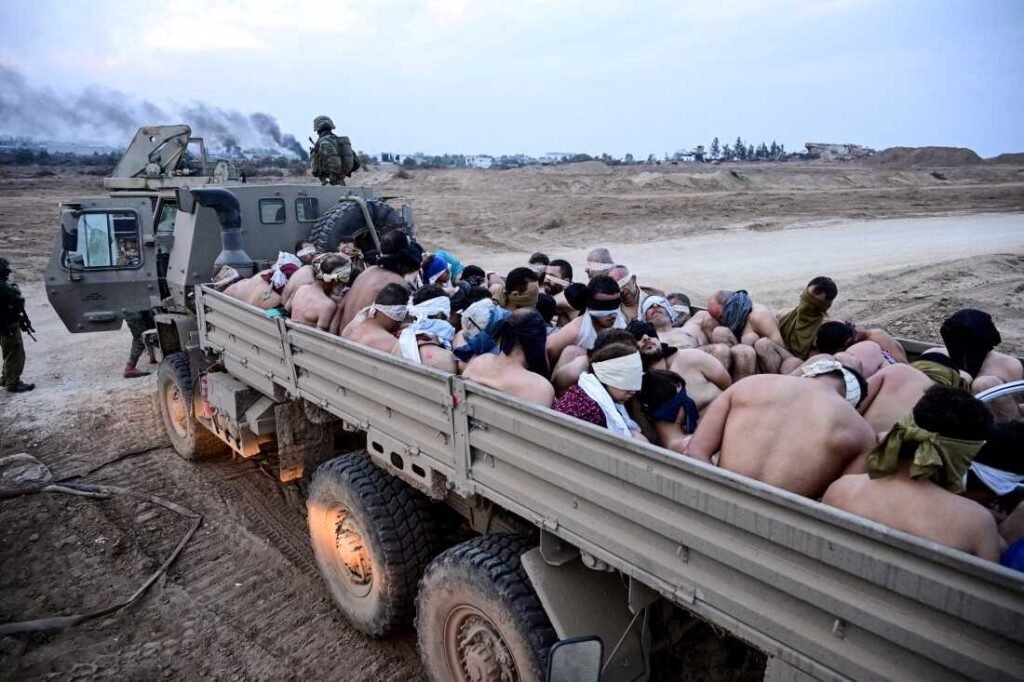
Gaza Herald – “The photo that spread of me among more than 100 detainees, that was me. They put me in a military transport vehicle, my hands tied. I asked them to cover me, but they refused and removed my hijab.”
With these stark words, Hadeel al-Dahdouh (24), a mother of two, begins recounting one of the harshest experiences she endured during 54 days of detention in Israeli prisons. Her testimony reveals detailed accounts from the moment her home was raided until her eventual release.
The Israeli occupation forces stormed their home in the Zeitoun neighborhood, south of Gaza City, at dawn on December 6, after blowing up a nearby wall. “They forced us into the street and ordered us to stand with our hands raised. They took the men and tied them up, then an officer called my name,” she recalls.
“I was holding my crying child. The officer told me to hand him to his grandmother. I refused, but he forced me, saying he would conduct a check and return me within half an hour. I was terrified and crying.”
Hadeel explains that she was subjected to multiple examinations, including a DNA test, under the claim of verifying her children’s identities. “They accused me of possibly having children who were taken on October 7,” she says.
She adds that she was sedated and interrogated about Hamas and tunnels. “They beat me whenever I denied knowing anything. They tied the blindfold so tightly that my eyelashes pressed into my eyes. I screamed that I had lost my sight.”
The following day, she says, she was placed among more than 100 detainees, most of them nearly naked and bearing signs of severe beatings. “I was tied up, and the soldiers threw things at me, insulted me, and beat me with rifle butts and boots.”
The third day, according to her account, was the most brutal. “They put us in a large pit that looked like a grave. Tanks and bulldozers surrounded us. They began burying some detainees while they were still alive.”
She recalls hearing a relative screaming, “I’m suffocating .. I’m suffocating,” but she was not allowed to help. “One soldier told us, ‘We will bury you alive and let the dogs eat you.’ I told him: ‘Kill us, shoot us, I don’t want to die like this.’”
Later, she was placed inside a military vehicle. “I was the only woman, my hands tied, and they piled the men on top of me. I asked them to cover me, but they refused and removed my hijab.”
Hadeel says they were then transferred to military tents and later into Israel, eventually reaching the Anatot detention facility near occupied Jerusalem, where she was subjected to strip searches and had her belongings confiscated.
Interrogations focused heavily on the events of October 7. “They kept asking where I was that day. Every time I said I didn’t know, they beat and tortured me. When I asked about my children, they told me: ‘When our children return from Gaza, we’ll return you to yours.’”
She spent 54 days in detention, enduring what she described as severe psychological and physical abuse. “Our hands remained tied even when using the bathroom. We were in extreme cold. Soldiers insulted us and even cursed the Prophet when they saw us praying.”
She adds that in Beersheba, she was forced to sit in water while being beaten, despite having undergone a cesarean section, which caused complications she still suffers from today.
Hadeel also says she was forced to take medication to stop breastfeeding. “They told me it would dry up the milk, and it did.”
Reflecting on her release, she says the emotional toll continues. “My children became distant. They no longer approached me like before. I felt they had forgotten me. I was afraid I might never see them again.”
She concludes: “We were reunited, but the pain is still inside me. It’s something I cannot describe.”

