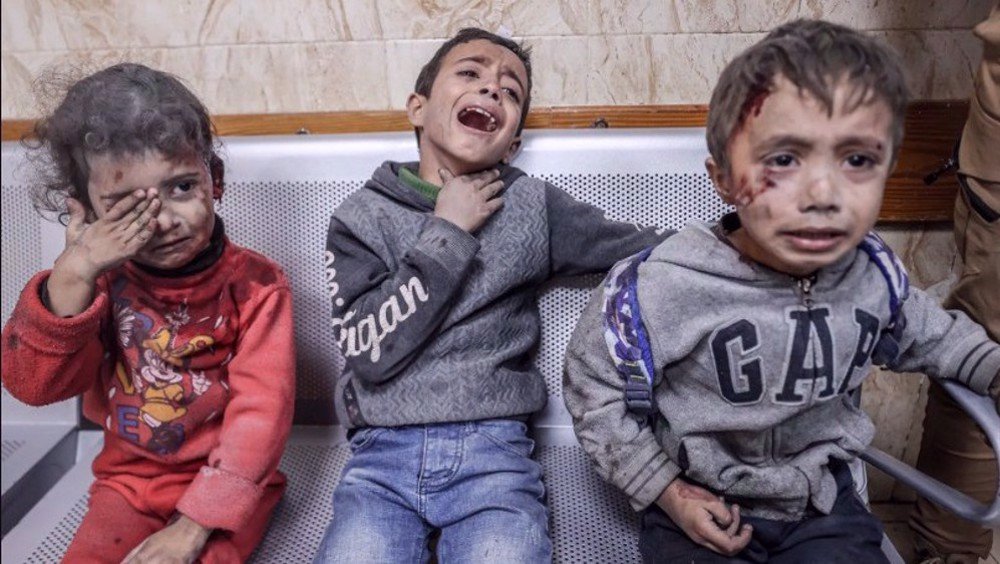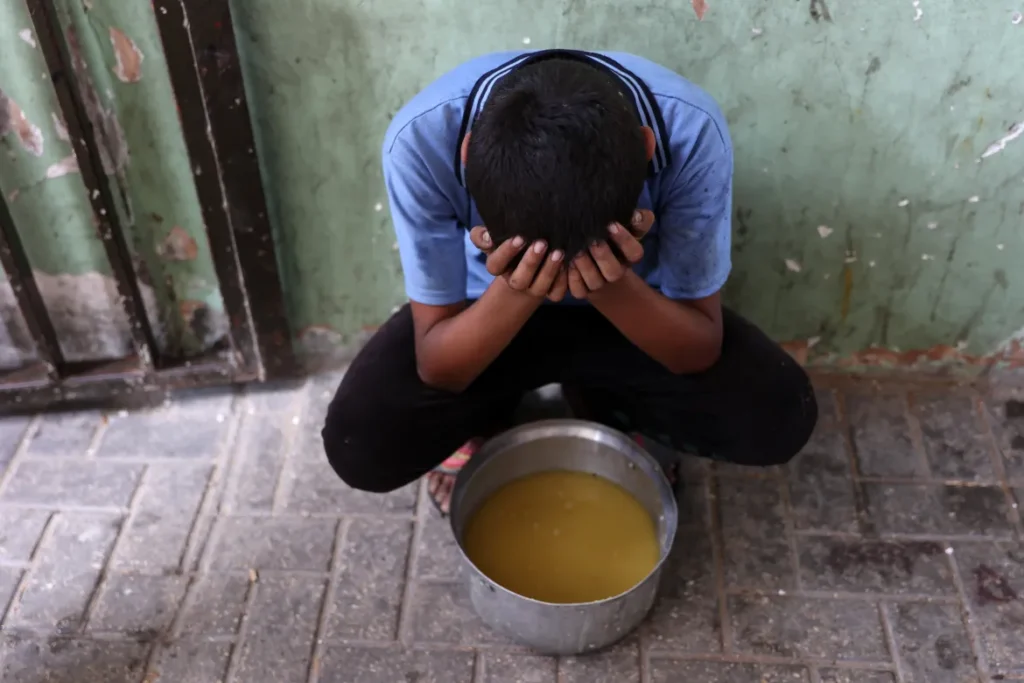
Gaza Herald — The people of Gaza do not need many words to explain the depth of their suffering. It is enough to walk through any alleyway, or pass by the endless rows of tents stretching like a grey sea across the Strip, to see dozens of buckets lined up, waiting for a trickle of water that never comes, or arrives in broken breaths like a tired soul.
Despite the arrival of colder weather, which should normally reduce consumption, the water crisis grows harsher by the day. Securing even a few liters has become a distant dream for more than two million people living on the edge of thirst in a land surrounded by the sea yet deprived of drinkable water.
Scarce water, Almost Nonexistent
Across every neighborhood, residents run behind water trucks as if chasing their last chance at life. The high-pitched whistle of the tanker has become a daily sound that every Gazan recognizes, raising fear in every tent. You either arrive early and secure a spot in the line or return with nothing.
Mohammed Hammouda, displaced to the Al-Mawasi area in Khan Younis, stands holding his bucket and says:
“We live above one of the largest natural aquifers, but we die of thirst. What we get each day doesn’t even cover one person, let alone an entire family.”
He points around him at the surrounding tents:
“Even the groundwater we find is no longer usable. Sewage pits, rubble, the absence of any treatment… everything is polluted.”
Gaza’s Crisis Goes Beyond Water
Throughout the war, the occupation destroyed most of Gaza’s wells and water stations, targeting trucks, workers, and even displaced people searching for water.
With fuel almost entirely cut off, the remaining wells that could still operate were forced to shut down.
Adel Abu Mehladi, who depends on a water line from a nearby agricultural plot, explains that their submersible well stops working on cloudy days:
“The generator runs directly on solar power, without storage batteries. When there is no sun, the whole neighborhood starts searching for water again.”
Abdulrahman Al-Astal says their family, well, once serving the entire neighborhood, was destroyed during the latest invasion. Now his family waits in long lines like everyone else, beginning each morning with a long and exhausting search.
Water Sold at a Heavy Price
Most families are now forced to buy water from private tankers. Abu Tamer Ashour explains:
“A thousand liters costs between 80 and 100 shekels. That’s a huge amount, and it only lasts two or three days for two families. But what choice do we have? Water is not a luxury.”
He adds that even though the trucks are no longer enough, crowds are massive, quantities are limited, and the water distributed is often not drinkable at all.
A Humanitarian Catastrophe Taking Shape
Local sources in Gaza say the occupation used water, food, and medicine as direct weapons throughout the war, destroying 90% of civilian infrastructure and cutting off the fuel needed for every water and sanitation facility to function.
During the 50 days of ceasefire, only enough fuel entered the Strip to power municipal facilities for five days.
Fifty days versus five an equation impossible to reconcile with the scale of destruction or the needs of the population.
Global Warnings
Pedro Arrojo-Agudo, the UN Special Rapporteur on the right to drinking water and sanitation, warned that the catastrophe worsens by the hour. He confirmed that the occupation has destroyed nearly 90% of Gaza’s water facilities and that water contamination threatens deadly diseases, including cholera.
In a statement, he said:
“Thirst was used as a weapon of war. And even after the ceasefire, the humanitarian disaster continues to grow.”
Life at the Edge of Thirst
Gaza today looks as though it has been pushed decades into the past, a besieged territory with no infrastructure, no fuel, and no means to produce even a drop of clean water. Millions live between rubble and tents, watching the sky for a cloud that might bring rain, or waiting for a truck that might carry life.
Despite everything, families continue searching for small solutions: sharing makeshift water lines between tents, organising fairer queues, trying to restart a well here or there.
But these efforts remain fragile, unable to withstand a crisis of this magnitude.