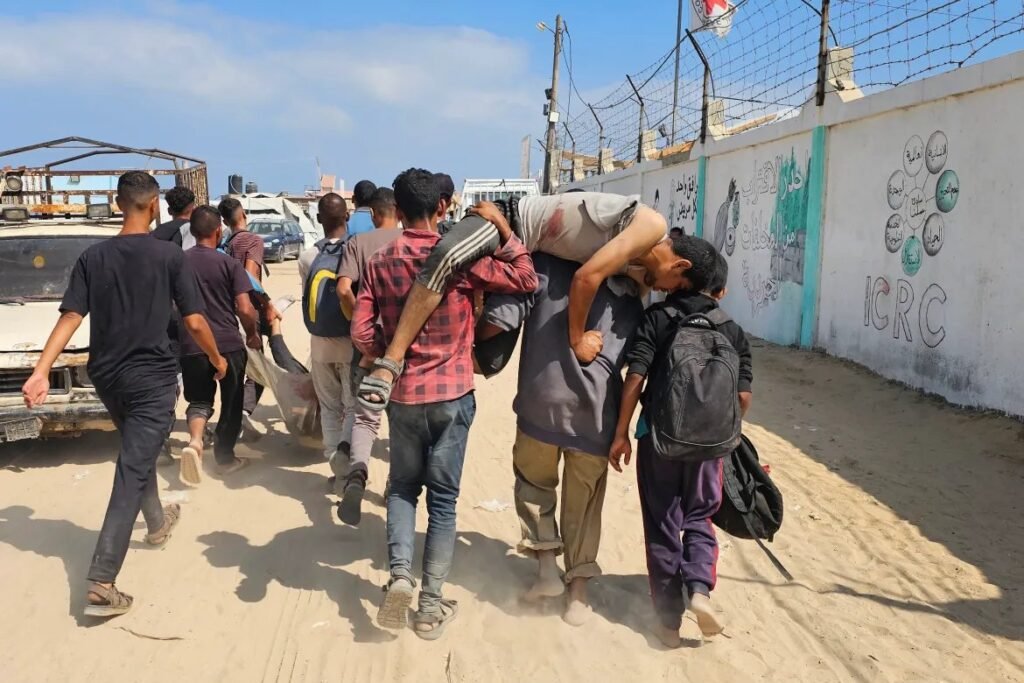
Gaza Herald — After more than two years of unrelenting destruction, Palestinians in Gaza say the latest UN resolution has done little to ease their suffering, deepening fears that the world is still unwilling to confront the humanitarian catastrophe Israel has created. With the enclave facing mass displacement, widespread hunger, and the collapse of every essential service, residents hoped international action would finally prioritise their survival. Instead, many feel the UN has once again chosen political manoeuvring over protecting a population pushed to the edge of existence.
Instead, residents say the UN Security Council’s approval of a US-sponsored resolution on Monday shows that the lives of Palestinians remain secondary to political considerations. Abu Malek Jerjawi, a displaced resident, said he had hoped the international body would focus on rebuilding Gaza and expanding humanitarian aid, but was met with disappointment. He warned that more than a million people still need safe shelter while Israel continues blocking even the most basic supplies. He added that the resolution is “deeply discouraging” because it ties humanitarian relief to political conditions, turning survival into a bargaining chip.
The resolution, known as UNSC 2803, endorses a US-designed plan for a foreign governing administration in Gaza and deploys an international force tasked with overseeing the disarmament of Palestinian resistance groups. It grants broad authority to use “all necessary measures” to carry out its mission, raising fears that critical support for civilians will be conditioned on political developments that could take years to achieve. Residents argue this approach effectively sidelines their immediate needs for shelter, medicine, and food in favour of political engineering.
Satellite imagery analysed by the United Nations Satellite Centre (UNOSAT) shows the staggering scale of the destruction: as of October, around 81 percent of Gaza’s structures were either obliterated or damaged after more than two years of continuous bombardment. Over 198,000 buildings have been affected, leaving the majority of the population in makeshift shelters, crowded schools, fragile tents, or the ruins of their homes.
For many Palestinians, the crisis has stripped away any remaining sense of security. Nermin Basel, a mother who fled early in the war, said she can only believe in any international plan if it guarantees displaced families the right to return. She explained that those who fled did so out of desperation, not choice, and that any agreement claiming to promote peace must start with restoring Palestinians to their homes. Before Israel closed the Rafah crossing in May 2024, more than 100,000 Palestinians had left the territory; since then, returns have become impossible.
The 20-point plan announced in September 2025 by Donald Trump and Benjamin Netanyahu has been heavily criticised by Palestinians and human rights advocates for excluding local voices and undermining Palestinian political rights. Basel said such plans feel less like steps toward peace and more like attempts to erase Palestinian claims to their land. She argued that no proposal can hope to establish stability unless it ends the occupation and affirms Palestinian rights and sovereignty.
The creation of an international force has raised further alarm. Jerjawi warned that rather than defusing tensions, the deployment risks triggering new confrontations. Palestinian resistance groups, including Hamas, rejected the resolution outright, affirming that they will not surrender their weapons as long as the occupation persists. They insist that armed resistance is protected under international law and that disarmament is a national issue linked directly to ending the occupation, establishing a Palestinian state, and securing self-determination.
Jerjawi said he had always believed that the UN’s purpose was to prioritise peace and security, yet the mandate in this resolution appears capable of reproducing violence rather than preventing it. For many in Gaza, the resolution represents another example of how international decisions are made without considering the lived realities of Palestinians who continue to endure displacement, loss, and immense suffering.
In Gaza, the distance between policy and reality remains a matter of life and death. Residents say any resolution that ignores the root causes of their suffering and prioritises political conditions over basic human survival cannot bring peace. As long as Palestinians are excluded from shaping their own future, and as long as their rights remain negotiable, Gaza’s people fear the world will continue to manage the crisis rather than resolve it. For them, genuine recovery begins only when the siege ends, accountability is enforced, and Palestinians are finally allowed to reclaim their homes, their land, and their right to live with dignity.