Gaza Herald_ The Palestinian media landscape has never witnessed the level of systematic targeting it has endured over the past two years of Israel’s war on the Gaza Strip.
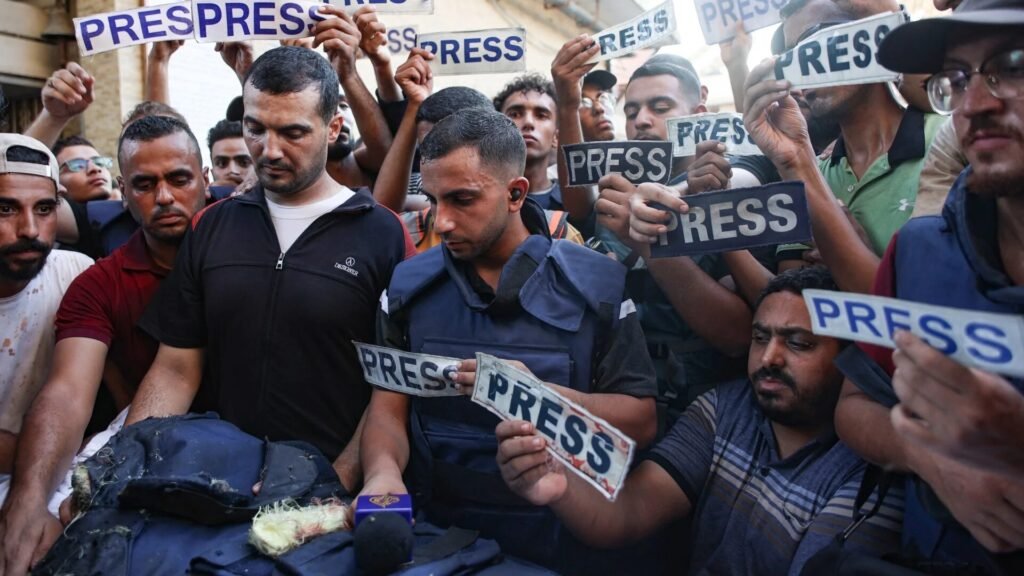
From the earliest hours of the assault, journalists’ lenses and reporters’ voices were directly in the line of fire, an unmistakable attempt to obscure the truth and prevent the Palestinian narrative from reaching the world.
According to data from the Government Media Office, 254 journalists have been killed by direct strikes and targeted assassinations, while media headquarters have been destroyed and press institutions restricted—an unprecedented campaign aimed at crippling Palestinian journalism at its core.
Against this grim backdrop, the case of three journalists—Nidal Suheil Al-Wahidi, Haitham Jamal Abdel-Wahed, and Ahmed Issam Al-Agha—stands out as one of the most complex and mysterious. Since their arrest on October 7, 2023, their trail has completely vanished, and their fate remains unknown. Their disappearance has become a stark symbol of Israel’s policy of enforced disappearance targeting journalists in Gaza.
Press Protection Center Sounds the Alarm
The Palestinian Center for the Protection of Journalists has called on the United Nations, the International Federation of Journalists, and international fact-finding missions to urgently intervene and reveal the fate of the missing journalists.
The center stressed that Israel is holding 26 Palestinian journalists under ambiguous conditions, withholding information about their detention sites and denying families any communication or knowledge of their health status.
Testimonies from journalists recently released by Israel reveal severe abuses inside prisons, including torture, denial of medical care, and harsh detention conditions, placing Israeli authorities under serious accusations of violating international law.
The center’s statement emphasized that the targeting of journalists constitutes a blatant breach of the Geneva Conventions and violates Article 9 of the International Covenant on Civil and Political Rights. It also amounts to a crime against humanity under the Rome Statute of the International Criminal Court, especially in light of the systematic campaign of targeting and enforced disappearance.
The First Hours of War: The Beginning of the Disappearance
At dawn on October 7, the three journalists headed with colleagues to the Erez crossing in northern Gaza to cover fast-moving developments on the ground.
Their presence coincided with intense Israeli bombardment that struck the area, killing several civilians and journalists. Amid chaos, shelling, and mass arrests, the traces of Nidal, Haitham, and Ahmed vanished, marking the start of a prolonged mystery that continues to this day.
Despite the release of dozens of Gaza detainees under the ceasefire agreement more than a month ago, the three journalists were never mentioned among the freed prisoners, and their families have received no official information. This has deepened fears that they may have been subjected to abuse or are being held in undisclosed facilities.
Profiles of the Forcibly Disappeared Journalists
Nidal Suheil Al-Wahidi
A field journalist known for his courage in covering border areas and broadcasting scenes of strikes and destruction directly from the ground. He worked with local media institutions and was distinguished by his active presence in the field. He was arrested near the Erez crossing while covering events, and no official information about him has surfaced since.
Haitham Jamal Abdel-Wahed
One of the most prominent journalists in northern Gaza. He consistently documented Israeli assaults on border homes and was known for his calm approach and ability to access dangerous areas. He was arrested the same day near Erez and has been forcibly disappeared for more than two years, with no indication of his fate.
Ahmed Issam Al-Agha
A field photographer who documented the aftermath of strikes and violations in eastern Gaza. He contributed to impactful humanitarian and field reports. He was arrested by Israeli soldiers while covering events, and communication with him was completely severed since the morning of October 7.
Despite local and international appeals, the fate of the three journalists remains unknown, leaving their families in a painful state of waiting, caught between hope and fear.
As Israel continues its policy of silencing journalists and targeting media institutions, the central question remains:
Will the fate of Nidal, Haitham, and Ahmed finally be revealed, or will their disappearance stand as yet another attempt to bury the truth?