Gaza Herald_ As Gaza endures yet another chapter of its long tragedy, the fragile truce brokered last month teeters on collapse. Israel’s repeated violations, relentless bombardments, and forced displacement campaigns have once again plunged the Strip into chaos, even as Hamas continues to uphold its end of the agreement under the most impossible conditions.
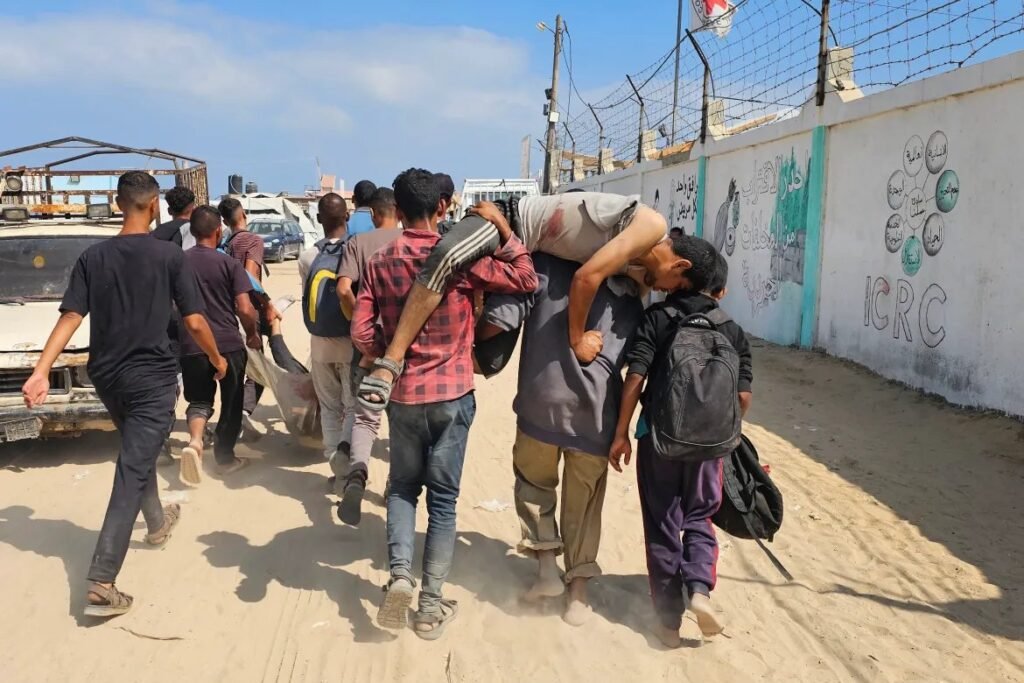
According to Gaza’s civil defense, Israeli forces have intensified pressure on northern Gaza residents, ordering tens of thousands of Palestinians to evacuate to the central and southern regions of the enclave. The scale of displacement, officials warn, risks triggering an irreversible humanitarian catastrophe.
Civil defense spokesperson Mahmoud Basal told reporters on Tuesday that Israel’s plan to forcibly relocate nearly one million people from Gaza City and its northern districts is “not an evacuation but a continuation of the ethnic cleansing project.” He added that more than 85 percent of homes and infrastructure in Gaza City’s ash-Shuja’iya and al-Tuffah neighborhoods have already been destroyed, along with 70 percent of the az-Zeitoun, al-Sabra, Jabalia an-Nazla, and Jabalia al-Balad areas.
“These are not military zones,” Basal said. “They are neighborhoods, schools, hospitals, and homes. Israel has turned them into uninhabitable ruins to make the north permanently empty.”
He noted that the so-called “humanitarian zone” where Israel wants to concentrate displaced civilians covers no more than 12 percent of Gaza’s total area, a fraction of the space needed for Gaza’s more than two million residents. “This means forcing two million Palestinians into an area smaller than a single Gaza City district without food, water, or sanitation. It’s a death trap presented as a safe zone,” he added.
Hamas Upholds Commitments Despite Collapse of Infrastructure
While Israel continues to bulldoze neighborhoods and bomb residential zones, Hamas has remained committed to the ceasefire terms. Despite limited equipment, destroyed infrastructure, and severe shortages of fuel and supplies, the movement has been working to maintain internal stability and to coordinate with humanitarian organizations to deliver aid to Gaza’s civilians.
In statements and on-the-ground reports gathered by Gaza Herald, Hamas officials and local administrators have underscored their ongoing efforts to fulfill all obligations under the truce, including the search for missing Israeli soldiers’ bodies, even in areas still littered with unexploded bombs and rubble.
“Hamas does not have cranes or advanced recovery vehicles, yet its teams are digging by hand and using basic machinery to locate and retrieve remains, Palestinian and Israeli alike,” one civil defense source explained. “This shows commitment to the agreement despite the complete collapse of living conditions.”
Mahmoud Basal, the civil defense spokesperson, emphasized that Hamas’s rescue and civil protection teams “are operating with courage and discipline, despite the total absence of international support.” He added that Israeli forces continue to obstruct the entry of essential heavy machinery needed to remove debris and recover the thousands of bodies still trapped underneath.
“The issue of missing persons is a moral, humanitarian, and national duty,” Basal said. “But without the tools to dig, every rescue attempt is a struggle against time and suffocation.”
Hamas Protects Aid — Israel Sabotages It
Parallel to its search and rescue efforts, Hamas has also taken steps to secure humanitarian aid convoys and distribution sites. Contrary to U.S. and Israeli propaganda that paints Hamas as a “looter” or “obstructor” of aid, local reports and UN data show that the movement has brought a degree of order to an otherwise chaotic humanitarian scene.
Since Hamas’s return to managing internal security in the Strip, the rate of looting at aid distribution points has dropped from around 80 percent under Israeli military oversight to less than 5 percent, according to multiple international agencies.
Hamas’s internal police and community committees have been deployed to escort aid trucks, prevent black-market resale, and ensure that supplies reach civilians in hospitals and displacement shelters.
“These young men, many of whom have lost family members themselves, are standing unarmed beside aid convoys to protect food for the hungry,” said a relief volunteer in Deir al-Balah. “Meanwhile, Israel uses drones and tanks to bomb the same roads those trucks travel.”
Despite the chaos, Hamas has attempted to maintain communication channels with UN agencies, the Red Crescent, and local NGOs. “They are doing what they can with what little they have,” a UN aid worker said on condition of anonymity. “It’s not perfect, but without Hamas’s presence, aid distribution would collapse entirely.”
U.S. Complicity and the War of Narratives
Even as the humanitarian crisis deepens, the United States continues to enable Israel’s collective punishment of Gaza while spreading disinformation to justify it.
A recent video shared by an official U.S. account purported to show Hamas fighters looting an aid truck in Gaza. However, scrutiny revealed that the footage was heavily edited, and the accompanying text merely said the men were suspected of being Hamas members.
The drone footage, captured by American surveillance equipment, managed to track a single aid truck but not the daily Israeli bombings, executions, and bulldozing of cemeteries across Gaza.
Observers also pointed out that the video’s stated location, northern Khan Younis, lies adjacent to Israeli military positions and is controlled by the militia of Hossam Al-Astal, who operates under Israeli protection. “If looting happened there, it wasn’t under Hamas’s control,” one journalist noted.
The U.S. narrative further crumbles when compared to international data: while American and Israeli officials claim that 600 trucks of aid enter Gaza daily, UN and local monitors confirm that the real number rarely exceeds 145 trucks, insufficient to feed even a fraction of the displaced population.
This campaign of disinformation seeks to obscure Israel’s starvation policy, one that uses hunger as a weapon to break Gaza’s resistance.
The Human Cost Under Rubble and Silence
As the propaganda war rages online, Gaza’s reality remains unchanged: bodies still lie beneath the rubble, and survivors dig for them with hammers and bare hands.
Gaza’s civil defense estimates that around 10,000 Palestinians remain buried under collapsed buildings, their retrieval impossible due to the destruction of infrastructure and Israel’s ban on heavy machinery. Among them are several Israeli captives killed during the bombing whose remains Hamas continues to search for, fulfilling its obligations, even as Israel blocks recovery efforts.
For the people of Gaza, this grotesque imbalance defines their existence. When Israeli or American officials speak of “humanitarian concern,” they refer only to Israeli captives while tens of thousands of Palestinians are left uncounted, unburied, and forgotten.
“This is a question of humanity,” Basal said. “A human being is a human being, whether Palestinian or Israeli. But Israel and the international system have lost that sense of equality.”
Two Realities, One Occupation
The contrast could not be clearer. On one side stands Israel armed, emboldened, and funded by Washington, continuing its starvation policy, displacing civilians, and demolishing entire neighborhoods while lying about aid delivery. On the other side stands Hamas, a besieged movement with no heavy machinery, no air power, no external funding, and no international allies struggling to uphold the truce, maintain order, and deliver food to its people.
While American drones document “suspected looters,” they ignore the Israeli bulldozers flattening homes and cemeteries. While U.S. officials demand that Hamas locate the bodies of missing Israeli soldiers, they say nothing about the tens of thousands of Palestinian corpses decaying under the ruins Israel created.
This is not a war between equals. It is the continuation of a system built on occupation, impunity, and Western complicity.
And yet, amid all this, Gaza’s people and the movement that represents them persist. They dig for the dead with hammers, protect food with their bare hands, and cling to the idea of life and dignity even when the world has abandoned them.
As one elderly man in Khan Younis said while watching a team of volunteers clear debris from a bombed-out school: “Israel destroys everything. But we still have our hands and our will.”