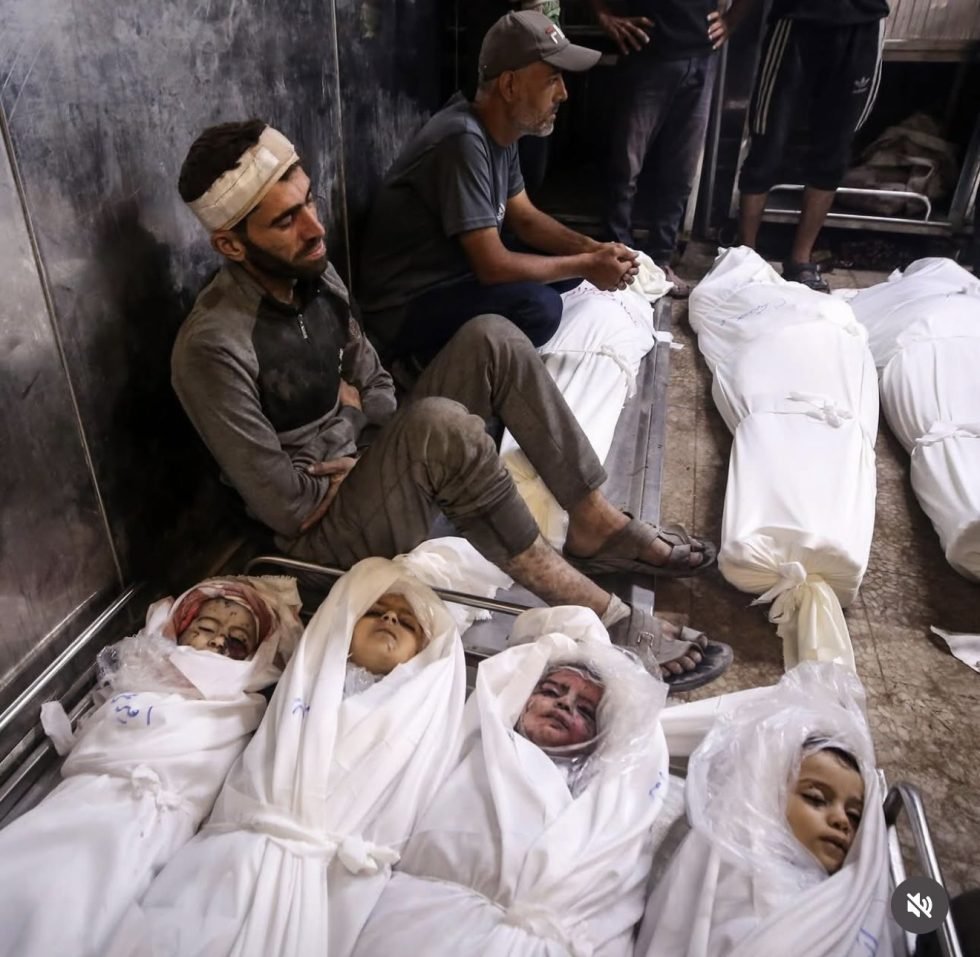
Gaza Herald_ Three hundred and three days into Israel’s genocidal onslaught on the people of Gaza, the Israeli occupation returned to Khan Younis the bodies of 89 Palestinians in a shipping container. The living, desperate to identify their loved ones, were met instead with the embodiment of mass death. Decomposed beyond recognition, the corpses retained none of their histories.
Were these the bodies of tortured detainees? Were they corpses stolen from bulldozed graves in Gaza? The occupation refused to say. Without the means to conduct DNA testing, Palestinian officials were unable to identify the bodies. They had no choice but to bury them—bag by bag—in a single large grave near Nasser Hospital.
Euro-Med Monitor has documented several such cases. Israeli forces were seen taking dozens of bodies from graves and streets surrounding Al-Shifa Medical Complex and the Indonesian Hospital in northern Gaza. Similar accounts emerged from across the Strip. In the aftermath of the ceasefire, as people returned to areas the Israeli army had withdrawn from, they found further evidence of mass graves.
According to Euro-Med, “Concerns about organ theft from the corpses were brought up by Euro-Med Monitor, which cited reports from medical professionals in Gaza who quickly examined a few bodies after their release. These medical professionals found evidence of organ theft, including missing cochleas and corneas as well as other vital organs like livers, kidneys, and hearts.”
Zionist brutality reaches beyond death. For years, the occupation’s war machine has claimed the bodies of Palestinian martyrs—not only holding them hostage and withholding them from their families, but also using them to perpetuate schemes of organ theft and trafficking. Israeli doctors, in direct violation of international law, have stolen Palestinian organs and even skin.
The Zionist entity’s expansionist approach to autopsies stands in clear violation of established medical ethics. The Nuremberg Code and the Declaration of Helsinki—both foundational to modern medical research- establish consent as the cornerstone of any procedure involving human subjects. This framework extends to the dead.
In 2010, the World Health Organization issued guiding principles on organ transplantation rooted in the donor’s consent, whether living or deceased. Similarly, the United Nations’ International Humanitarian Law and the Geneva Conventions (Rules 113 and 114) mandate the dignified handling of the dead: no mutilation, no delay in return, and the preservation of bodily integrity.
Israel routinely disregards these principles by labeling Palestinian martyrs as “terrorists” to justify biomedical abuses.
‘Organs Were Sold to Anyone’
Testimonies of Israeli organ theft from Palestinian bodies date back more than three decades. In 1990, Dr. Hatem Abu Ghazaleh, former chief health official for the West Bank, told reporters that during the First Intifada, “there are indications that for one reason or another, organs, especially eyes and kidneys, were removed from the bodies during the first year or year and a half.”
Yet, as so often, Palestinian testimonies alone were dismissed by Western media. It wasn’t until American anthropologist Nancy Scheper-Hughes began investigating “organized transplant tours run by underworld brokers” in Israel that the story gained international attention.
Scheper-Hughes co-founded Organs Watch in 1999, an organization monitoring the global trade in human organs. Her research led her to Israel, where she uncovered evidence of widespread organ theft. In 2001, testifying before a U.S. Congressional subcommittee, she confirmed that human rights groups in the West Bank had complained about Israeli pathologists stealing tissue and organs from the bodies of Palestinian martyrs.
Swedish journalist Donald Boström later published a comprehensive investigation describing a “troubling history of abuse of dead bodies” brought to the Israeli National Institute of Forensic Medicine, Abu Kabir, built atop an ethnically cleansed Palestinian village.
For much of this period, the Institute was run by Dr. Yehuda Hiss, who admitted to harvesting skin, bones, cardiac valves, corneas, and other tissues during autopsies without family consent. He even described returning bodies with eyelids glued shut to conceal missing eyeballs.
His protégé, Dr. Chen Kugel, later exposed these abuses to Israeli authorities, prompting a short-lived investigation. Kugel revealed that organs were taken from all types of bodies, but thefts from Palestinians were easier to conceal. “If there were any complaints from [Palestinian] families,” he said, “they were the enemy, so of course no one would believe them.”
Hiss was investigated twice, in 2002 and 2005, and was accused of the thefts but was never truly held accountable. After the second investigation, he was promoted to a higher salary.
Kugel later told Scheper-Hughes, “Organs were sold to anyone; anyone who wanted organs just had to pay for them.” Hearts, brains, and livers were sold for research, demonstrations, and medical drills. Entire sets of organs could be purchased for about $2,500.
Israeli officials dismissed these claims as “antisemitic,” yet the perpetrators themselves spoke openly. Hiss justified his crimes as “patriotic service” to the nation, echoing a chilling logic of supremacy.
Extremist rabbis reinforced this ideology. In 1996, Rabbi Yitzhak Ginsburgh, a prominent Chabad-Lubavitch leader, asked: “If a Jew needs a liver, can you take the liver of an innocent non-Jew passing by to save him? The Torah would probably permit that. Jewish life has infinite value.”
Former Institute employee Meira Weiss, in her 2014 book Over Their Dead Bodies, confirmed that during the First Intifada, the Israeli army allowed organ harvesting from Palestinians under a “mandatory autopsy regulation.” Many staff referred to that era as “the good days,” when harvesting was done freely.
‘Tracing the Missing’
Israel’s theft of Palestinian organs is part of a broader policy of withholding Palestinian bodies, turning the dead into hostages. Many are buried in secret “cemeteries of numbers” inside military zones, unmarked and inaccessible to families.
When bodies are returned, they are often decomposed, dismembered, or frozen beyond recognition. In 2016, Dr. Saber Al-Aloul described receiving martyrs’ bodies kept at –35°C, making a proper autopsy impossible. Under siege conditions, Palestinian doctors have resorted to CT scans to document violations.
According to Doctors Without Borders, tracing the missing and identifying the dead is essential to uphold human rights. Yet under occupation, even death does not guarantee dignity.
In 2019, Israel’s Supreme Court ruled that the military could hold Palestinian bodies as “bargaining chips.” An 83-page report by the Jerusalem Legal Aid and Human Rights Center, titled The Warmth of Our Sons, noted that Israel and Russia are the only two states legally permitting such practices.
Palestinian writer and revolutionary Walid Daqqa, imprisoned for 38 years, died in custody in 2024 after being denied medical release. His body remains withheld. The Israeli High Court justified this as leverage for future exchanges.
In October 2024, Israeli forces seized the body of Yahya Sinwar, Hamas’s military and political leader, after killing him in battle. They conducted a full autopsy without family consent, parading details of his final days to the world.
Even the bodies of children are held hostage. According to Defense for Children International, as of 2024, Israel retains the remains of at least 38 Palestinian children.
Now, as the ceasefire takes effect, Gaza’s survivors are still searching under the rubble for loved ones, some alive, many not. Others wait for bodies to be returned on trucks, frozen and nameless.
When the occupation is finally held accountable for its war crimes, it must be forced to answer for every missing body and every stolen organ.