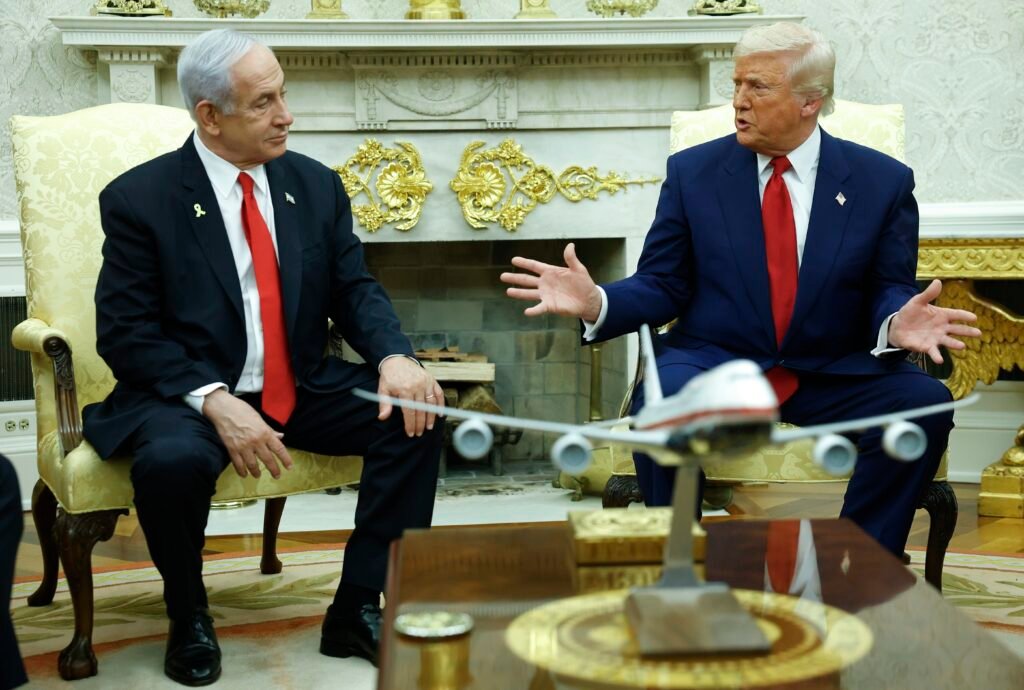
Gaza Herald — U.S. President Donald Trump has unveiled a sweeping new proposal for Gaza, presenting it as a roadmap to end the war and reshape the territory’s future. However, the plan, which centered on foreign oversight, prisoner exchanges, and the controversial possibility of Tony Blair leading Gaza’s transitional administration, has triggered strong criticism and fears of renewed colonial-style governance being imposed from abroad.
Ceasefire and Prisoner Release
At the heart of Trump’s proposal is a promise of an immediate ceasefire and a phased withdrawal of Israeli forces once both sides accept the plan. Within 72 hours of Israel’s acceptance, all Israeli captives, both alive and dead, would be released. In exchange, Israel would free 250 Palestinians serving life sentences and 1,700 detainees arrested since October 7, including women and children.
Security and Governance Under Foreign Control
The plan would declare Gaza a demilitarized zone. Hamas members willing to surrender their weapons and renounce resistance would receive amnesty, while others could leave the Strip. Trump envisions a transitional technocratic committee managing Gaza, overseen by a new “Peace Council” chaired by himself and supported by international figures such as Tony Blair.
Humanitarian Aid and Reconstruction
The proposal guarantees immediate large-scale humanitarian aid: water, electricity, hospitals, bakeries, and restored road access. Relief operations would be managed by international organizations such as the UN and the Red Cross, without interference from either Israel or the Palestinian authorities. The Rafah crossing would follow a mechanism agreed in January 2025.
Economic Development Vision
Trump also calls for an ambitious economic recovery plan. It would establish a special economic zone with investment incentives, tax privileges, and international backing. Supporters argue this could create jobs and rebuild shattered infrastructure, though critics warn it risks prioritizing profit-driven projects over Palestinian self-determination.
Backlash Against Tony Blair’s Role
The rumored appointment of former UK Prime Minister Tony Blair as transitional leader has drawn fierce backlash. Hamas political bureau member Husam Badran stressed that Palestinians “are not minors needing guardianship” and that decisions about Gaza must come from internal national consensus. He added that Blair should face trial for his role in the 2003 U.S.-UK invasion of Iraq, not oversee Gaza’s future.
Franco-Palestinian MEP Rima Hassan said: “Decolonizing Palestine means decolonizing it from ALL its colonizers.” Greece’s former finance minister Yanis Varoufakis described Blair’s possible role as “a war criminal running the site of Israel’s genocide on behalf of Trump in the finest tradition of white settler colonial projects.”
Chris Doyle, director of the Council for Arab-British Understanding, told Times Radio that Blair’s Middle East record is “not one to be proud of” and warned that Palestinians have no trust in him. UN Palestine expert Francesca Albanese wrote bluntly: “Tony Blair? Hell no.” Historian William Dalrymple added with sarcasm: “Given Blair’s superb record in the Middle East, what could go wrong?”
Trump’s proposal for Gaza is presented as bold but deeply complicated. It envisions a transformation of the territory’s governance, security structure, and economy. Many observers see it as a veiled American effort to impose control over Gaza, particularly with the inclusion of a foreign stabilization force, a measure considered both politically sensitive and nearly impossible to enforce.
For many Palestinians, the plan’s call to demilitarize Gaza and dismantle Hamas is viewed as an unacceptable condition, one that could be seen as surrender. Hamas has yet to formally respond, leaving the future uncertain.
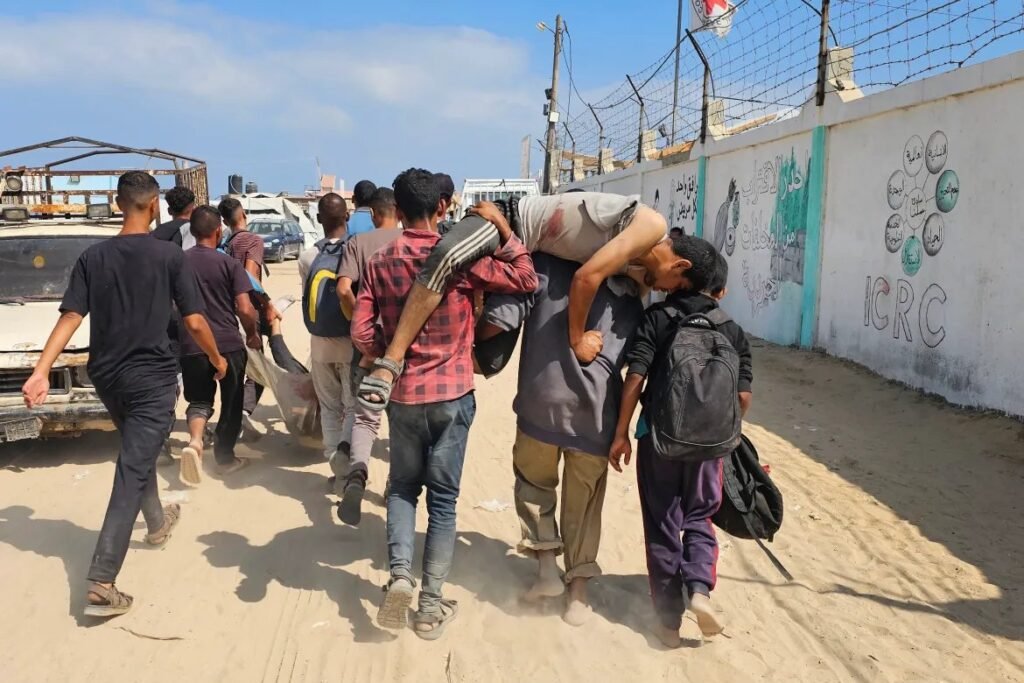
Meanwhile, skepticism dominates public opinion on the ground. While policymakers in Washington debated the proposal, Israel pressed ahead with its bombing campaign.
Even so, there remains a cautious hope for a truce that would secure the withdrawal of Israeli forces, the release of Palestinian detainees, and an assurance against renewed aggressive elements that remain unclear in the current framework.
Trump’s Gaza proposal, while wrapped in promises of peace, reconstruction, and investment, is widely seen by Palestinians and international critics as an attempt to impose foreign control over a devastated people. For Gaza’s residents who have endured nearly two years of bombardment, famine, and mass displacement, the idea of Tony Blair or any external figure administering their lives is a reminder of how little their voices are heard. As one Palestinian activist remarked, “Any plan for Gaza without Gaza is another form of occupation.”
Reading Trump’s so-called “Gaza plan,” it becomes clear this is not about ending the war or building a dignified future for Palestinians. It is about rebranding foreign control and imposing a new colonial-style guardianship over a people already devastated by siege, bombardment, famine, and displacement. The promises of ceasefire, prisoner releases, and reconstruction are nothing but window dressing for a project of domination.
Foreign Tutelage with Old Faces
The idea of installing Tony Blair or any foreign “Peace Council” to oversee Gaza is an insult. Palestinians are not minors in need of guardianship. Blair, in particular, is a symbol of destruction in our region, complicit in the 2003 invasion of Iraq and in policies that fueled endless bloodshed. To bring him back as a supposed “savior” is an obscenity.
Disarmament Means Surrender
For Palestinians, the demand to demilitarize Gaza translates into one word: surrender. How can people under occupation be asked to give up their only means of resistance while Israeli jets continue to rain bombs on their homes? That is not peace; it is subjugation. Resistance is not a luxury; it is survival.
Reconstruction Without Sovereignty Is a Lie
Yes, we need water, electricity, bread, and hospitals. But any reconstruction plan that strips Palestinians of sovereignty is nothing more than crisis management. What good are new roads if Israeli tanks can demolish them in a day? What meaning does “international aid” have if Palestinians themselves are denied the power to decide their future?
The Bottom Line: No Gaza Without Palestinians
Talk of “special economic zones,” “foreign investments,” or “comprehensive peace” may sound attractive, but without freedom, it is hollow. Any plan that does not begin with ending the occupation, releasing prisoners, and guaranteeing Palestinian self-determination is fraudulent.
As one activist put it: “Any plan for Gaza without Gaza is just another form of occupation.”
That is the truth, no matter how carefully it is dressed up in promises.