Gaza Herald- Gaza City, once a vibrant symbol of Palestinian resilience and urban life, is now being systematically stripped of its identity as Israeli warplanes intensify their campaign against the Strip’s remaining residential towers. These high-rises, which once housed families, businesses, clinics, and media offices, are being reduced to rubble in a deliberate attempt to erase both the physical landscape and the collective memory of Gaza’s people. What was once a city of towers by the sea has become a graveyard of concrete and shattered lives.
Once remembered across Palestine and the Arab world for its skyline of high towers overlooking the Mediterranean, Gaza City now lies scarred and faceless. The relentless Israeli campaign has turned its landmarks into rubble, erasing not only homes but the very image of the city.
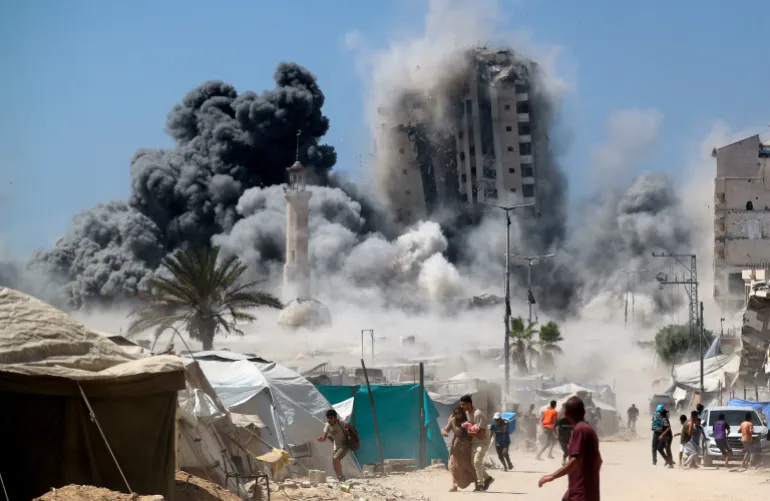
After weeks of devastating assaults on neighborhoods in the north, east, and south, Israeli warplanes on Friday bombed the Mushtaha Tower near Ansar Junction, one of the few remaining high-rises still standing. For months, it had provided shelter for thousands of displaced families scattered by the genocide. Despite partial damage, the tower had become a symbol of resilience for residents who clung to the hope of stability.
Towers in the Crosshairs
On Friday, residents received one of the familiar ominous calls: an evacuation order from the occupation. Within minutes, hundreds of men, women, and children rushed into the streets. Moments later, Israeli missiles reduced the tower to rubble.
The building’s administration immediately denied Israeli claims that the site contained military infrastructure, stressing that it was entirely residential and inhabited only by displaced families. But Israel demolished it regardless, later justifying the strike by alleging Hamas activity inside, an accusation repeated countless times before against purely civilian structures.
Palestinian survivor Khalil Obeid described the horror: “Dozens of families were inside when we were forced to run barefoot into the street. Everything collapsed in an instant.”
Only hours later, the Makkah Tower, one of Gaza’s most recognizable landmarks, was also evacuated under Israeli orders. Hundreds fled carrying children, essential documents, and whatever they could hold. One displaced mother, who had already lost her home in Shujaiya, told our correspondent: “We thought this tower would give us stability, even the children felt it was a home again. But Israel left us homeless once more.”
A Policy of Systematic Destruction
Human rights groups and analysts stress that Israel’s assault on Gaza’s remaining towers is more than military targeting — it is a deliberate policy of erasing the city’s identity. These towers, many of which included offices, clinics, shops, and media outlets, symbolized Gaza’s modern urban life. Their destruction strips the Strip not only of housing but also of essential services, collective memory, and social fabric.
Since October 2023, dozens of high-rises have been destroyed across Gaza City alone, according to rights organizations. The pattern is not new. In 2014, Israel leveled 11 prominent towers, including Al-Basha and Al-Dhafar. In May 2021, it targeted Al-Shorouq, Al-Jawhara, and Al-Jalaa — the latter housing international media offices.
By flattening towers, Israel sends two messages: first, to continue the collective punishment that has already destroyed more than 80 percent of Gaza’s housing; and second, to intimidate residents, destroy what little shelter remains, and accelerate forced displacement.
Erasing the City’s Memory
Human rights activist Mohammed Amin notes that Israel deliberately targets towers because they are more than homes — they are urban landmarks tied to Gaza’s collective memory. “These buildings carried the social and economic life of the city. Destroying them is an attempt to erase Gaza’s past and present,” he said.
Since August 11, Israeli forces have demolished more than 700 homes in Gaza City’s neighborhoods as part of their broader campaign to occupy and empty the city. The ongoing destruction leaves families drifting from tent to tent, carrying fragments of their lives without walls to shelter them.
Legal experts emphasize that such targeting of civilian towers has no proven military necessity, making it a clear violation of international law. Instead, it represents collective punishment, and in its scale and intent, genocide.
The Crime Beyond the Rubble
What Israel seeks to destroy is not only Gaza’s physical structures but its existence as a living city. Each tower reduced to rubble represents not just homes lost, but a deliberate erasure of place, identity, and memory.
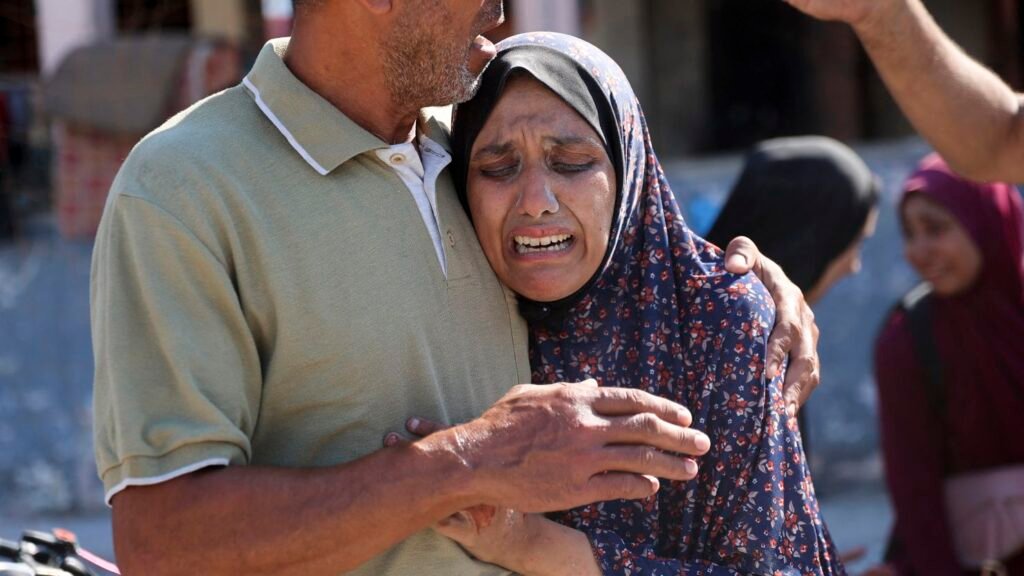
Scenes of children bewildered at their repeated displacement and women weeping over the rubble tell the story: this is a war aimed at uprooting a people. Yet, for every tower that falls, the memory of Gaza’s residents endures, stronger than the rubble, bearing witness to crimes committed against them, and holding on to their right to life, return, and survival.
The destruction of Gaza’s towers goes far beyond military aggression; it is a war against memory, identity, and existence itself. Each demolished building represents not just lost shelter, but the erasure of a community’s heartbeat, a family’s history, and a city’s face. While Israel seeks to turn Gaza into faceless ruins, the resilience of its people ensures that every fallen tower will remain a testament to survival, dignity, and the enduring struggle for justice and return.