GazaHerald – The Israeli occupation army continues to issue evacuation threats to the residents of Gaza City, home to nearly one million people. Civilians are ordered to abandon their homes and head south to the so-called “humanitarian zone” in Al-Mawasi, Khan Younis. In reality, Al-Mawasi is a narrow strip of land already overwhelmed by hundreds of thousands of displaced Palestinians from Rafah and Khan Younis, suffering suffocating overcrowding and the absence of essential services.
Prime Minister Benjamin Netanyahu, wanted by the International Criminal Court, warned the people of Gaza City to “leave now,” a direct threat coupled with promises of intensified destruction. The occupation army’s spokesperson, Avichay Adraee, reinforced the order, directing residents from Gaza City’s old neighborhoods and the Al-Tuffah district to move via the Al-Rashid axis to Al-Mawasi, declaring that the military was “determined to operate in Gaza with great force.”
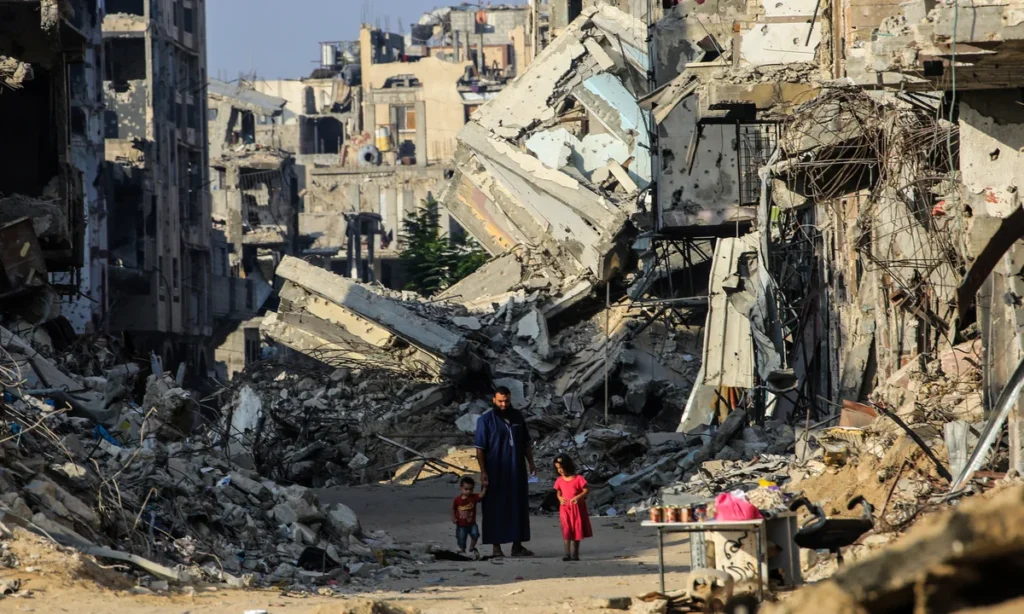
On the ground, the army has launched relentless operations to accelerate the displacement plan. Since April, Israeli forces have pushed into eastern Gaza City, demolishing neighborhoods in Al-Zaytoun and Al-Sabra while advancing towards Jabalia and Al-Nazla in northern Gaza. Explosive-laden robots have been deployed to raze residential buildings. Entire city blocks in Sheikh Radwan were reduced to rubble, forcing families into the streets.
The strategy escalated with the systematic destruction of high-rise towers. Five residential complexes, sheltering more than 4,100 people, were demolished within days. Over 350 tents hosting displaced families were burned. The targeting has focused on dense civilian hubs, markets, residential squares, and makeshift shelters in a clear attempt to force a mass exodus southward.
Analysts warn that these evacuation orders constitute a plan of mass forced displacement, part of a broader Israeli-American project to depopulate Gaza. The south, already collapsing under the weight of displacement, cannot absorb hundreds of thousands more, raising the specter of an unprecedented humanitarian catastrophe.
Defiance in the Rubble: Gaza City Residents Reject Displacement
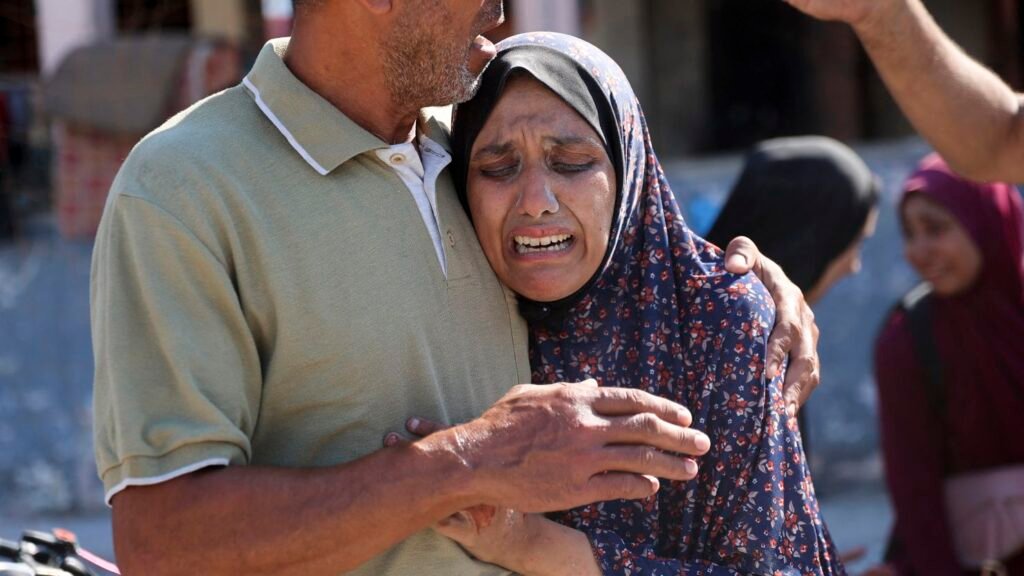
Despite the unrelenting bombardment, destruction, starvation, and psychological warfare, the people of Gaza City have refused to comply. Instead, they have taken to the streets in open defiance.
A massive symbolic protest, known as the “Shroud March,” brought thousands together under the slogan “Displacement from Gaza to the sky only.” Wrapped in burial shrouds, men, women, and children marched through Gaza City to declare their readiness to die in their homeland rather than be expelled. Local leaders, doctors, and community dignitaries joined, led by Munir Al-Barash, Director General of Gaza’s Ministry of Health.
The march embodied Gaza’s collective refusal to relive the bitter experience of displacement. Only a year ago, residents were ordered south under fire, only to be hunted, bombed, and starved there too. Many now insist on staying close to their homes, even if it means sleeping in a torn tent or under the ruins of a half-demolished building.
“Death here is more merciful than displacement,” said Munira Al-Musallami, a 62-year-old widow who lost her three sons in the war and now lives with her daughters-in-law and 11 grandchildren in a single tent. “Every day, we live between fear and hunger, between waiting and loss. If they force us out, we will still die on the road or in the so-called safe zone. Better to die in Gaza.”
The Shroud March and the growing acts of defiance are a message to Israel and the world: Gaza will not be erased.
The Myth of Safety: Al-Mawasi as a Death Trap, Not a Haven
Israel continues to market Al-Mawasi as a “safe humanitarian zone.” But testimonies from residents, officials, and aid workers expose the claim as a dangerous illusion.
Before the war, Al-Mawasi’s 15 square kilometers were home to fewer than 20,000 people. Today, more than half a million displaced Palestinians are crammed into the barren agricultural land, with no infrastructure to sustain them. Makeshift latrines overflow, clean water is scarce, disease spreads rapidly, and there are no functioning hospitals, schools, or electricity.
“Al-Mawasi is unlivable,” said Tarek Othman, a displaced resident. “We have no water, no sewage system, no shelter. This is not safety; this is slow death.”
Ismail Thawabta, Director General of the Government Media Office in Gaza, noted that Al-Mawasi itself has been bombed 109 times, killing more than 2,000 people. “These figures alone prove Israel’s claims false. Al-Mawasi is no refuge, it is a killing ground,” he told Al Jazeera.
For many, displacement south has become a sentence of hunger, disease, and exploitation. Families report being forced to pay exorbitant rent for patches of dirt, while thousands more remain without any cover at all. “There isn’t a single empty square meter left,” said Maher Malaka, who sent his son to check Al-Mawasi. “Every corner is filled with tents. It is impossible to send a million more people there.”
The desperation is captured in the words of Bajis Al-Khaldi, a sick and displaced man: “There is no place, neither north nor south. We are completely besieged.”
After 700 days of relentless war, Gaza City stands at the edge of catastrophe. With over one million civilians trapped between bombardment and the mirage of a “safe zone,” Israel’s evacuation orders amount to a death sentence for an entire city.
Yet, amid the ruins, Gaza’s people refuse to surrender. They remain rooted to their land, declaring that their destiny will not be exile. As the world watches, blind and deaf to their suffering, Gaza City echoes with a single cry: “We are not leaving.”