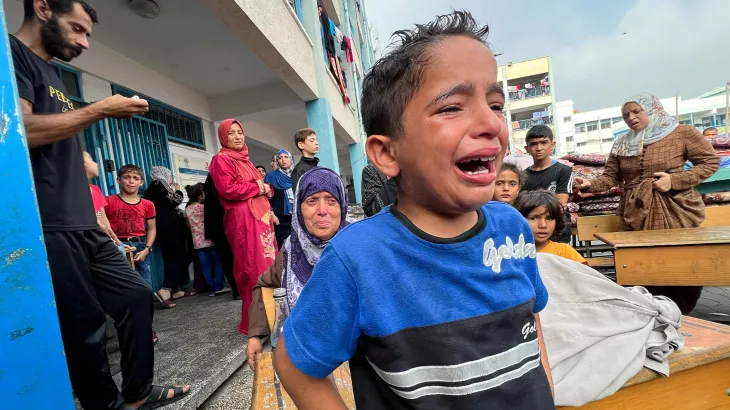
GazaHerald – In the Nuseirat refugee camp in central Gaza, Samar Abu Ajwah held her weak newborn son in her arms as his feeble sobs filled the crowded clinic.
Weighing just 1.9 kilograms, little Eyad has been diagnosed with malnutrition. “He needs milk, and we are appealing for help from people who can afford it because we cannot,” Abu Ajwah said. Like many mothers in Gaza, she too suffers from hunger, her body worn down by months of Israeli-imposed starvation.
Nearby, Ameera Tafesh held her six-month-old daughter, Ru’a, whose tiny frame bore the unmistakable signs of severe malnutrition. “I breastfed her when she was born, but it lasted only a week because I couldn’t produce enough milk,” Tafesh said. “I need to feed her formula, but it’s not available.”
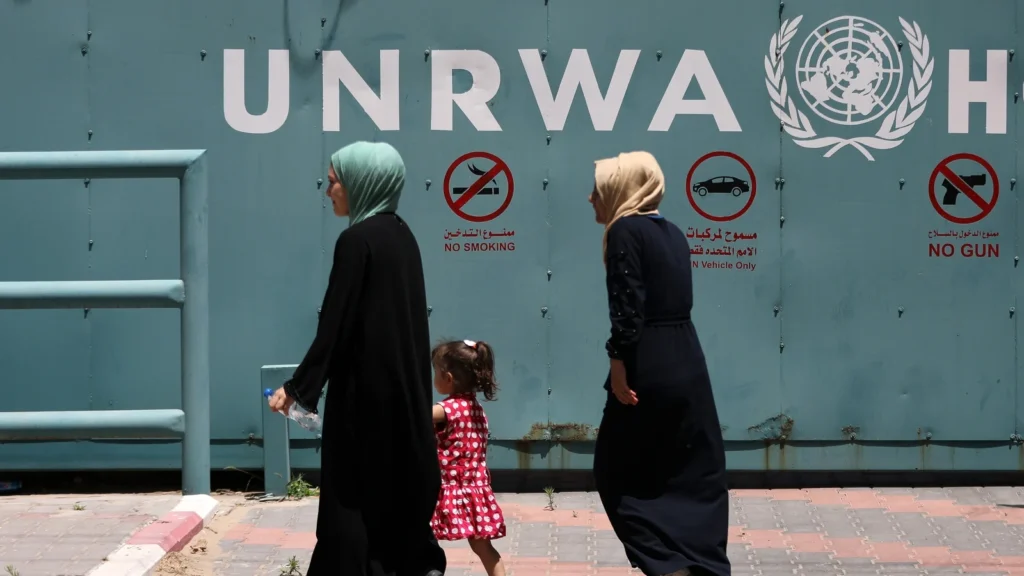
Such stories have become tragically common in Gaza, where mothers are desperate to find food for their children and themselves. Since Israel broke a ceasefire in March, it has blocked aid deliveries through the United Nations and humanitarian agencies, instead funneling limited supplies through army-controlled distribution points run by the US-based Gaza Humanitarian Foundation (GHF).
The system has proven deadly. According to Gaza’s Health Ministry, Israeli soldiers and GHF security contractors have opened fire on crowds at these sites, killing more than 2,200 Palestinians and injuring over 16,225 since late May. UN agencies have condemned the arrangement as “an abomination” and “a death trap,” demanding the right to resume their own distributions.
Meanwhile, hunger is spreading at a terrifying speed. The Integrated Food Security Phase Classification (IPC), the world’s leading famine monitor, confirmed this month that famine is already occurring in northern Gaza and projected it will spread to central and southern areas by the end of September. By then, nearly 641,000 people, almost a third of Gaza’s population, are expected to face catastrophic conditions.
Women and newborns are at acute risk. The IPC warned that 55,500 pregnant and breastfeeding women in Gaza are suffering from malnutrition and urgently need food assistance. At least 132,000 children under the age of five are at risk of death from acute malnutrition by June, the analysis added.
UN Secretary-General António Guterres has called famine in Gaza “a man-made disaster, a moral indictment, and a failure of humanity itself.”
But Israel disputes both the existence of widespread malnutrition and the reported fatalities, despite mounting evidence from UN agencies and humanitarian groups.
The UN Population Fund has warned that women in Gaza are being forced to give birth “malnourished, exhausted, and at heightened risk of death.” Babies, it said, are being born “too small, too weak, or too early to survive,” while mothers often cannot breastfeed because they themselves are starving.
“No woman should be forced to give birth in famine conditions. No child should begin life starving. Every day of inaction condemns more mothers and newborns to suffering,” the agency said.
Catherine Russell, head of UNICEF, described “unmistakable” signs of spreading malnutrition: “children with wasted bodies, too weak to cry or eat; babies dying from hunger and preventable disease; parents arriving at clinics with nothing to feed their children.”
“There is no time to lose,” she warned. “Without an immediate ceasefire and full humanitarian access, famine will spread, and more children will die.”
Gaza’s Health Ministry reported that 339 people, including 124 children, have already died from famine and malnutrition since the war began.