
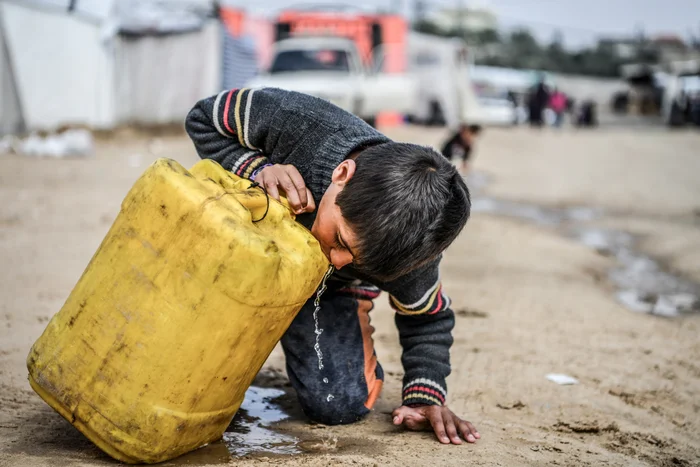
Gaza Herald – In Gaza, summer no longer brings life; it brings death. Where once the sun lit up beaches and breezes cooled down courtyard gardens, now it scorches the plastic walls of overcrowded tents, where over a million displaced Palestinians are trapped under siege and heat.
What the world calls a “climate crisis” has been weaponized here into a tool of domination. This is not just about rising temperatures. This is heat used as a policy.
As Europe distributes sunscreen, fans, and bottled water in response to heatwaves, Gazans sleep in suffocating tents without water, electricity, or medicine. The Israeli blockade has reduced Gaza to ashes, and the Mediterranean sun now acts as a second siege.
“I have a skin disease that requires cold ointments to be applied to my skin, but I cannot apply anything because of the extreme heat, and my condition is deteriorating,” Laila told the Gaza Herald team.
“I would trade anything for a cold glass of clean water. That’s all I want. Just water.”
Ahmad, 50, displaced from Beit Lahia, told Gaza Herald.
“Every morning, I wake up dizzy from dehydration. My son faints if he stands in line too long. This isn’t life—it’s survival in slow motion,” says Amina, 29, displaced from Deir al-Balah.
“The nights are worse. You feel the heat pressing down on you like it has weight. You hear babies crying, people coughing, and drones buzzing. And you just lie there—helpless.”
says Layali, 22, former university student
A Manufactured Inferno
The air in Gaza is heavy with dust, pollution, and despair. Israeli bombings have not only flattened cities, but also ignited wildfires, filled the sky with smoke, and poisoned the little farmland that remained. Waste piles rot in the open. Garbage burns in the streets. Fields that once fed families now smolder in silence.
“We used to hide from war in our homes,” says Um Rami, 47, interviewed by Gaza Herald. “Now we have no homes, no shade, and no strength to keep hiding.”
This is no longer a humanitarian crisis. It is a calculated collapse of livability. People cannot “stay indoors” because there are no homes left. They cannot “stay hydrated” because there is no clean water. They cannot “limit outdoor activity” because survival—food, water, fuel—is all outside, under the punishing sky.
The Tent as a Weapon
The displacement camps are not shelters. They are slow-cooking chambers. Nylon tents trap heat and fear. They provide no insulation, no privacy, no peace. By night, the heat lingers. By day, it intensifies. Children suffer from sunstroke. The elderly collapse from exhaustion. Insects swarm the camps, feeding on sweat and open wounds.
“Living in this tent is like living inside a sealed jar on a stove,” said Salem, 35, a father of four.
Since March, humanitarian aid has been severely restricted. Israel’s blockade on flour, fuel, and food has turned survival into a daily battle. Aid is now distributed through humiliating systems—sacks of flour tossed into metal cages, with civilians crawling toward them under armed watch.
“They scream at us to take off our hats, to lie face down in the heat,” says Hatem, 19. “It’s not aid. It’s punishment.”
A War Beyond Bombs
This is not merely about deprivation—it is about destruction of dignity.
Israel has combined every weapon: bombs, blockade, heat, thirst, and starvation. There is no fuel to power water pumps. No medicine to treat heat exhaustion. No ice, no fans, no shade. Nothing but sunburned dust and the silence of a world that chooses to look away.
Last summer, Gaza Herald reported from areas that still had access to aid kitchens and flour distribution centers. This summer, even those have vanished. Fishermen can no longer access the sea. Farmers can no longer plant. The soil is ash. The air is poison. And the sun is merciless.
Gaza Herald’s Call to Conscience
The world must stop calling this a “conflict” and begin recognizing it for what it is: a campaign of climate cruelty, where weather is not an obstacle, but a method of war.
This is not a natural disaster. It is deliberate deprivation. It is the use of the environment as a siege. And the world’s silence is complicity.
As Gaza suffocates beneath this artificial sun, as children faint in breadlines and mothers cook with plastic, we at Gaza Herald ask: How many more summers can Gaza survive?
And will the world only pay attention once there is nothing left to report?

