
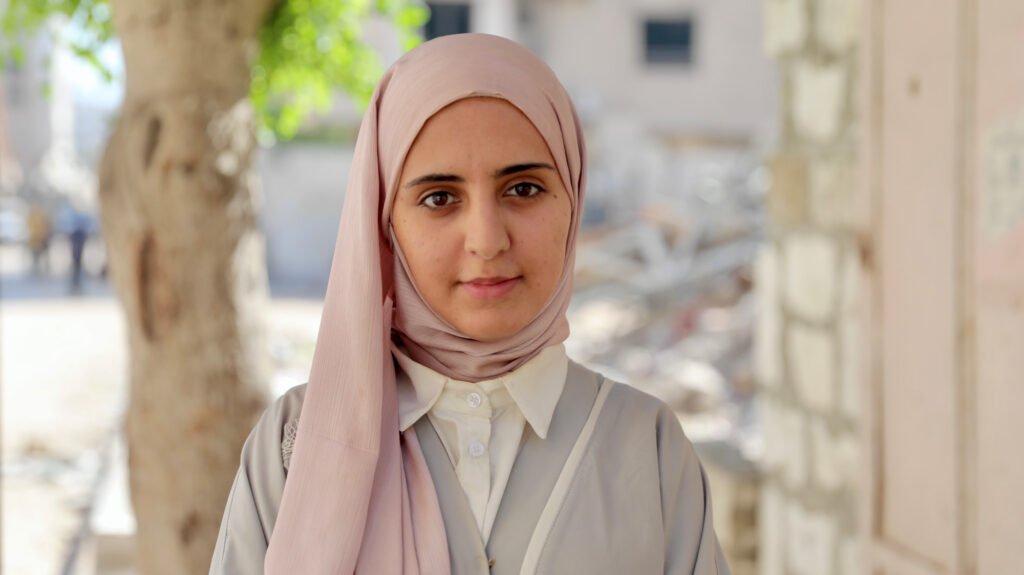
GAZA – More than a year has passed since Israeli forces stormed Gaza City’s al-Shifa Hospital in March 2024, yet survivors are still struggling to piece together the trauma they endured. For 21-year-old Hadeel Saleh, the nightmare is seared permanently into memory: her father and brother were executed in front of her, and the rest of her family was humiliated and terrorized at gunpoint.
Speaking to Middle East Eye, Saleh shared the details of that grim morning, a testimony that sheds light on the scale of devastation and the cruelty that accompanied Israel’s military operation on and around Gaza’s largest medical facility.
“We were trapped in total darkness, with tanks outside and warplanes above. Then they came for us,” she said.
A Family Under Siege
In March 2024, Saleh and her family, nine in total, had taken shelter in a small apartment near al-Shifa Hospital after their home was destroyed in an earlier airstrike. It was their tenth displacement since the start of the war.
“It was Ramadan, and everything was scarce. We had no food, no basic goods, and no way to leave,” she said.
On the night of 18 March, Israeli forces launched a major offensive on al-Shifa hospital and the surrounding neighborhoods, encircling the area with tanks and unleashing relentless artillery and air strikes.
For eight days, Saleh’s family remained under siege, too terrified to move. “We couldn’t even use a torch. There were soldiers outside, tanks moving constantly. We were surrounded.”
“They Shot him before he could speak”
Then came the morning of 26 March.
At around 3am, while preparing suhoor, the pre-dawn Ramadan meal, their building was blown open by Israeli forces using explosives. Over 60 soldiers stormed the premises and burst through the apartment door, firing before even identifying who was inside.
“We were hiding in a dark room. My father tried to speak, to tell them we were civilians, that children were present, but they shot him in the stomach before he could finish a word,” Saleh recalled.
Her brother Bilal, 28, rushed to help his father and was also shot, first in the leg, then in the stomach. The youngest brother, Salah, 18, was beaten, stripped, and interrogated. Israeli soldiers then searched the apartment while preventing the family from reaching the wounded men.
When one soldier saw Bilal was still breathing, he shot him again, this time in the neck. “He made sure he was dead,” Saleh said.
Their pleas for a doctor were ignored. Moments later, a soldier returned and coldly declared that their father had died.
Humiliation and Mockery
After confirming both men were dead, Israeli troops demanded the family identify themselves, only then realizing they had killed civilians.
“When Salah told them the men were his father and brother, a soldier mockingly said: ‘Now you’re the man of the house,’” Saleh recounted. “Salah replied: ‘After you killed the man of the house, you say this?’”
The soldiers pointed their guns at him, and Saleh believes he would have been executed too had the family not pleaded for his life.
They were then ordered to evacuate. The women asked to change, but the soldiers refused, forcing them to leave in their prayer garments. When Saleh asked about her father’s and brother’s bodies, they laughed.
As they were leaving, the soldiers blew up the apartment above theirs and mockingly said, “Ramadan Kareem.”
“At 5:10am, they forced us out. We were crying, stumbling through pitch-black streets, corpses lying on the ground,” Saleh said. “They told us if we didn’t keep moving south, a tank and drone would follow us.”
The family did not make it south. Instead, they stayed hidden in Gaza City until the Israeli military completed its withdrawal on 1 April, ending a two-week assault on the al-Shifa hospital that left hundreds dead or wounded.
On 2 April, the family returned to recover and bury their loved ones. But the apartment has remained abandoned ever since.
Saleh’s story is one of many emerging from the March 2024 siege on al-Shifa, an assault that decimated Gaza’s largest medical center and turned surrounding homes into death zones. Human rights groups have since documented extrajudicial killings, forced displacement, and the deliberate targeting of civilians during the operation.
“I haven’t stepped foot back inside that home,” Saleh said. “It’s not just a house. It’s the place where they murdered my family.”
As the world debates ceasefires and political frameworks, stories like hers remind us that for many in Gaza, the scars of this war will not fade with the headlines.

