
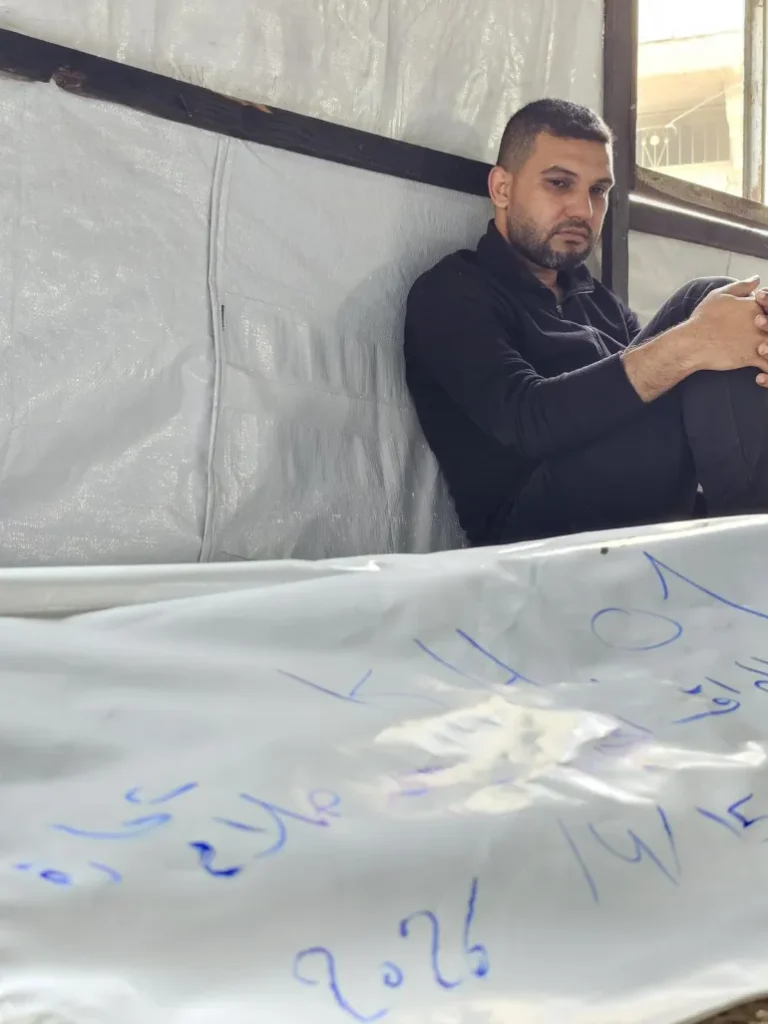
Gaza Herald – The phone call did not bring hope but a long-delayed confirmation of absence. For Muhammad, it came after 814 days of waiting for his father, whose fate had remained unknown since he disappeared during the Israeli genocide.
On the other end of the line was a stranger’s voice: a recovered phone, found inside the clothing of a decomposed body. The message was simple and devastating: identify the remains at Nasser Hospital.
When Muhammad arrived, he stood frozen in front of a body he struggled to recognize at first glance. But the clothing told the story before the face did: a worn black jacket, a red keffiyeh, and shoes he remembered well. Inside the pocket, an identity card confirmed what had been feared for more than two years: his father had not been missing but buried beneath the war’s ruins.
The case is not isolated. Humanitarian data indicate that thousands of families in Gaza are still living in the same suspended reality: neither confirmation of death nor proof of life.
According to the Palestinian Center for Missing and Forcibly Disappeared Persons, an estimated 7,000 to 8,000 Palestinians remain unaccounted for across the Strip. Families have formally registered between 3,000 and 4,000 cases, yet no file has been conclusively resolved. Authorities emphasize that a missing person’s status cannot be closed without the recovery and identification of remains.
The International Committee of the Red Cross framework defines missing persons in the genocide as civilians whose whereabouts are unknown, including those presumed killed under rubble or subjected to enforced disappearance, until verified evidence confirms their fate.
Civil defense estimates suggest an even wider scale. Field reports and family notifications once placed the number of Palestinians trapped under destroyed buildings at over 10,000. As recovery efforts progressed under extreme constraints, lack of heavy machinery, fuel shortages, and continued insecurity, only a fraction of bodies could be retrieved. Current estimates still suggest around 8,000 remains may be unrecovered beneath collapsed structures across more than a thousand destroyed buildings.
The uncertainty extends beyond rubble. Thousands are believed to have vanished during displacement routes, Israeli military checkpoints, or in areas under Israeli control, with families unable to determine whether they were killed, detained, or otherwise unaccounted for.
Human rights organizations warn that Gaza is entering a pattern seen in other prolonged wars, where mass missing-person files gradually fade without resolution. The UN Working Group on Enforced or Involuntary Disappearances has repeatedly stressed that states must clarify the fate of missing persons and ensure accountability under international law.
For families like Muhammad’s, and thousands of others, the outcome is not only grief, but the collapse of certainty itself, where mourning is delayed by the absence of a grave, and closure depends on recovery that may never come.
In Gaza today, the missing are not only those without names in official records. They are also those buried without reach, those erased without trace, and those whose families still wait between two impossible possibilities: life without evidence, or death without return.

