
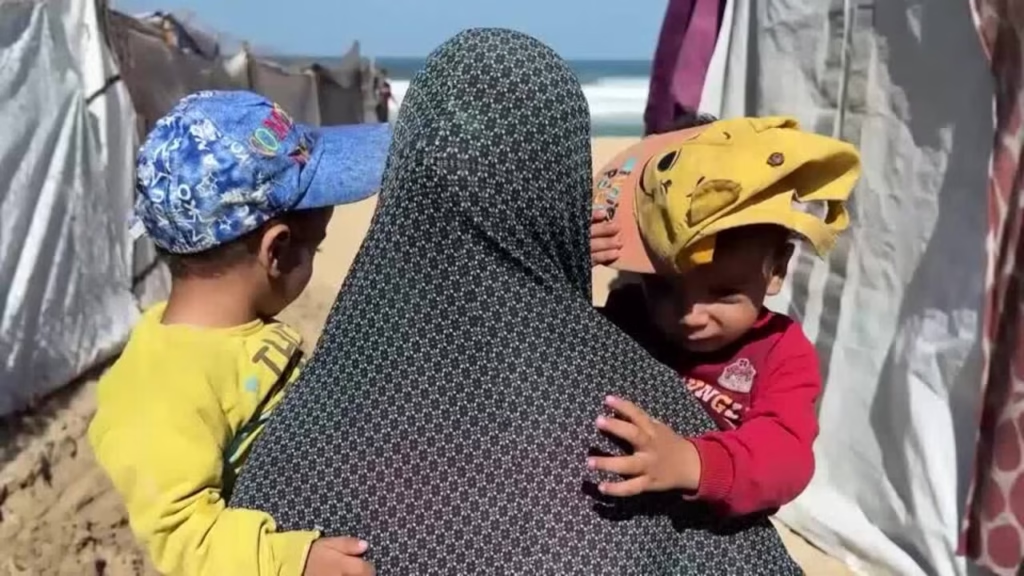
Gaza Herald _The World Health Organization marked International Women’s Day by highlighting the extraordinary role women in Gaza have played in protecting children from polio amid Israel’s ongoing war on the territory.
According to the WHO, women have been on the frontlines of public health efforts, working under extremely difficult conditions to ensure that children receive life-saving vaccinations despite the ongoing conflict and widespread displacement.
Polio Reappears After 25 Years
In July 2024, while Gaza was experiencing intense fighting and mass displacement, a mutated poliovirus linked to polio was detected in wastewater samples in Khan Younis and Deir al-Balah for the first time in more than 25 years.
Soon after, a 10-month-old infant in Gaza was confirmed to have contracted polio. The child had never received vaccinations, as immunization campaigns had been halted since the start of the war.
The discovery triggered an urgent public health response. Under the leadership of the Palestinian Ministry of Health and with support from the World Health Organization and its partners, health workers mobilized to vaccinate hundreds of thousands of children against a disease that can cause lifelong paralysis.
Behind the complex operation were countless individuals working under extraordinary conditions , including several women whose leadership and determination helped ensure that Gaza’s children received protection from the virus.
Dr. Ola Al-Najjar: Leading After Personal Tragedy
Dr. Ola Al-Najjar, director of the Non-Communicable Diseases Department at Gaza’s Ministry of Health, became a symbol of resilience during the vaccination response.
In October 2023, during the first week of the war, Dr. Al-Najjar lost 16 members of her family in an Israeli airstrike, including her parents, siblings, and their children. Her home was destroyed and looted, forcing her to flee with her husband and their four young children.
Despite the devastating loss, she remained committed to protecting Gaza’s children from polio, a disease that can be prevented through vaccination.
When news of the outbreak emerged, Dr. Al-Najjar resolved to act immediately, even when that meant leaving her children at home amid an unstable and dangerous environment.
Damaged roads, electricity outages, and the collapse of communication networks created major obstacles as she supervised vaccination campaigns across Gaza City. She played a key role in coordinating with partners and organizing the campaign’s logistics.
Even after the fragile “humanitarian pauses” allocated for vaccination campaigns ended, Dr. Al-Najjar and her colleagues remained in the field collecting data, knowing that the journey home could be dangerous.
Reflecting on the success of the campaigns, she emphasized the importance of women’s participation.
“Having women working alongside men in vaccination and community outreach teams helped improve access to mothers and children,” she said.
Dr. Yara Al-Hajjamad: Reaching Every Child
Dr. Yara Al-Hajjamad, a surveillance officer with the WHO in the occupied Palestinian territory, also played a key role in the vaccination campaigns.
During the third round of the polio vaccination campaign in February 2025, she spent her days traveling across Gaza City, monitoring vaccination teams, reviewing records, and overseeing mobile outreach units. In the evenings, she managed logistical tasks, including securing supplies for the following day.
One memory stood out to her.
It involved a nine-year-old boy living in a school that had been converted into a shelter at night and a temporary vaccination center during the day. Determined to ensure no child was left unvaccinated, the boy took it upon himself to knock on doors in his neighborhood, urging families to bring their children under the age of ten to receive the vaccine.
Dr. Al-Hajjamad said she also witnessed remarkable dedication from female vaccinators who went beyond their duties. In one marginalized Bedouin community located near an area requiring special coordination to access, she worked closely with community organizers to ensure every child received the vaccine.
Alongside vaccination efforts, Dr. Al-Hajjamad and her colleagues supported the Ministry of Health in establishing a unified surveillance system to monitor 16 diseases and health conditions across Gaza.
Their work included equipping health facilities, training staff, verifying alerts, and analyzing data to enable rapid evidence-based public health responses.
Dr. Rifqa Skayek: Witnessing Resilience
Dr. Rifqa Skayek, another WHO surveillance officer working in overseas territories, coordinated vaccination teams across Deir al-Balah and Khan Younis during the campaign.
She said she witnessed extraordinary commitment from both healthcare workers and families.
Parents, she noted, overcame their fears to protect their children from a preventable disease that causes paralysis. Many continued to trust health workers even when little around them provided a sense of safety.
Dr. Skayek also observed how young female doctors sometimes had to work harder to build trust with families, explaining medical information carefully and relying on evidence-based discussions.
Despite the hardships children had endured during the war, she recalled moments of joy during vaccination campaigns, such as a child proudly showing the purple-ink mark on his finger after receiving the vaccine.
For Dr. Skayek, these small moments reflected children’s remarkable ability to find happiness even under the harshest circumstances.
“Parents could not protect their children from airstrikes or hunger,” she said. “But they believed they could protect them from polio , and they did.”
Dr. Mona Abu Omar: Ensuring the System Keeps Working
Dr. Mona Farid Mohammad Abu Omar, a nursing supervisor at Rafah’s health directorate within the Palestinian Ministry of Health, also played a crucial role during the vaccination campaigns.
Across the three rounds of polio response campaigns, she served both as a field supervisor in Gaza’s central region and as the coordinator for vaccines and logistics at primary healthcare centers in Qarara and Abasan al-Kabira.
Her work required managing supplies, coordinating teams, directing operations, and maintaining accountability across the campaign.
Each morning began with a quiet tension as she prepared to travel near areas requiring special coordination to access. Yet regardless of the challenges, she remained determined that no delay would prevent a child from receiving protection.
“Our mission was stronger than fear,” she said. “We experienced moments of anxiety, but we stayed focused, followed safety protocols, and supported one another as a team.”
She added that participating in the response strengthened her resilience and reinforced her belief in the ability of women to lead and serve courageously, even in the most difficult circumstances.

