
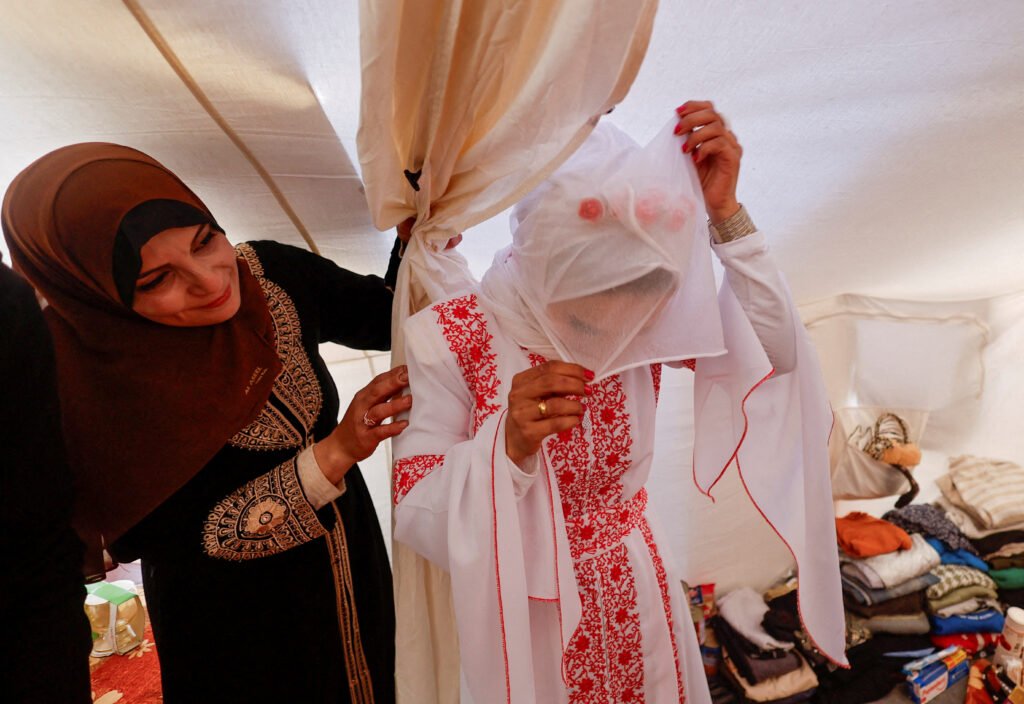
Gaza Herald _At the edge of Gaza City’s Shuja’iyya neighborhood, only a short distance from what residents call the “yellow line,” a small gathering formed among the ruins of destroyed homes. Word had quietly spread through the neighborhood that a family was celebrating the engagement of Dina, the only daughter of Iman.
The familiar chant of Palestinian weddings, “Ya Dablet Al-Khotouba, Aqbalna Kolna,” echoed softly between shattered buildings. The words, meaning “Oh, engagement ring, may we all have this happiness,” carried a wish for joy that felt almost impossible in a city scarred by war. It was not an ordinary celebration. Dina and Mohammed were known among relatives as “the newlyweds of survival,” two souls who had emerged from the rubble of conflict, carrying the weight of lost family members and the scars of a city under siege. Their smiles, though fragile, were a quiet act of defiance—a testament that life, even in its smallest joys, could persist amidst devastation.
Both had escaped death during the war.
Dina had been pulled alive from beneath the rubble of her family’s destroyed home in July 2024. Mohammed, months earlier, had survived the bombardment of his own house in December 2023, an attack that killed his father and brothers.
Their engagement was not only a family celebration. It was a moment of survival.
Inside a small storage room that served as the gathering space, relatives prepared what little they could. Chairs were placed along the walls for guests. Black burn marks left by fire were wiped from the walls. A couch was placed in the center for the bride and groom. The door, pierced by bullets, was covered with a long sheet.
The goal was simple: to make room for joy, even in the middle of devastation.
Yet the absences were impossible to ignore.
One of the relatives searched the room for her aunt, the woman who used to lead the family’s celebrations with traditional Palestinian wedding chants. She had memorized dozens of them and always insisted on beginning weddings with the old melodies rather than modern songs.
But the aunt was not there.
She had been killed in the war.
She was not the only one missing. The bride and groom’s grandmother, a woman whose presence once filled every celebration with warmth and blessings, was also gone. Since her death, relatives often felt as though someone had quietly turned off the lights in the room.
Another absence weighed heavily on the gathering. Um Hamdi, the eldest daughter-in-law in the family, had inherited the tradition of preparing sumagiyya, a beloved Gazan dish traditionally served on wedding nights.
But she too had been killed during the war, along with her daughter Rimas and her pregnant daughter-in-law Naghm.
That night, the dish was never prepared.
Throughout the celebration, the bride’s aunt sat quietly on one side of the room. Her voice had been hoarse for days, and she used that as an excuse to avoid ululating with the other women. In truth, she felt she had neither the voice nor the heart for it.
Guests fought back tears, determined not to let grief overshadow the moment.
At one point, the groom’s mother began dancing as a song played through a loudspeaker, asking, “Where is the groom’s mother? I can’t see her.”
Everyone saw her.
They saw her wiping tears from her cheeks while she danced.
Perhaps she was remembering her husband who had been killed. Perhaps she was thinking of the son who died beneath the rubble while calling for help. Or the other son who later died from his wounds.
Since the war, people in Gaza often recognize the groom’s mother at weddings by the same sign, tears quietly running down her face as she celebrates.
For the bride’s aunt, the moment was no easier. She wiped her tears with the edge of her dress while greeting the aunts who had come in place of her own mother.
Her mother could not attend.
Between them lay barbed wires, checkpoints, border crossings, and barriers that separate families inside Gaza from relatives outside.
She loved her aunts deeply because they stood beside her in every moment of joy or grief when her mother could not.
But she had never imagined that Dina would become a bride while her mother remained absent.
For many in Gaza, the war has not only taken lives. It has also stolen moments of happiness, disrupted traditions, and scattered families across borders and barriers.
Yet the celebration continued.
Women released another ululation into the air.
It was not the last one.
Only a few meters away from the rubble of their homes, they celebrated, wiped their tears, and held on to their traditions.
For them, these fragile celebrations remain one of the last fortresses still standing, a quiet, deeply human form of resistance.

