
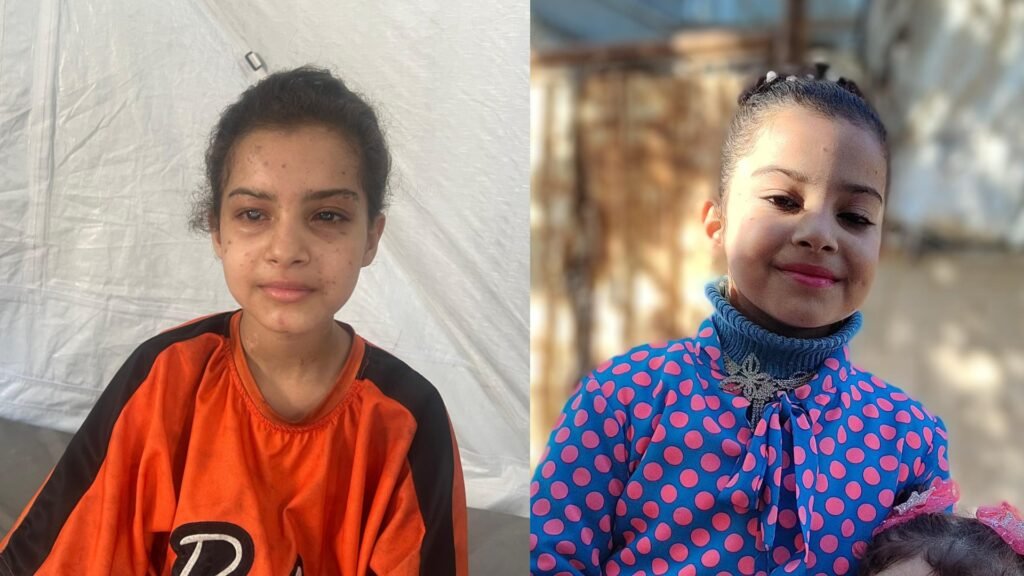
Gaza Herald _ Gaza is facing a severe health crisis that is threatening thousands of eye patients, after many civilians were injured during the Israeli war, including children who now risk permanently losing their vision due to a severe shortage of medications, medical supplies, and specialized surgical procedures.
Thirteen-year-old Mohammed Shaheen, who has already lost sight in his right eye, carefully moves through Gaza’s Eye Hospital with the help of his mother as they search for treatment that could save his remaining eye from further damage. The boy was injured when an Israeli airstrike targeted his family’s home during the most recent assault.
Mohammed’s mother says that since her son lost vision in one eye, the family has been trying desperately to find doctors or hospitals that could save the other eye from permanent damage after it was seriously injured. However, the reality inside Gaza’s hospitals, and the suspension of specialized eye surgeries due to the lack of medical equipment, medicines, and surgical tools, now threatens to leave her son blind for life.
The case of Mohammed Shaheen is only one among thousands of Palestinians who suffered eye injuries during the two years of Israel’s war on Gaza. A significant percentage of them are children, and many now face the risk of permanent disability as the consequences of the war and the blockade continue to affect the enclave. The blockade prevents critically injured patients from traveling abroad for treatment and restricts the entry of medicines, medical equipment, and specialized tools needed for complex surgeries, including delicate eye operations for both injured patients and those suffering from chronic eye diseases.
Dr. Abdel Salam Sabah, director of Gaza’s Eye Hospital and a consultant in ophthalmology and eye surgery, confirms that patients with eye injuries caused by the war face a real risk of losing their sight because the treatments and medical equipment needed for their care are unavailable.
He explains that the hospital records cases of vision loss on a daily basis among injured patients and those suffering from eye diseases because doctors are unable to provide proper treatment or perform necessary surgical interventions, as Israel continues its blockade on Gaza and restricts the entry of medicines, medical supplies, and medical equipment.
Dr. Sabah notes that many eye injuries require urgent medical intervention, particularly cases in which the eyeball has been penetrated and shrapnel has entered the eye. These injuries can lead to severe infections that may ultimately result in the complete loss of the eye and the need to surgically remove it. Delays in treatment, he stresses, often result in permanent blindness that cannot later be reversed.
According to health statistics, the number of injuries recorded during the war on Gaza has exceeded 171,000 cases. Around 11 percent of these injuries involve the eyes, which equals approximately 17,000 cases. Children make up nearly 20 percent of these injuries and are considered the most vulnerable to permanent vision loss due to weaker immune systems, raising concerns that the number of visually impaired individuals in Gaza may increase significantly in the coming years.
Medical staff say they are currently prioritizing emergency cases while placing many other patients on waiting lists because essential medicines and medical supplies are unavailable.
Dr. Sabah adds that more than 3,000 people have already lost their sight during the war on Gaza. However, he notes that final and accurate statistics have not yet been completed, and the real number of eye injuries may ultimately prove to be far higher than current estimates.
He also stresses that specialized eye surgery teams are facing severe limitations due to the lack of medical equipment and the continued prevention of thousands of eye patients from leaving Gaza for treatment abroad. In many cases, eye injury patients are denied travel permits for medical care under the argument that their conditions are not considered life-threatening, despite the permanent disabilities they face.
The specialized Eye Hospital in Gaza, which was recently repaired after being damaged during Israeli military operations in the city before the ceasefire, is currently focusing only on performing emergency procedures aimed at saving the eyeball and preserving vision where possible. These include repairing wounds and providing treatment using the limited resources available.
Doctors warn that the hospital’s remaining medical supplies may run out within less than two months, which would lead to the complete suspension of emergency eye surgeries for both injured patients and those suffering from serious eye diseases in Gaza.
Dr. Iyad Abu Karsh, head of the surgery and anesthesia department at Gaza’s Eye Hospital, says that the hospital in northern Gaza alone received about 2,077 eye injuries between January 2024 and September 2025. During that period, eye injuries accounted for roughly 5 percent of the total war-related injuries.
He explains that 18 percent of these injuries resulted in the removal of the eye, while 34 percent involved foreign objects embedded inside the eye. Around 9 percent of the injured suffered damage to both eyes, significantly increasing the likelihood of complete and permanent blindness.
Meanwhile, Mohammed Khairi, coordinator at the Gaza Center for Human Rights, expressed deep concern over the alarming rise in eye injuries during the Israeli military offensive, particularly as Israeli authorities continue to block the entry of essential medical equipment needed to diagnose and treat these injuries.
Khairi states that documentation gathered by the rights center and testimonies from injured victims indicate that Israeli forces have deliberately caused permanent disabilities among Palestinian civilians. These include cases of direct sniper fire targeting the eyes, in addition to injuries caused by airstrikes and explosive weapons that scatter large amounts of shrapnel.
He reveals that approximately 5,000 eye patients and injured individuals are currently at risk of partially or completely losing their sight due to the lack of treatment. This situation stems from the destruction of the Eye Hospital’s infrastructure, generators, and surgical equipment, as well as the ongoing restrictions on the entry of medicines and medical supplies. As a result, serious conditions such as glaucoma, corneal disease, retinal damage, and cataracts are worsening, putting patients at risk of permanent blindness.
He also notes that around 2,400 patients are currently on waiting lists for urgent surgeries that cannot be performed inside Gaza. He emphasizes that Israeli authorities have not only caused the injuries but are also preventing patients from receiving treatment by blocking travel for medical care and restricting the entry of essential medical equipment.
The rights advocate warns that Gaza’s Eye Hospital is suffering from a severe shortage of basic diagnostic equipment required to treat war injuries. Despite international organizations offering to cover the full cost of these devices, Israeli authorities have refused to allow their entry, forcing medical teams to rely on basic tools and primitive equipment that are inadequate for the scale and severity of the injuries.
He concludes that the continued restrictions on the entry of medical equipment and supplies constitute collective punishment and a clear violation of international humanitarian law, particularly the Fourth Geneva Convention.
Gaza’s healthcare system continues to face an acute shortage of medicines and specialized equipment needed for complex and delicate surgeries. Several major hospitals in the territory have been destroyed or forced out of service during the war, while those still operating struggle with severe shortages of medical supplies and equipment, placing the lives of thousands of wounded and sick patients at risk and worsening the humanitarian crisis affecting nearly two million Palestinians living under blockade in the enclave.

