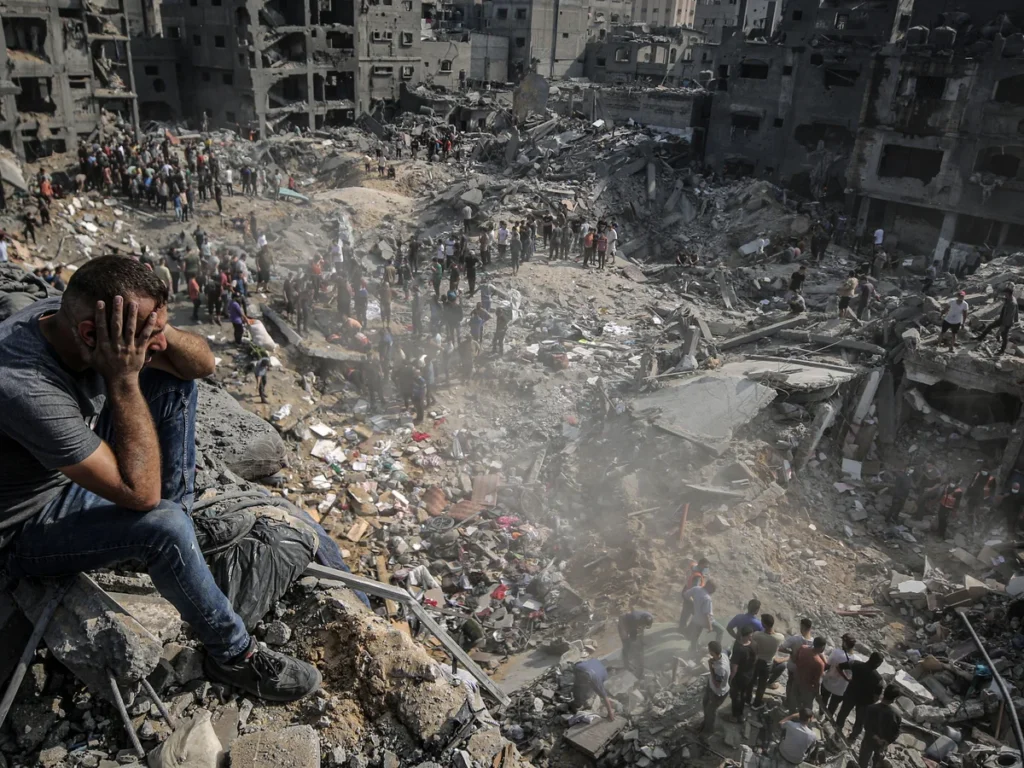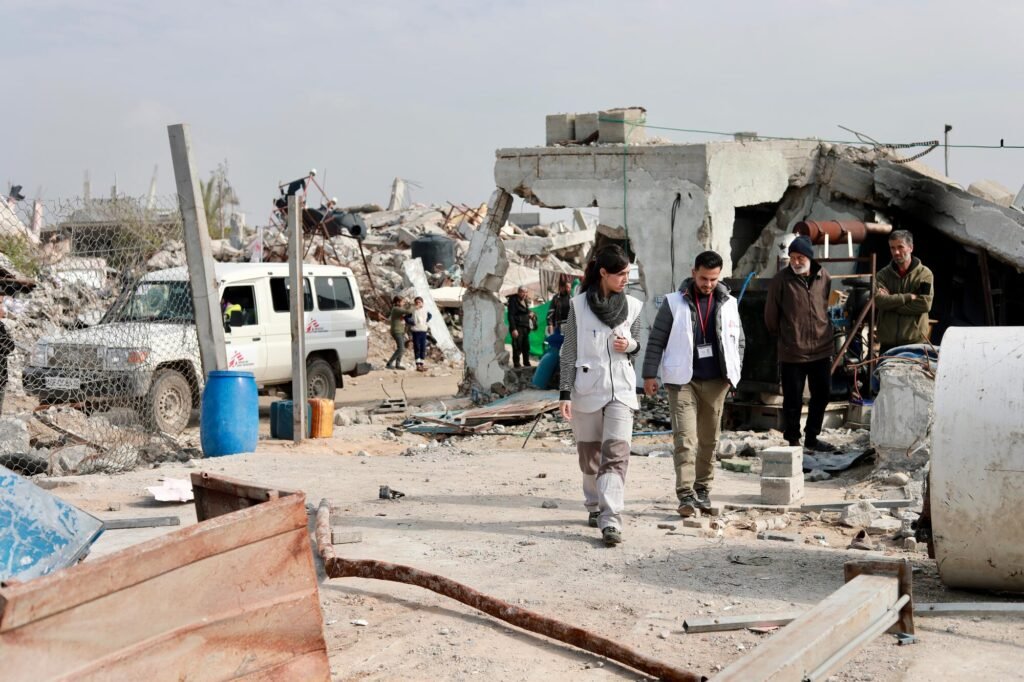
Gaza Herald_ In Gaza, even the smallest purchase has become a difficult calculation. As Israel’s war continues to devastate the territory’s economy and financial infrastructure, Palestinians are navigating an increasingly fragile system where cash is scarce, digital payments are unreliable, and credit has become one of the last lifelines for survival. For families already struggling with displacement, unemployment, and rising poverty, the simple act of buying food or medicine has turned into a daily test of endurance.
In Gaza City’s Remal neighborhood, Samar Abu Harbied pauses at a modest roadside stall to buy groceries for her family’s Ramadan iftar. With no physical money in her possession, the 45-year-old mother quietly asks the shopkeeper if she can take the items on credit until her husband or son can transfer the payment electronically.
“I haven’t held cash in months,” she said. “I don’t even have money for transportation. We walk everywhere now, no matter how far.”
Nearby, Najlaa Sukkar, 48, stands exhausted after attempting to walk to a medical appointment she ultimately could not attend. Unable to afford the 30-shekel consultation fee, and carrying only a worn 20-shekel note rejected by a pharmacist, she was forced to return home without treatment.
“They refused to accept the banknote because it was damaged,” she explained. “Even taxi drivers demand exact change, which we don’t have. Everything has become complicated. We don’t know how to live like this.”
Since the war began in October 2023, Gaza has faced a severe cash shortage. Palestinians rely on the Israeli shekel for daily transactions, but Israel controls the supply of new currency entering the territory. With most banks and ATMs destroyed or rendered inoperable, residents are left using worn and deteriorating banknotes or turning to electronic payment systems that remain unreliable under Gaza’s collapsing infrastructure.
To address the crisis, the Palestinian Monetary Authority has promoted mobile payment platforms such as PalPay and Jawwal Pay. For some families, these systems have offered a partial solution. Abu Harbied said her son now receives his wages through bank transfers instead of cash, allowing the family to purchase essentials using mobile banking applications.
“Before, his wages were paid in torn banknotes that nobody wanted to accept,” she said. “Now, we rely on digital payments because we have no other option.”
Yet for many Palestinians, digital payments bring new challenges. Frequent electricity outages, limited internet access, and the high cost of smartphones prevent large segments of the population from fully relying on electronic transactions. Even those with access to digital banking remain anxious about the safety and accessibility of their money.
“I prefer cash in my hand,” Abu Harbied said. “With cash, I feel secure. I can buy what I need without worrying about technology failing.”
Economic analysts say the crisis has evolved far beyond a simple cash shortage. Ahmed Abu Qamar, a board member of the Palestinian Economists Association, described the situation as a deeper structural breakdown of Gaza’s financial system.
“What began as a liquidity problem has turned into a collapse of the formal monetary system,” he explained. “Cash itself has become a commodity controlled by a small group of brokers who profit from scarcity.”
According to residents, these brokers charge enormous commissions, sometimes up to 50 percent, to convert digital funds into physical cash, exploiting desperate civilians who have no alternatives.
“We lose half our money just to access it,” Sukkar said. “They take advantage of our suffering.”
For small business owners, the crisis has been equally devastating. Abdallah Sukkar, whose family once operated a well-known grocery store before it was destroyed in the war, now runs a small roadside stall. He accepts damaged banknotes and allows customers to buy food on credit, even as his own financial stability erodes.
“People don’t have money,” he said. “How can I refuse someone who needs food? But debts have increased dramatically, and profits are almost nonexistent.”
He estimates that unpaid debts have increased fivefold during the war, while his earnings barely cover basic costs.
Across Gaza, credit has quietly become a survival mechanism, reflecting widespread poverty and collapsing incomes. Analysts estimate that nearly 95 percent of households now depend on humanitarian aid in some form.
For many families, the financial crisis is not just about money; it is about dignity, security, and the ability to care for loved ones. Parents worry not only about feeding their children today but also about the long-term consequences of growing up in an environment defined by scarcity and uncertainty.
As Gaza’s financial system continues to fracture under the weight of war and blockade, Palestinians are left navigating a reality where money exists but remains out of reach, and survival depends on fragile systems of trust, credit, and endurance. Until meaningful economic access and stability are restored, ordinary families will continue to bear the burden of a crisis they did not create, struggling each day to live.