
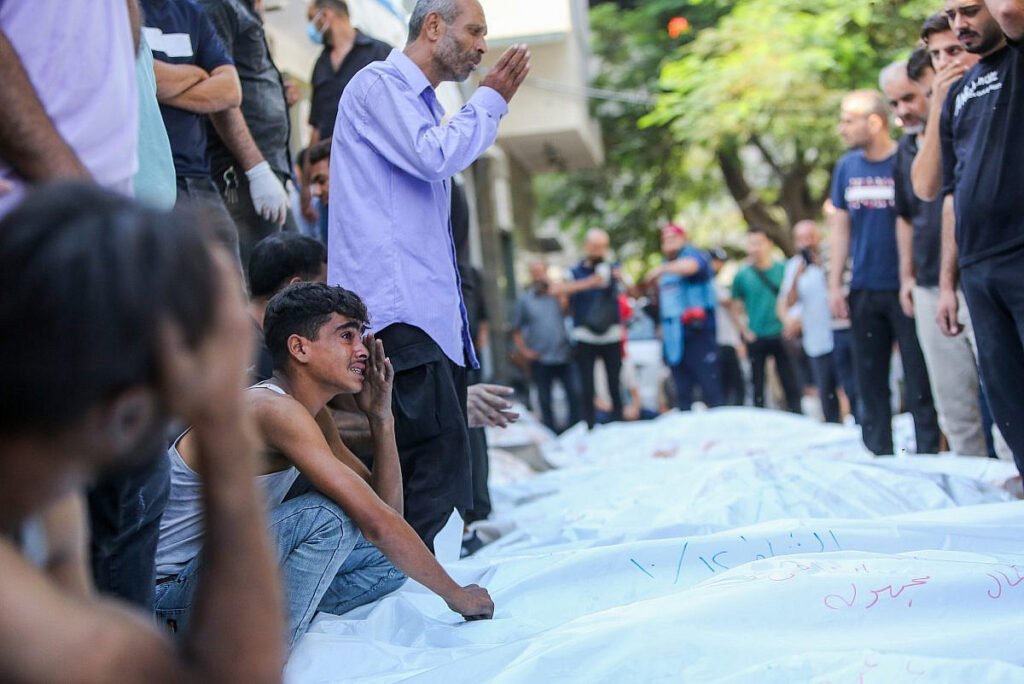
Gaza Herald — Even after the announcement of a ceasefire, Israeli gunfire continues to claim Palestinian lives across Gaza, particularly near the so-called “Yellow Line,” a military boundary dividing much of the devastated territory. Palestinian families who had hoped for safety now find themselves living under constant threat, as tanks, drones, and snipers positioned along the line continue to target civilians attempting to survive in the ruins of their homeland.
During Ramadan, the pain of loss has become part of daily life for many families. At one iftar table in Gaza City, Sara Warsh Agha and her brothers broke their fast without their mother, who was recently killed by Israeli gunfire. In another tragedy, 28-year-old Basma Banat was shot while heading to her job in Beit Lahia. According to her family, Israeli military vehicles stationed nearby opened fire, striking her in the back. She was transported to Al-Shifa Hospital, where she remained critically wounded for hours before doctors pronounced her dead, as relatives waited in anguish.
Scenes like these have become increasingly common. Hospitals across Gaza continue to receive victims shot or wounded by Israeli forces, particularly in areas near military positions. Palestinians living in tents or among the rubble of destroyed neighborhoods report constant gunfire, artillery shelling, and aerial surveillance from Israeli drones.
The “Yellow Line,” established as part of a ceasefire agreement in October, separates zones under Israeli military presence, covering more than half of Gaza’s territory, from areas where Palestinians are supposedly allowed to live and move. However, Palestinian officials say the line has instead become a deadly frontier. Gaza’s Government Media Office reports that at least 96 Palestinians have been killed by direct Israeli fire near the boundary since the ceasefire began, including women, children, and elderly civilians. Hundreds more have been injured.
According to Gaza’s Health Ministry, Israeli violations since the ceasefire have resulted in at least 818 Palestinian deaths and over 1,600 injuries. These incidents come after more than two years of devastating military assault that has killed over 72,000 Palestinians, injured more than 171,000, and destroyed nearly 90 percent of Gaza’s civilian infrastructure. The United Nations estimates that rebuilding Gaza will cost tens of billions of dollars.
For grieving families, the pain is deeply personal. Basma Banat’s mother described her daughter’s death with heartbreak, recalling how she had simply been on her way to work when she was shot. Her brother recounted the horror of hearing her children scream that their mother had been killed. Her husband now faces the unimaginable task of raising their children alone, including an infant too young to understand the loss.
Residents say Israeli forces have established fortified military positions on elevated sand dunes overlooking Palestinian neighborhoods, equipped with armored vehicles, sniper posts, and automated weapons systems. Surveillance drones hover constantly overhead, while heavy machinery continues to reshape the landscape, reinforcing Israel’s military presence.
Palestinian officials argue that these attacks are not isolated incidents but part of a broader pattern of deliberate violence against civilians. They accuse Israel of using the ceasefire to consolidate military control while continuing to impose lethal force on vulnerable populations.
As Palestinians struggle to rebuild their shattered lives, the promise of safety remains painfully out of reach. For families mourning loved ones and living under the constant threat of gunfire, the ceasefire has brought little relief—only the continuation of fear, loss, and uncertainty in a land already scarred by immense suffering.

