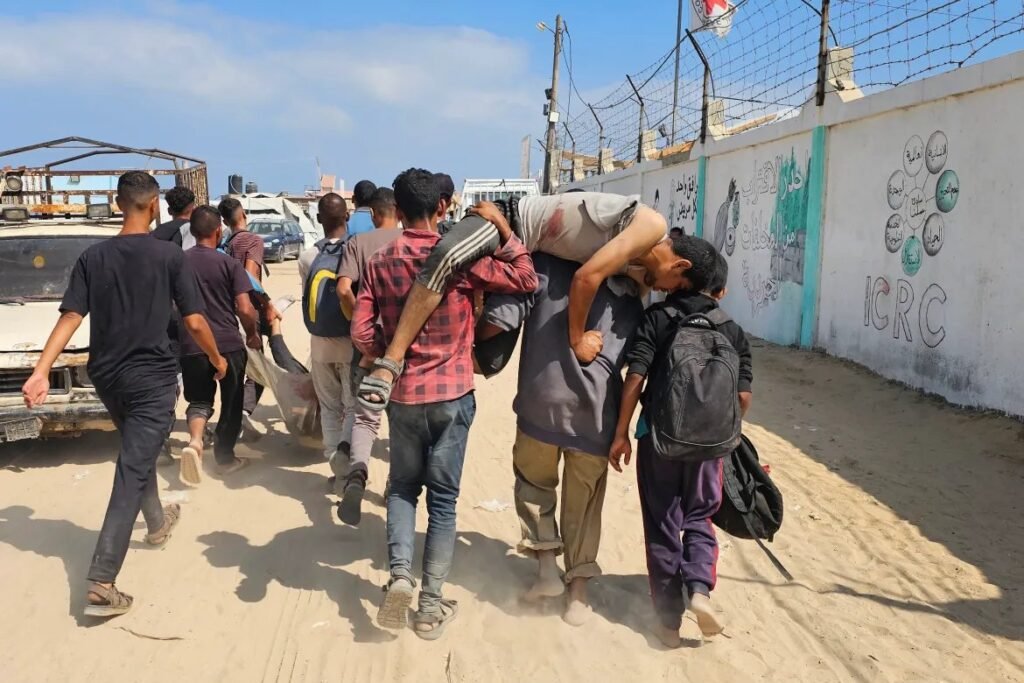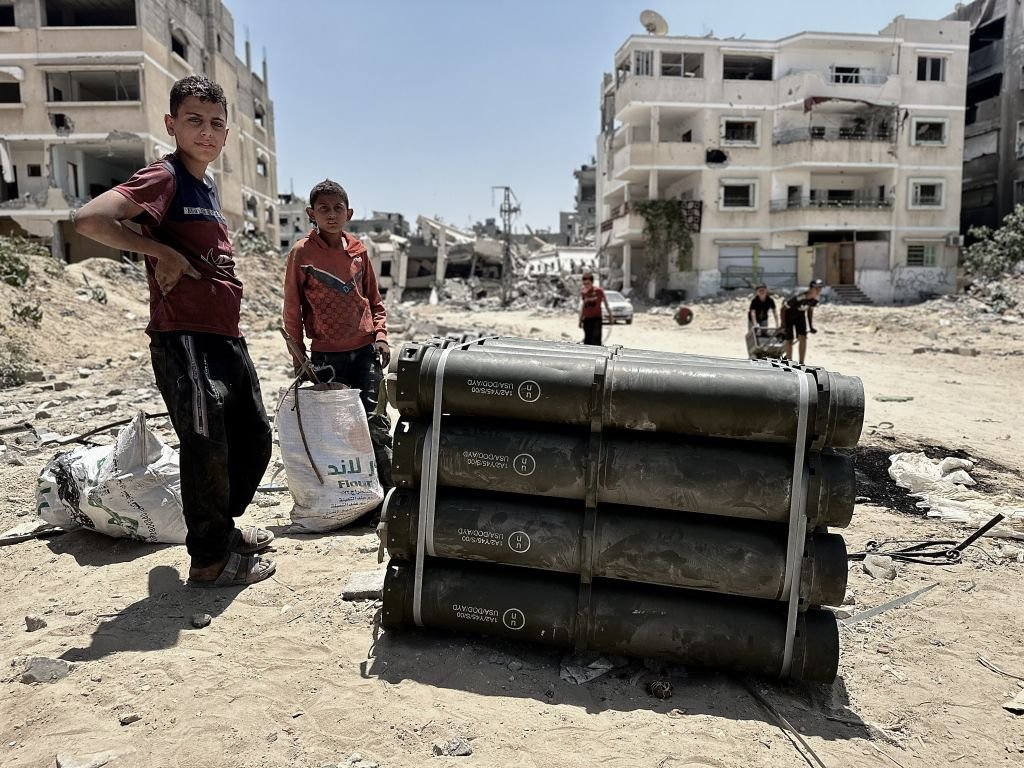
Gaza Herald — As Gaza moves toward the second phase of the ceasefire, the discussion around a proposed “international force” has surged to the center of political debate. Palestinians in Gaza, along with regional and global actors, are questioning whether this force would genuinely protect civilians or simply reshape the occupation under a new international façade. At a time when Gaza continues to struggle under extreme destruction, displacement, and loss, the intentions, structure, and powers of this proposed force raise critical concerns about sovereignty, justice, and the future of the Palestinian cause.
Washington’s Plan and Regional Concerns
In recent days, US President Donald Trump announced that a “stability enforcement force in Gaza” would be deployed soon, saying leadership for this force is now being selected. His secretary of state, Marco Rubio, confirmed that a multinational force is being arranged, but emphasized that it must be acceptable to Israel before it can move forward.
A circulated draft at the UN Security Council outlines the creation of an international force with wide-ranging authority over Gaza as part of Washington’s post-war vision. The draft grants the United States and participating states broad powers to manage Gaza and establish security, while also proposing that a “Peace Council” remain active until at least the end of 2027. The force would secure borders with Israel and Egypt, protect civilians and humanitarian corridors, dismantle military infrastructure, prevent its reconstruction, and oversee disarmament. It would also train a Palestinian police force meant to work alongside the foreign troops.
A US official described this force not as a peacekeeping mission, but as an enforcement power made up of troops from several countries. It would be formed in consultation with Gaza’s existing “Peace Council.”
Hamas negotiator Khalil al-Hayya confirmed that Palestinian factions accept a UN-mandated force whose role is to monitor borders, separate the sides, and oversee the ceasefire. However, he stressed that the UN would need to determine the type, duration, and mechanisms of such forces.
This stance contradicts the American and Israeli vision, which seeks to equip the international force with the authority to disarm Hamas and impose security across Gaza.
A Tool to Complete Israel’s Mission?
Military expert Major General Yusuf Al-Sharqawi explained in an interview that the proposed force resembles an “executive force,” not a monitoring body like UNIFIL in southern Lebanon. Instead of merely documenting violations, this force would perform operational tasks that intervene directly in Gaza’s internal affairs.
Al-Sharqawi said Washington’s proposal indicates that the purpose of this force is to complete the tasks Israel failed to finish, effectively serving as an extension of the occupation under new branding. Israel’s opposition to placing the force under Chapter VII of the UN Charter signals that it would not be a neutral peacekeeping entity, but rather an instrument of enforcement with international cover.
He warned that the structure of this “executive force” opens the door to a new form of foreign control over Gaza under the pretext of security and reconstruction, effectively weakening Palestinian decision-making and national sovereignty.
Al-Sharqawi argued that the proper alternative is an Arab–Islamic force operating within a political framework to separate the sides, monitor disengagement, and avoid repeating the failures of previous international interventions. He noted that the most dangerous aspect of the US proposal is the possibility of using this force to carry out Israeli objectives with global legitimacy, undermining Palestinian rights.
He emphasized that confronting this requires a unified Palestinian and Arab position that rejects any force undermining national will. According to him, Gaza’s security must come from internal consensus supported by Arab and Islamic partners—not from outside imposition.
Peacekeeping, Not Enforcement
Military expert Major General Mohammed Al-Masri emphasized that any force deployed in Gaza must be a peacekeeping force rather than one that imposes peace by force. Its primary mission should center on border security, with internal policing handled by Palestinian authorities under clearly defined mandates.
Al-Masri stressed that the force must be accepted by Palestinians and composed of neutral Arab or Islamic states with positive relations with the Palestinian people. It must not serve Israel’s vision of imposing security or disarming Palestinian factions—issues he described as internal matters to be resolved through national dialogue in a way that protects the legitimacy of resistance.
He noted that the plan being circulated in the Security Council has divided opinions: Israel wants the force to manage public order and disarm resistance groups, while Arab and Islamic states argue its mission should focus on protecting Palestinian civilians, separating the parties, and providing humanitarian support.
Al-Masri warned that the American–Israeli draft raises fears that Gaza could fall into a trusteeship system—an arrangement Palestinians reject. However, he said Palestinians welcome Arab or Islamic forces if they work with the Gaza police, respect sovereignty, and prioritize protecting the people rather than enforcing an occupation.
A Force Built for Genocide’s Continuation
Palestinian analyst Mohammed Al-Qeeq argued that the United States wants the force to be shaped according to American–Israeli standards, essentially replacing both the Palestinian Authority and Hamas while also standing in for Israel’s own military presence.
He said the force could be used to rewrite the narrative of genocide by shifting the focus away from Israel’s crimes and toward conflict between Palestinians and the international force. In this way, Washington would use the Security Council to legitimize the occupation’s objectives.
Al-Qeeq warned that no real understanding would emerge between Palestinians and the force, which he believes is designed to delay reconstruction, disarm resistance, and force political, educational, and cultural concessions on Palestinians.
He expressed fear that Washington seeks international authorization to give legal cover to operations that would otherwise be recognized as violations of international law. According to him, this force is tied to “law enforcement,” not peacekeeping, making it a vehicle for imposing Israel’s agenda.
Al-Qeeq stressed that Palestinian division only strengthens American and Israeli influence. A unified Palestinian position, he said, would undermine the force and the broader plan aimed at reshaping Gaza.
A Critical Crossroads for Gaza
The push for an international force comes at a moment when the United States is trying to contain global outrage over Israel’s actions while enabling the occupation to continue through new mechanisms. Gaza’s suffering over the past two years has exposed the deep failures of international institutions that have allowed genocide to unfold in full view of the world.
Yet the current situation may also be a turning point. If Palestinians break the American–Israeli veto on national reconciliation and unite behind a collective vision, they can confront these external plans with strength. Only through unity and a firm rejection of imposed arrangements can Palestinians safeguard their sovereignty and ensure that Gaza’s future is shaped by its people—not by foreign powers seeking to rewrite the outcome of Israel’s war.