Gaza Herald_ Killed in an Israeli “double-tap” strike while documenting civilian suffering in Gaza, Mariam Abu Dagga has been posthumously recognized for her courage and commitment to truth, as the International Press Institute (IPI) renews its call to end impunity for crimes against journalists.
(This statement was originally published on IPI Media on 14 October 2025.)
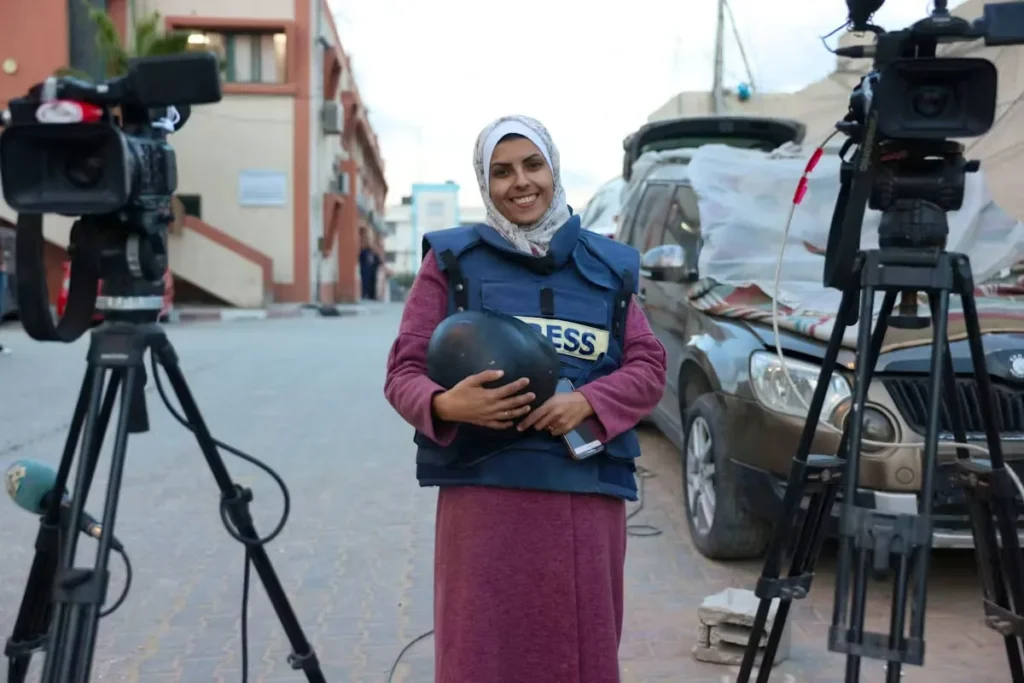
Killed by an Israeli strike, photojournalist Mariam Abu Dagga exemplified the remarkable courage and determination of Palestinian journalists bringing the world the truth.
Days before she was killed, Mariam bylined an Associated Press (AP) story about Gaza’s deepening humanitarian crisis. Through her lens, she captured devastating scenes at Nasser Hospital in southern Gaza, where malnourished children succumbed to starvation as famine spread throughout the Strip.
Her photographs, often graphic, told a story of unbearable desperation: a family showing Mariam a picture of their daughter’s skeletal body; a severely malnourished toddler clutching her mother as she spoke to journalists.
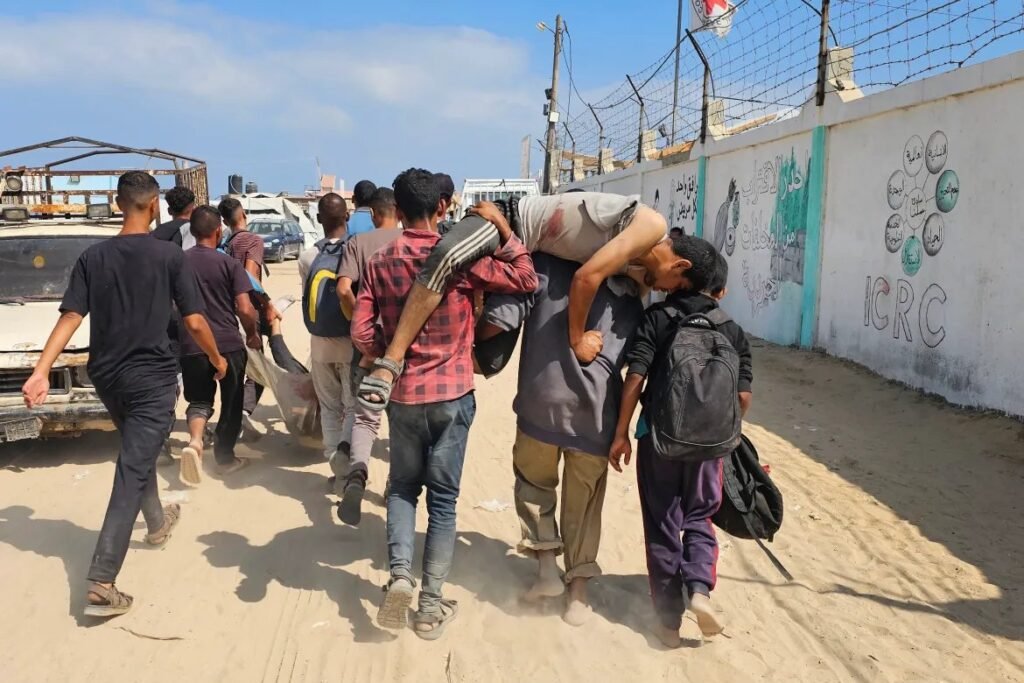
Just outside the hospital gates, Mariam documented the steady stream of patients, some wounded, others already dead, arriving for treatment. She also photographed funerals of children killed in Israeli airstrikes and the chaos around Gaza’s few remaining aid distribution hubs.
Barely an hour before her death, as Israeli bombardment intensified in her area, Mariam sent editors at Independent Arabia footage showing civilians fleeing their homes.
Her Deliberate Targeting
On August 25, 2025, Mariam and four other Palestinian journalists were killed in an Israeli “double-tap” strike targeting Nasser Hospital, where she and colleagues from international outlets such as Reuters and Al Jazeera were based. Israel routinely carries out such strikes, launching a second, delayed missile at the same site to hit first responders and journalists.
Israeli Prime Minister Benjamin Netanyahu later called the strike a “tragic mishap” and said an investigation was underway. Yet Mariam’s killing fits a long pattern of deliberate targeting of Palestinian journalists by Israel. As civilians, journalists are protected under international humanitarian law, and their deliberate killing constitutes a war crime.
At the time of her death, Mariam was among the few remaining local reporters and even fewer female reporters still working on the ground amid escalating dangers.
Mariam risked her life repeatedly to show the world the atrocities unfolding in Gaza. In recognition of her selfless and unwavering commitment to truth, IPI has named her one of the distinguished recipients of the 2025 World Press Freedom Hero Award, in partnership with International Media Support (IMS).
The World Press Freedom Hero Award is given annually to journalists who have made significant contributions to promoting press freedom at great personal risk. Last year, IPI and IMS also recognized Palestinian journalists covering Gaza.
By honoring Mariam this year, the selection committee celebrates the incredible bravery of photojournalists, especially women, risking their lives to bear witness to Gaza’s suffering. IPI also renewed its call to end the ongoing impunity surrounding the killing of journalists in Gaza.
“AP’s team of journalists in Gaza continues to provide the world with crucial eyewitness reporting despite incredibly difficult and dire circumstances,” said AP Executive Editor Julie Pace. “This is exactly what Mariam Dagga, a visual journalist who worked for AP and other regional outlets, was doing when she was killed in a strike on a hospital in Khan Younis earlier this year.”
“Mariam produced searing photos and video that captured the lives of Palestinians facing extraordinary challenges, including families displaced from homes and doctors treating wounded and malnourished children,” Pace added. “We remain devastated by her death and continue to seek answers to ensure journalists are protected as they cover this war.”
“Her Mission Will Live On”
As a journalist living and working amid relentless conflict, Mariam’s professional and personal worlds were deeply intertwined.
Her career began in 2018 when she filmed the shooting of a Palestinian protester during Gaza’s Great March of Return. She later discovered the victim was her brother.
After the war broke out on October 7, 2023, Mariam threw herself into journalism, becoming one of the few women reporters covering the conflict. Freelancing for the Associated Press and Independent Arabia, she offered global audiences a rare glimpse into the human toll of Israel’s assault.
Throughout the war, Mariam endured immense personal tragedy, losing colleagues, her mother, and facing separation from her 13-year-old son, who was evacuated to the UAE. Despite displacement and grief, she continued to report with unwavering dedication, inspiring many of Gaza’s journalists.
“Our late colleague was known for her courage, sincerity, and dedication to her mission,” said Adhwan Alahmari, editor-in-chief of Independent Arabia. “She showed the world the raw reality of civilian suffering and humanitarian conditions in one of the most dangerous environments.”
“[Mariam] was an example of a free journalist who made truth her mission,” Alahmari continued. “Her mission will live on in our work. We will continue to report the truth and defend press freedom, no matter the challenges.”
“I Want You Not to Ever Forget Me”
In the days before her death, Mariam wrote a letter to her 13-year-old son one she hoped he would never have to read:
“I want you not to ever forget me. I did everything I could to keep you happy, safe, and well,” she wrote. “And when you grow up, and get married, and have a baby girl, name her Mariam, after me.”
More than 200 journalists have been killed during Israel’s two-year assault on Gaza, making it the deadliest conflict for journalists in modern history, according to the Committee to Protect Journalists (CPJ).
Independent investigations have found that in many cases, journalists were deliberately targeted by Israeli forces.
Mariam was not the only journalist to leave behind a final message. On August 10, Israel killed five journalists in a strike targeting Al Jazeera’s Anas Al-Sharif, whose reporting had drawn international attention. Following his death, Israel falsely accused him of working with Hamas. In a prewritten message published posthumously on X, Al-Sharif wrote:
“I never hesitated for a single day to convey the truth as it is, without distortion or falsification.”
Since the start of the conflict, Israel has barred international journalists from entering Gaza, forcing foreign media to rely on local freelancers like Mariam. With more reporters killed, displaced, or starved, the number of journalists able to document Gaza’s suffering continues to shrink.
Even in her final hours, Mariam embodied the courage of her profession. Photos recovered from her camera moments before her death show the aftermath of the first Israeli strike that killed a Reuters cameraman at Nasser Hospital. As she approached the site with her camera, a second Israeli strike, the “double tap,” killed her.
She was 33 years old.
The World Press Freedom Hero Award
The IPI will present the World Press Freedom Hero Awards on October 24 at the University of Vienna, during its annual World Congress marking IPI’s 75th anniversary.
This year, seven journalists will be honored for their courage and resilience in defending press freedom: Mariam Abu Dagga (Palestine), Mzia Amaglobeli (Georgia), Martin Baron (United States), Gustavo Gorriti (Peru), Jimmy Lai (Hong Kong), Victoria Roschyna (Ukraine), and Tesfalem Waldyes (Ethiopia).
“This year’s awardees embody the challenges facing journalists as authoritarianism gains ground, impunity prevails, and new threats to free expression emerge,” said IPI Executive Director Scott Griffen. “With this award, we honor their courage and renew our urgent call to defend media freedom as a pillar of free society.”
“Each of this year’s recipients has faced acute danger simply for doing their job,” added IMS Executive Director Jesper Højberg. “Two of them – Victoria Roshchyna and Mariam Abu Dagga – paid with their lives. With immense courage and persistence, these journalists have uncovered corruption, war crimes, persecution, and injustice. We owe them our deep gratitude for their fearless commitment to truth.”