
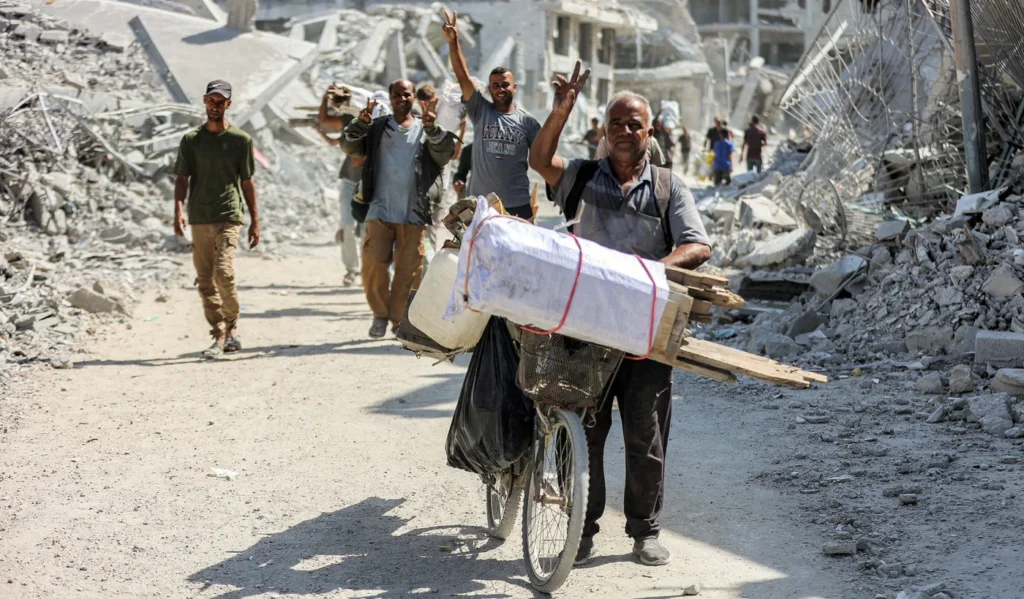
Gaza Herald_ In the heart of Gaza City, where the echoes of bombs have barely faded, families returning home after the ceasefire find nothing that resembles home. Streets once filled with laughter are now fields of dust and ruin. Amid the wreckage, Hiba al-Yazji and her husband Mohammad stand as the last survivors of two families wiped out by war, their story a reflection of the unbearable human cost Gaza continues to endure.
For Hiba, 32, and Mohammad, 35, the past two years have been a nightmare that refuses to end. They have buried dozens of family members, lost their homes, their work, and their sense of belonging. When the ceasefire began two weeks ago, they dared to return to their neighborhood in northern Gaza, hoping to find traces of the life they once knew. Instead, they found only graves desecrated, memories erased, and the haunting silence of a city turned to dust.
“I don’t understand anything anymore,” Hiba said quietly, sitting on a mound of sand beside the tent she now calls home. “The war ends and begins again, and we are just people waiting to die or lose more.”
A family erased
The couple stayed in northern Gaza when Israel’s onslaught began, refusing to abandon their family home in the Sheik Radwan neighborhood. That decision, Hiba says, “cost us everyone.”
On December 3, 2023, their four-story home sheltering dozens of relatives who had fled from other areas was bombed. Sixty members of their extended family were killed in a single strike.
“I lost my entire family: my father, my mother, my six siblings, their children, and their spouses,” Mohammad said, staring at the rubble where his home once stood. “My wife’s family too her parents, siblings, and their children. None of them survived.”
Only Hiba, Mohammad, their 10-year-old daughter Iman, and Hiba’s younger brother were pulled alive from beneath the rubble. But even that fragile miracle didn’t last. A month later, Israeli tanks surrounded the area where they were sheltering, and Hiba’s brother was shot in the back as they ran for safety.
“We hid in a basement while my brother bled beside me for four days,” Hiba recalled, tears streaming down her face. “I couldn’t scream or move. We were waiting to die with him.”
When the tanks withdrew, they buried his body in the sand. “After that, I wished I had died too,” she said. “Surviving feels like punishment.”
Graves bulldozed, memories shattered.
After months in displacement camps in southern Gaza, the family returned north following the ceasefire, only to discover another devastation. Their homes were gone, their business flattened, and the graves of their families bulldozed.
“Imagine spending the whole night collecting the remains of your loved ones — those you buried with your own hands,” Hiba said, pointing to a patch of sand where the graves once stood. “I keep warning people not to walk over them. They are under this ground, what’s left of them.”
Mohammad’s voice was hollow. “Even death is not sacred here. Our families were killed twice, once under the bombs, and again under the bulldozers.”
No future left
The ceasefire has brought no sense of peace. “There’s no water, no electricity, no life,” Mohammad said. “Even this so-called ceasefire it’s just a pause before the next attack.”
He says he will leave Gaza the moment the borders open. “There’s nothing left to live for,” he added. But Hiba’s only thought is for their daughter.
“My daughter has seen death more times than she’s seen a classroom. She’s only ten, and she’s lived through horrors no child should know. I want her to have a future anywhere, far from this.”
The weight of survival
Each night, the couple sits together outside their tent, staring into the distance. “Sometimes I ask my husband,” Hiba says softly, “if we had started this war ourselves, would we deserve this punishment?”
There is no answer, only silence, broken by the wind that carries the dust of Gaza’s dead. For Hiba and Mohammad, survival feels like exile in their own land, surrounded by ghosts, waiting for a peace that never truly comes.

