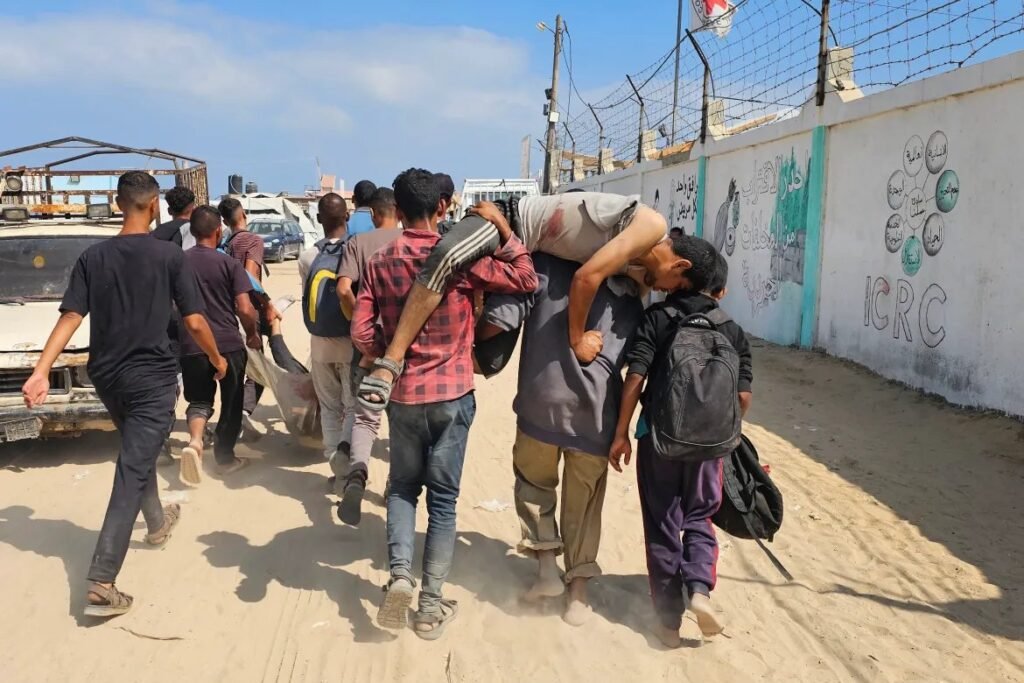
Gaza Herald_ When a ceasefire was announced in Gaza, many hoped it would mark the beginning of relief for a population starved and battered by nearly two years of relentless warfare. But for Palestinians, the silence of the guns has not meant the return of life. Instead, Israel’s control over humanitarian aid has emerged as a new front in its ongoing campaign, one that trades bombs for blockades and fire for famine, keeping Gaza’s civilians trapped in a cycle of dependence and deprivation.
Nearly a year after the International Criminal Court (ICC) issued an arrest warrant for Israeli Prime Minister Benjamin Netanyahu on war crimes charges — including the use of starvation as a weapon Israel continues to defy international law with impunity. Despite the ceasefire, the Israeli government has again turned humanitarian aid into a political weapon, halting and restricting assistance to Gaza’s two million residents.
On Sunday, Israel temporarily froze all aid convoys entering Gaza, and for several days, it has partially blocked the flow of essential supplies. Officials justified the decision as a means to pressure Hamas into locating and returning the bodies of Israeli captives. Yet for the people of Gaza already living amid ruin, hunger, and disease the move deepens an already intolerable humanitarian crisis.
The act is not only a moral failure but also a legal one. The Rome Statute of the ICC explicitly classifies “using starvation of civilians as a method of warfare” as a war crime, including the deliberate obstruction of relief supplies indispensable to survival. By withholding food, fuel, and medicine during a declared ceasefire, Israel violates the very framework of humanitarian law it claims to respect.
A recent report from the UN Commission of Inquiry confirms that this policy is part of a broader campaign to collectively punish Palestinians. Investigators concluded that Israel’s “use of starvation as a method of war through the total siege on the Gaza Strip has had devastating impacts on civilians,” particularly children. The report documented rising rates of acute malnutrition, disease outbreaks, and preventable deaths — all outcomes directly linked to Israel’s blockade and bombing of vital infrastructure.
While the ceasefire was meant to usher in a period of recovery, Israel’s actions ensure continued suffering. Aid trucks sit idle at border crossings. Medical shipments are held up. Water and sanitation systems remain unrepaired. Yet, in official statements, Israeli authorities shift blame onto Hamas and international agencies, creating a narrative of shared responsibility that conceals deliberate policy choices.
In practice, Israel’s manipulation of aid represents a continuation of warfare by other means. By deciding who eats, who heals, and who survives, Israel retains total control over Gaza’s population — even without firing a single shot. This power dynamic underscores that for Palestinians, “peace” remains a conditional privilege, not a right.
The ceasefire may have halted the bombs, but it has not ended the siege. Israel’s weaponization of aid lays bare the hollowness of international promises and the failure of global institutions to uphold their own laws. Until access to food, medicine, and relief is treated not as a bargaining chip but as a human right, Gaza will remain a place where peace exists only on paper and where survival itself is an act of resistance.