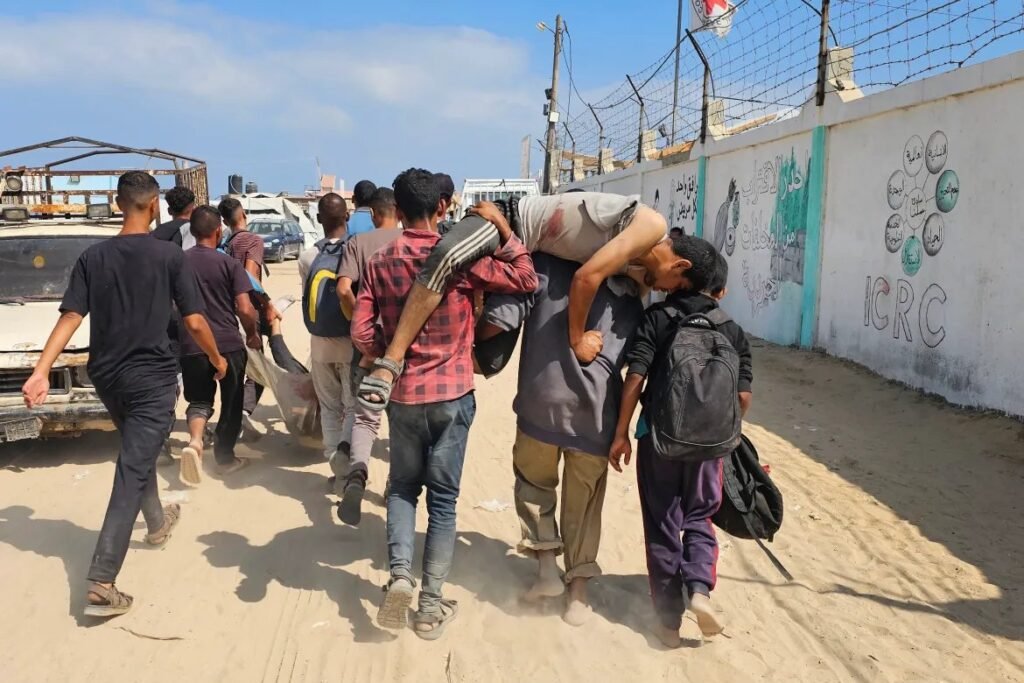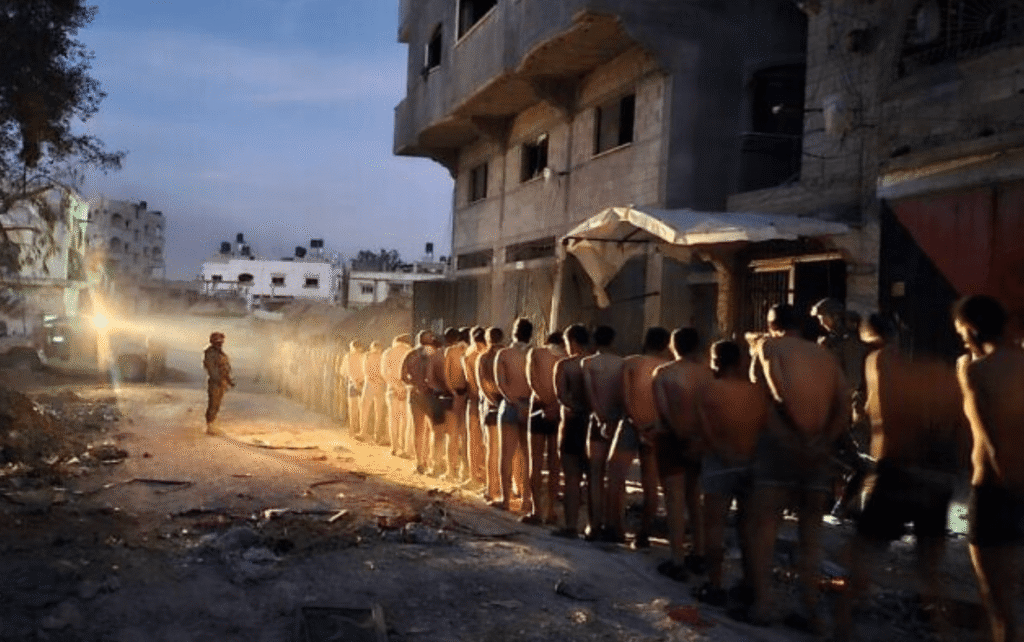
Gaza Herald_ Palestinian detainees recently released from Israeli custody have described horrifying conditions, detailing systematic torture, starvation, and psychological abuse inflicted on prisoners throughout the two-year genocidal war on Gaza.
One former detainee condemned Israeli prisons as “prisons of injustice,” saying that most Palestinian inmates were subjected to torture multiple times a day. He recalled being shot with rubber-coated bullets, sustaining deep wounds around his private parts and back, and witnessing others being electrocuted by Israeli soldiers. “We were detained in a slaughterhouse,” he said.
Speaking from Nasser Hospital in Khan Younis after his release, he affirmed that despite the suffering, Palestinians in Gaza remain “brave and steadfast.” He added, “We have sacrificed a lot, but our sacrifices are too little compared to others,” expressing gratitude to “God, the Palestinian people, and the resistance fighters in Gaza” for securing his freedom.
Another released prisoner, Shadi Abu Seed, gave a harrowing account of his time in detention, describing unrelenting abuse and deprivation. “I went hungry for the past two years. I swear to God, they didn’t feed us. They kept us naked. They beat us while we were naked day and night. We were tortured,” he said.
“Until our last day in Israeli prison, they cut us, hit us, and abused us. We endured every kind of torture, emotional and physical. We couldn’t even sleep. They threatened us with our children. They told me they killed my children. Not only that, but they told us Gaza was destroyed,” Abu Seed continued.
“When I arrived, I found that everything was gone. It looked like the end of the world. Everything is different.”
These testimonies echo mounting reports of widespread torture, starvation, and forced disappearance of Palestinians in Israeli detention centers, a system that rights groups have long described as an instrument of collective punishment and dehumanization.
Earlier Testimonies Reveal the Depth of Abuse
In May 2024, additional testimonies gathered by the Palestinian Prisoners’ Club and the Commission for Detainees and Ex-Detainees Affairs revealed yet more horrifying details about the conditions endured by Gaza detainees held in Israeli prisons and military camps.
Legal teams visiting prisoners in the so-called Rakevet Section beneath Israel’s Nitzan Prison, a section reserved for what Israel calls “elite detainees” or “unlawful combatants,” described the underground facility as a dungeon crawling with insects and filled with holes in the walls and floor. Access was permitted only under extreme restrictions and close surveillance, with guards forbidding any mention of family members or life outside the prison walls.
Lawyers reported visible signs of terror and exhaustion among the detainees. Initially, most were too afraid to speak, fearing punishment. But after reassurance, some began recounting their ordeals — stories of systematic abuse, humiliation, and physical torment that have become disturbingly familiar.
One detainee, identified as S.J., described being arrested in December 2023 and subjected to six days of relentless interrogation. “They forced me to wear diapers for all six days,” he said. “I was not allowed to use a toilet. They changed them only twice.” Others reported sexual assault, the breaking of fingers, and beatings so severe that bones were crushed.
The organizations’ findings confirm a pattern of deliberate and systematic torture — acts that meet the international legal definition of war crimes and crimes against humanity. What emerges from these accounts is not isolated abuse, but an institutionalized policy of degradation meant to erase Palestinian dignity and identity.
Starvation, Isolation, and Endless Transfers
One detainee described being deprived of food and given only half a cup of water a day during interrogation. His hands were tied and his eyes were blindfolded at all times. After days of continuous torture, he was transferred from the Sde Teiman military camp to Ashkelon Prison, where he remained for 45 days, then to al-Moskobiya interrogation center for 85 more days, before finally being sent to Rakevet Section in Ramla Prison — described as the harshest of all.
Each cell, he said, holds three prisoners, one of whom sleeps on the floor. Detainees are allowed into a small courtyard only every other day, always shackled, and even then, the space receives no sunlight. “At every moment, we are humiliated and insulted,” he said.
Sexual Assault and the “Breaking of Fingers”
Another detainee, identified as W.N., recounted being arrested in December 2024 and subjected to interrogation and beatings before being transferred to Ramla Prison. “Today, I suffer severe pain throughout my body,” he said. “They forced us to kneel for long periods and hit me on sensitive parts of my body during searches — a form of sexual assault.”
He added that prisoners are denied clothing, forced to wear torn garments, and forbidden from having underwear. “We live in complete isolation; we don’t know when the sun rises or sets. They make us curse our mothers and beat us when we refuse. During one transfer, they broke my finger. The guards use that method, breaking fingers as punishment. Many detainees suffered the same.”
“The Disco Interrogation” and Disease
A third detainee, identified as Kh.D., described being subjected multiple times to what is known among prisoners as the “disco interrogation,” a method involving prolonged exposure to loud, disorienting sounds, followed by beatings and stress positions. “They tied me to a chair for hours, threw me to the ground while my hands were bound, and interrogated me for 30 days in Ashkelon Prison,” he said.
He developed scabies during his detention in Ofer Prison, a disease that spread to many other inmates, and continues to suffer from chest pain caused by being tied with his arms pulled backward. He explained that the prison administration punishes detainees by deliberately breaking their thumbs.
Constant Surveillance and Medical Neglect
Another detainee, A.G., spent 35 days in Sde Teiman camp, where he endured “disco” interrogations for five consecutive days despite being injured and suffering from a heart condition. “I was in constant pain and screamed all night. I fainted several times,” he said. “For 15 days, I was handcuffed and blindfolded at all times. I had no clothes or blanket, only the freezing air in a makeshift barracks open on several sides.”
These testimonies, collected under strict surveillance, add to the growing body of evidence documenting Israel’s systematic use of torture, sexual violence, and starvation against Palestinian detainees, practices that meet the definition of war crimes under international law.
What emerges is a regime of deliberate cruelty, where humiliation replaces justice, and pain is used as a language of control.
Yet, through all the horror, one truth remains: even under conditions of unspeakable suffering, Gaza’s prisoners carry the unbroken spirit of their people, steadfast, unyielding, and determined that no cell, no chain, and no torture will strip them of their humanity or their right to freedom.
These testimonies, past and present, are a chilling testament to the cruelty of Israel’s apartheid system, a regime that wages war not only on Gaza’s cities and hospitals, but on its prisoners’ bodies and souls. Yet even in the darkest cells of occupation, the Palestinian spirit endures, refusing to yield, reminding the world that freedom is not granted by power, but earned through unbreakable resilience.