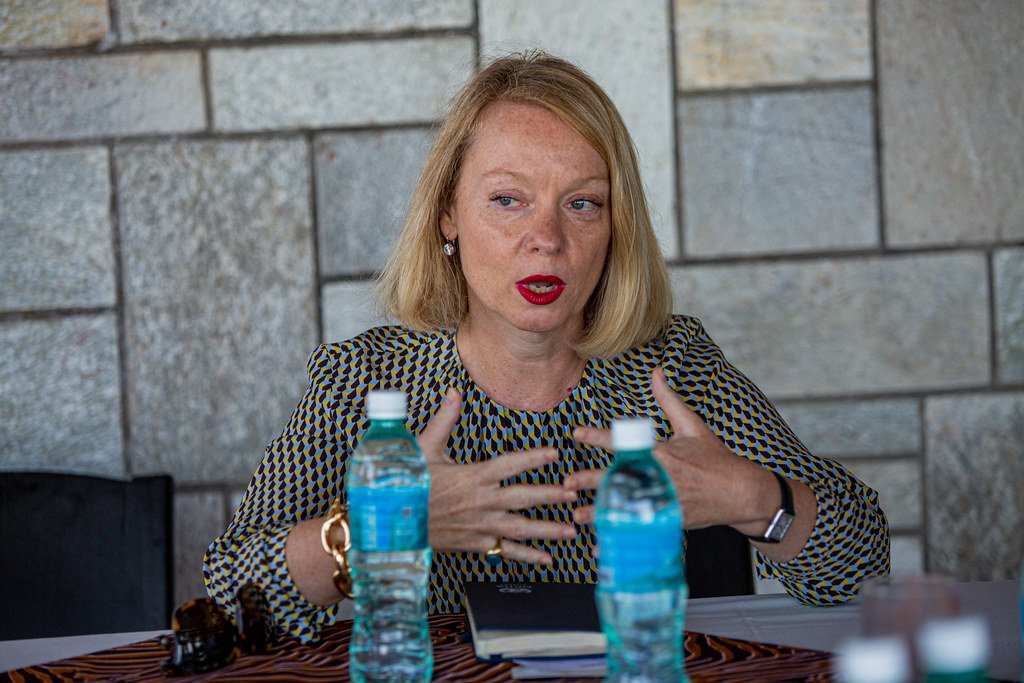
Gaza Herald— An explosive investigation by The New Humanitarian has revealed that Susanna Tkalec, Deputy Humanitarian Coordinator for the United Nations in the Occupied Palestinian Territories, is facing serious accusations from humanitarian staff in Gaza of collusion with Israel’s siege policies and complicity in the systematic starvation of civilians.
According to testimonies from 11 humanitarian workers interviewed by the outlet, Tkalec allegedly allowed Israeli authorities to manipulate the distribution of humanitarian aid, delayed or avoided confronting restrictions on aid entry, and repeated Israeli talking points while blaming Palestinians for the severe shortages of food and medicine in Gaza.
“She Cares More About Dogs Than People”
The report cites one of the most shocking claims: that Tkalec personally negotiated with Israeli authorities to import food for stray dogs near her residence while thousands of Palestinians were dying of hunger.
“She cares more about dogs than people,” one UN staff member said. Another described her conduct as “utterly insensitive toward her Palestinian colleagues.”
Tkalec has also been accused of taking frequent, unnecessary trips outside Gaza, leaving the UN’s humanitarian leadership absent from the field during one of the most catastrophic crises in modern history. Colleagues told The New Humanitarian that her actions “served Israel’s interests” by granting it a humanitarian cover for its blockade while allowing the limited entry of symbolic aid shipments.
Complicity Through Silence and Inaction
One of the most controversial decisions, according to the report, came in August, when Tkalec signed an agreement with Israeli authorities restricting the distribution of humanitarian tents to southern Gaza only. Humanitarian workers said the move effectively endorsed Israel’s forced displacement campaign, which coincided with a major military offensive that displaced more than 780,000 Palestinians from Gaza City and northern areas.
Staff members accused Tkalec of falling completely under the influence of Israel’s Coordination and Liaison Administration (COGAT), the military unit overseeing Gaza’s blockade. Her leadership, they said, has weakened the role of the UN Office for the Coordination of Humanitarian Affairs (OCHA) and marginalized UNRWA, the main UN agency providing services to Palestinian refugees , a long-standing Israeli objective.
In May, she reportedly approved a controversial plan to distribute flour only to bakeries instead of directly to families — without consulting local communities. The policy collapsed within days, leading to chaos, stampedes, and several deaths as desperate residents struggled to obtain bread amid widespread hunger.
UN Silence Under Scrutiny
While Tkalec has denied all wrongdoing, claiming her actions reflect “the position of the United Nations” and insisting her only goal is “effective and safe aid delivery,” many field workers describe her public statements as devoid of any criticism of Israel.
“She keeps talking about ‘progress in negotiations’ while children are starving to death in the north,” one humanitarian worker said.
According to insiders, Tkalec has also sought to sideline UNRWA and transfer its key roles to the World Food Programme (WFP), despite the WFP’s lack of UNRWA’s infrastructure and deep local networks in Gaza.
“The entire community trusts UNRWA,” said one aid worker. “But she behaves as if the agency no longer exists.”
Humanitarian analysts note that this mirrors Israel’s long-term strategy of weakening UNRWA, which represents not just a service provider but a symbol of Palestinian identity and rights.
“An Outrageous Insult” to Palestinians
In another widely criticized incident, Tkalec met with Palestinian journalists in June, urging them to “calm their communities and prevent looting” , without mentioning Israel’s role in creating the famine. Outraged journalists later issued a statement calling her remarks “an unbearable insult.”
“You cannot discuss looting without addressing the crimes of occupation,” they said.
The report concludes that Tkalec’s leadership has fractured the humanitarian response in Gaza, leaving aid workers demoralized and coordination paralyzed.
Her approach, colleagues warn, represents a moral and institutional failure at a time when silence equals complicity.
“She behaves as if Gaza is a normal emergency,” one senior aid official said. “But this is not an emergency ,it’s a genocide against an entire people.”