GazaHerald- Surviving in Gaza today is not a single decision. It is a daily calculus of life and death, a choice repeated endlessly under relentless bombardment. Over a million Palestinians in Gaza City now face this agonizing dilemma: stay and risk being killed at home, or leave and face deadly hazards on the road south.
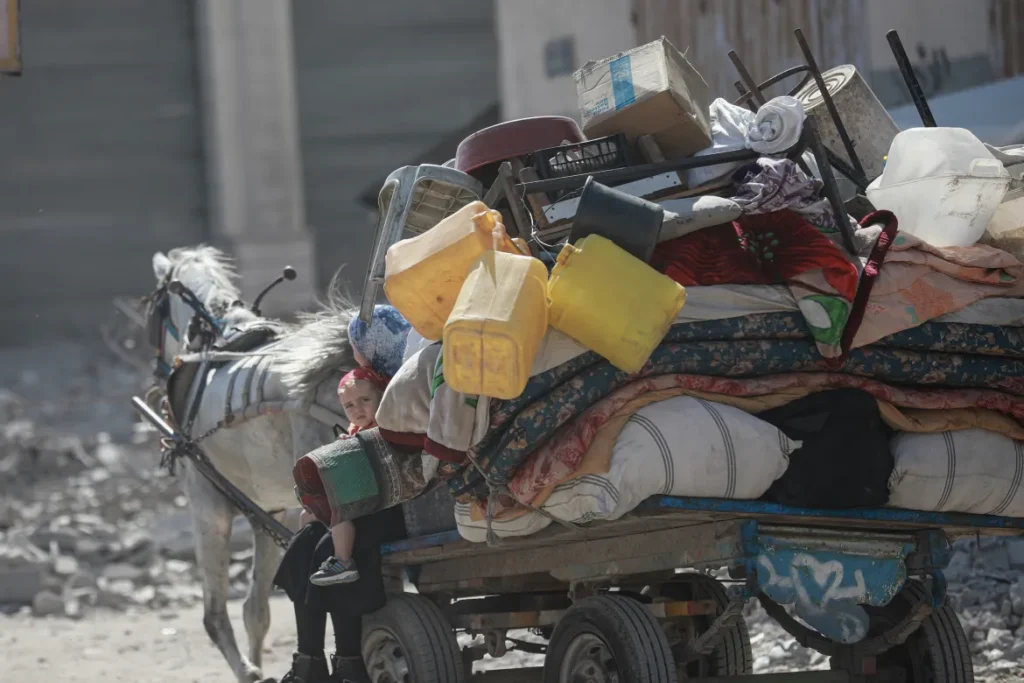
One family, Mohammed, his wife Inas, and their two children, walked for four hours under the scorching sun along what was once a bustling neighborhood in Al Rashid Street. Local sources describe the area as a wasteland, littered with leaflets in Arabic directing residents along routes dictated by Israeli expulsion orders. One child clutched a schoolbag, and another was dressed in black, as the family stepped into the unknown.
For Mohammed and Inas, this was not their first displacement. Last year, they attempted to leave Gaza for Egypt to secure their children’s education after schools were destroyed in Israeli airstrikes. At the Netzarim Corridor checkpoint, Inas was arrested; soldiers seized her savings, passports, phones, and even the family’s gold. After two days, she was released to the north, while Mohammed and the children continued south, only to find the Rafah crossing closed. The family spent 75 days separated before a brief ceasefire allowed them to reunite.
Desperate Flight and Lifelines Destroyed
Now, they are on the move again. Mohammed described a night of terror: Israeli forces dropped three exploding robots and 20 to 30 bombs near their home. Quadcopters hovered overhead, and neighboring houses were shelled. With possessions and memories left behind, the family slept on the street before embarking south, carrying what little they could save.
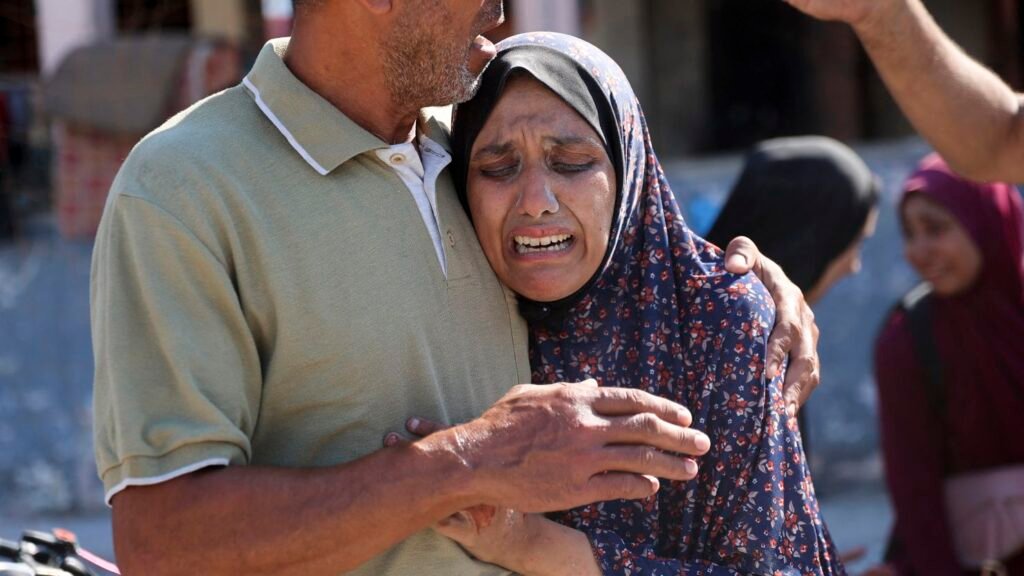
“This trip is the second-worst day of our lives,” Mohammed said. “We bid farewell to our home and to Gaza and head into the unknown.”
Palestinians resisting expulsion face systematic deprivation. Witnesses report that Israeli forces have destroyed essential lifelines, targeting water tanks, rooftop solar panels, schools housing thousands, internet access points, and mobile charging stations. Emad Sarsawi, a resident who chose to remain, described the slow suffocation of life: “If we were bombed, we would all be killed at once. But like this, we can’t even find drinkable, or even undrinkable, water, and we’ll die slowly of thirst.”
For those who flee south, danger does not end. Accessing food means risking sniper fire. One Israeli sniper admitted to killing dozens of Palestinians daily, including children, under the pretext of securing humanitarian aid. He described it as a grim game of cat and mouse, with civilians unknowingly crossing invisible lines under threat of death.
No Safe Place
The choice between home and the road is a cruel one. Residents debate constantly whether to stay in a crumbling city or risk violent displacement. “Not only is there no safe place, but I prefer to die in my house in Gaza City than to evacuate. I have nothing to lose,” one local said.
Recent Israeli expulsion orders and nighttime attacks have displaced tens of thousands. Gaza’s Civil Defence Rescue and Support Agency estimates 70,000 were forced from their homes in recent days, while the Israeli military claims 300,000, including 20,000 in a single night. The disparity underscores the political nature of displacement: the emptier Gaza City becomes, the freer Israeli forces feel to kill those who remain.
After a grueling 12-kilometer trek in intense heat, Mohammed and his family finally reached Nuseirat refugee camp north of Deir al-Balah, exhausted and broken. Bombs continued to fall around them.
“This was supposed to be the best time of my life, when I could watch my children grow up and become something important,” Mohammed said. “Instead, I am living through the worst days of my life, and I don’t know if I will even live to see them grow up.”