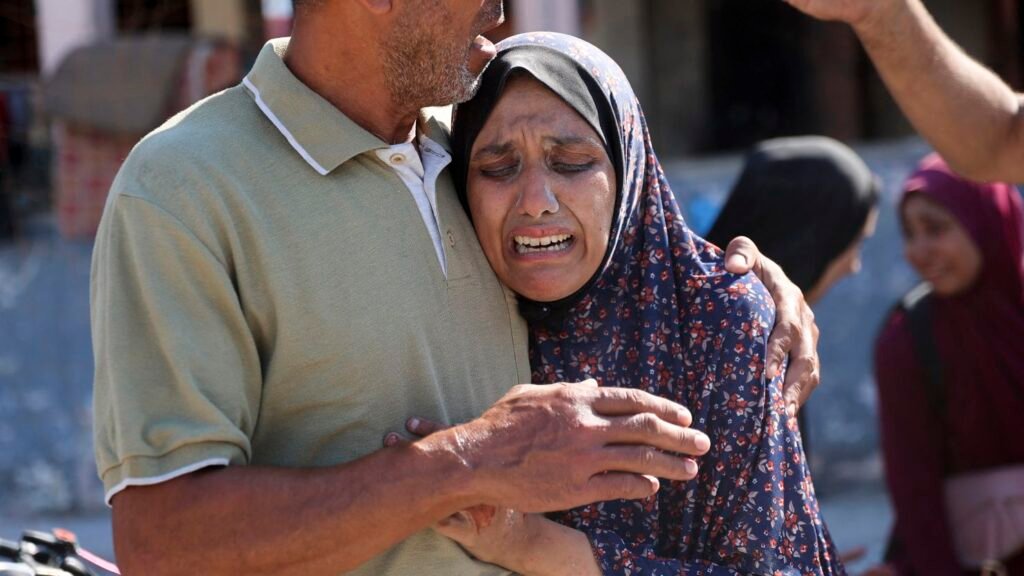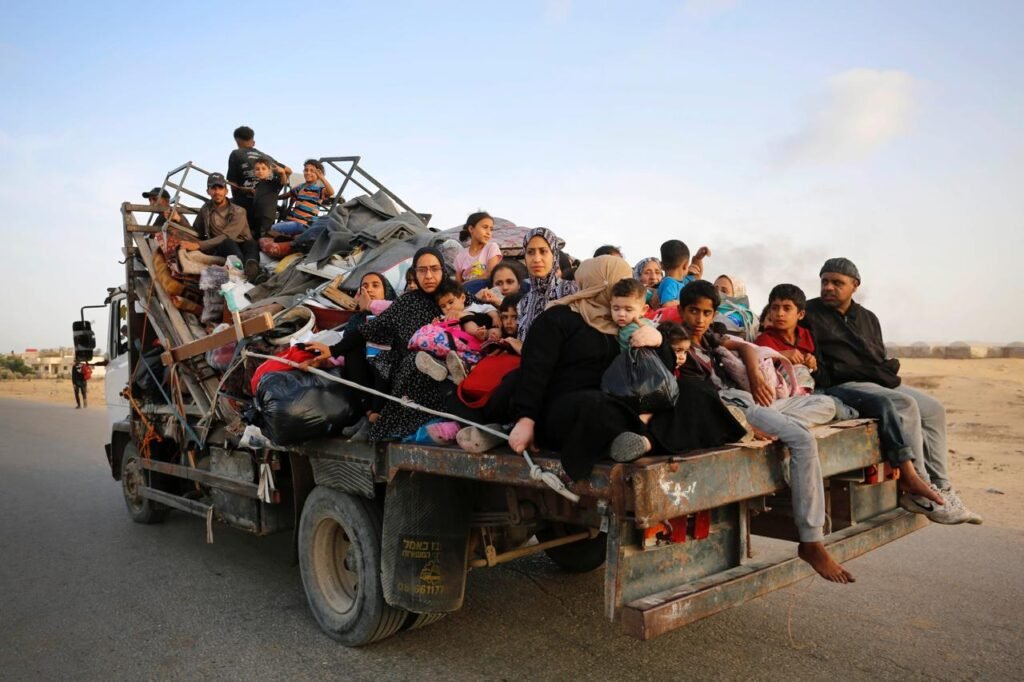
Gaza Herald- For tens of thousands of Palestinian families, displacement has become the defining tragedy of life under Israel’s relentless assault on Gaza. What was once unthinkable, leaving behind homes, memories, and entire lives, has now become a recurring reality.
Every new round of bombing brings a new wave of forced evacuation, tearing families away from their neighborhoods and pushing them into overcrowded shelters or fragile tents that can barely withstand the weather.
On the seventh floor of a residential tower in central Gaza City, Mohamed Al-Attar faced a choice no parent should ever have to make. Within minutes of an Israeli warning to bomb the building, he was forced to abandon the home he had spent years building, piece by piece, with the money he earned working in the Gulf.
Al-Attar managed only to grab a small bag with clothes and identification papers before leading his family out, leaving behind the apartment he was still paying for — its furniture, his memories, and the life he had carefully built, now left at the mercy of an Israeli airstrike.
Speaking with a voice heavy with grief, he told our reporter: “I felt as though I was being torn from my home the way the soul is torn from the body. The decision was harsher than words can describe, but saving my children was more important than anything else.”
Homes Turned to Rubble
In recent days, Israel has escalated its bombardment of residential towers and high-rise buildings in Gaza City, forcing tens of thousands of residents and already-displaced families to flee further south.
But leaving is far from simple. Electricity cuts have shut down elevators, making it impossible to move furniture. Carrying wooden cabinets or appliances down narrow staircases requires laborers, whose transport costs often exceed the value of the items themselves. In desperation, some families have sold their cupboards and beds as firewood for cooking, a tragic reminder of how possessions, once symbols of dignity and stability, are now reduced to fuel for survival.
From a Modern Apartment to a Leaking Tent
The journey of displacement cost Al-Attar more than 2,500 shekels — covering taxis, a few salvaged belongings, and temporary shelter. He eventually reached Deir al-Balah, where relatives had already taken in dozens of displaced families. Overcrowding forced him to pitch a tent on a rooftop, where he now lives with his wife and children in barely livable conditions.
“I used to live in a 150-square-meter apartment in a modern tower worth $70,000. Today, I am in a tent hardly ten meters wide, with a roof that leaks whenever it rains,” he said, his words painting the scale of his fall from comfort to bare survival.
Financially Crippling Displacement
Al-Attar’s ordeal mirrors thousands of other Gazans. Umm Mahmoud, a mother of seven from Al-Rimal neighborhood, explained that moving her family to Deir al-Balah cost around $4,000. The expenses covered overpriced transport, the purchase of a large tent, and the construction of a makeshift bathroom of tin and bricks to preserve a minimal sense of privacy.
“Displacement here is not just about losing a house and furniture,” she said. “It empties what little savings we have left. Even going back after a truce costs us more money.”
A Cycle That Crushes Families
Economist Mohamed Abu Jayab says these forced displacements come amid one of the harshest economic conditions Gaza has ever faced, nearly two decades of blockade, skyrocketing prices for fuel and basic goods, and a suffocating economic paralysis.
Families, he explained, are often forced to sell possessions at rock-bottom prices or plunge into debt just to survive. “This repeated cycle of displacement and return has destroyed household economies,” Abu Jayab said. “Families have drained their savings in losing deals and are no longer able to rebuild.”
Beyond Homes: The Loss of Safety
But the impact goes deeper than material loss. Children who once slept in their own rooms now crowd together with cousins on a tent floor. Women who once managed their homes with dignity now stand in long lines for a liter of water or a hot meal.
Displacement is not only the destruction of houses, but it is the destruction of stability, safety, and the very fabric of family life.
Endless Displacement, Endless Waiting
The stories of Al-Attar, Umm Mahmoud, and countless others are just fragments of the larger catastrophe unfolding across Gaza. Each cycle begins with fear, continues with the loss of homes and savings, and ends in a tent unfit for human life.
And each time violence escalates, the cycle starts again: forced evacuation, fragile resettlement, and the crushing burden of return. Displacement has shifted from a temporary measure to a chronic, permanent reality, turning dreams of home into fading memories and leaving Gazans suspended in a state of waiting for a return that may never come.
For the people of Gaza, displacement is not only the loss of houses but the loss of dignity, stability, and the very sense of belonging. It is a war within a war a battle to hold on to identity, memory, and hope in a land where even survival comes at an unbearable cost.