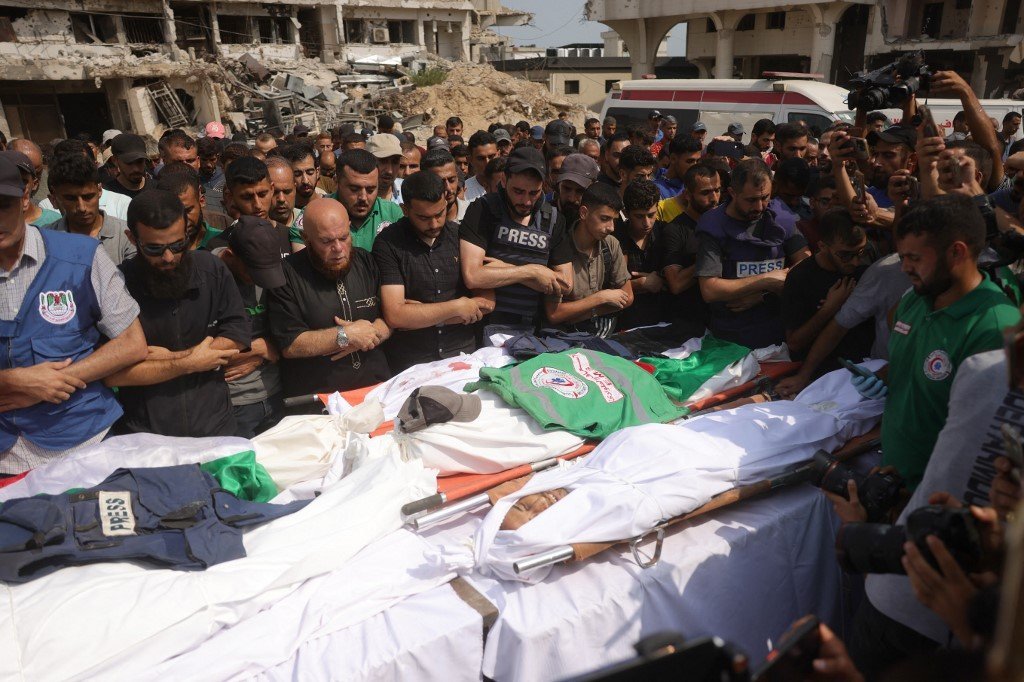
Gaza Herald- With their press vests draped across their bodies, six more Palestinian journalists targeted and killed by Israeli forces were laid to rest on Monday in Gaza.
The scene was tragically familiar. For nearly two years, reporters wearing jackets marked “press” have gathered not for work, but to grieve over the bodies of their friends and colleagues. This time, the mourners said goodbye to Anas al-Sharif, Middle East Eye contributor Mohammed Qreiqeh, Ibrahim Zaher, Mohammed Noufal, Moamen Aliwa, and Mohammed al-Khalidi bringing the total number of Palestinian journalists killed in Gaza since October 2023 to at least 238.
Their deaths came after Israeli forces deliberately struck a media tent outside al-Shifa Hospital in Gaza City late Sunday night. Medhat al-Sawalha, whose own tent was only metres away, witnessed the aftermath.
“I stepped out to buy something from a stall,” he recalled, saying he returned to find the journalists’ tent engulfed in flames. “I didn’t hear the blast, but my family at home said they did.”
When he rushed over, he found Sharif and several others dead, their bodies torn apart. “Anas may God have mercy on him, I carried him with my own hands,” he said. Next to him was another body so badly mutilated it could not be identified; the head was missing.
Bound by shared danger
Just hours later, Palestinian reporters were back at the site. The tent’s frame had been blown away, leaving only charred mattresses and scattered belongings. They mourned, took photographs, and recorded footage, a heartbreaking merging of their loss with the work they continue to do under fire.
It is a grim routine broadcast journalist Mohammed Abu Namous knows too well. “Imagine last night, I arrived at the scene in the middle of the night and went live on air,” he said. “With one hand I was speaking to the channel, and with the other I was texting my family to tell them I was safe.”
Addressing his peers abroad, Abu Namous said the least the international press could do was demand protection for Palestinian journalists. “What’s the difference between a foreign journalist and a journalist in Gaza?” he asked. “To the Israeli occupation, all Palestinians are targets who can be killed at any time.”
Ramadan Abu Sakran, a close friend and colleague of Sharif, Qreiqeh, and Zaher, said they were “closer than family” because they lived and worked side by side sharing food, sleeping in the same places, and covering dangerous sites together.
“We lived through the same fear, the same feeling of being targeted,” he said. “We comforted each other over the horrors we saw every day.” He remembered Sharif for his constant laughter and quick jokes, even after being threatened directly by the Israeli military alongside fellow journalist Hossam Shabat last year. “We used to say, ‘If we’re going to die, we’ll die together.’ That’s how we found the courage to keep going.”
Israeli accusations without evidence
Shabat himself was killed in March when Israeli forces deliberately struck his vehicle in northern Gaza. The Israeli army has since claimed, without producing any credible proof, that Sharif was “the head of a terrorist cell in Hamas,” the same accusation it made about Shabat. The Committee to Protect Journalists has repeatedly rejected such claims as baseless.
Al Jazeera, for whom Sharif was a prominent Gaza correspondent, called him “one of Gaza’s bravest journalists” and said the attack was “a desperate attempt to silence voices ahead of the occupation of Gaza.”
“These reporters told the truth without distortion to the entire world,” said Tamer Daloul, a correspondent for Al-Ghad TV in Gaza City. He noted that Sharif and Qreiqeh refused to leave northern Gaza even during mass displacement, choosing to remain first at the Ahli Arab Baptist Hospital, then at the al-Shifa complex, where they were eventually killed.
Daloul said the deaths of these journalists, along with hundreds of others, have left him fearful not only for himself but for his family. “We no longer sleep at our families’ homes, afraid of putting them in danger,” he said. “We don’t know anymore, should we keep reporting? Should we stop? Are we even protected?”
And yet, despite the risks, he insisted, Palestinian journalists try to keep going. “We continue to do everything we can,” he said, “because our stories must be told.”
The funeral of these six journalists was not only a farewell, but also a defiant statement that their voices will not be erased. Each camera they carried, each report they filed, was an act of resistance against the silence Israel tries to impose on Gaza. Even in the face of relentless targeting, their colleagues vow to keep telling the world what is happening, not just for those still alive, but for those who died with the word “press” across their chests, bearing witness until their final breath.