
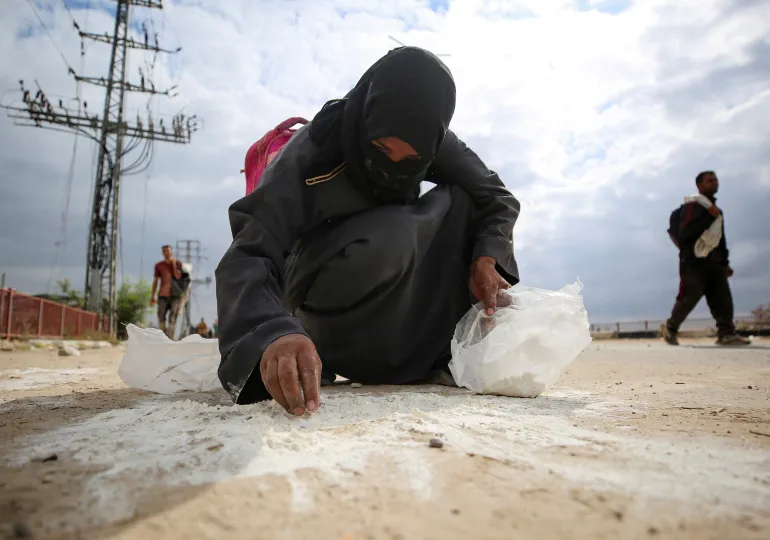
Gaza Herald- In the heart of Gaza’s humanitarian collapse, desperate Palestinians are risking their lives just to secure a handful of food. With Israel’s siege turning aid distribution into a scene of horror, survivors recount how food lines have become fatal traps.
Man from Nuseirat Camp: ‘It’s a Game, They Let You Move, Then Open Fire’
Ibrahim Mekki, a resident of the Nuseirat refugee camp in central Gaza, described a harrowing experience at a food distribution site run by the GHF. He waited for over six hours, braving the constant threat of Israeli gunfire, only to walk away with a meager portion of aid.
“Shooting, killing, death, destruction, and martyrs,” Mekki recalled. “And for what? Just to get a little food.
“It’s a trap, a game… Letting you move a little, then opening fire.”
According to Mekki, the site was overwhelmed with people, but only a small fraction perhaps 5 percent — managed to retrieve anything useful.
“Look at me, what did I get? Nothing,” he said, showing a plastic bag containing just two small packets of pasta and a bag of bulgur wheat. “It’s not even enough to feed the kids for a single day.
“I’m forced to go back every single day to try again,” he added.
Palestinian Mother: ‘A Death Journey Just to Feed My Girls’
A Palestinian mother of two described the aid distribution ordeal as a “death journey” — a brutal struggle to provide for her daughters in a system that has collapsed under the weight of war and blockade.
“I need to provide for my girls. I don’t have anyone to support me,” she said.
The aid lines, she explained, are a battleground where only the strongest or most desperate get through. Children often manage to reach supplies, only to have them snatched away by adults. “There are children who worked hard to get [aid], and men come to take it from them,” she said.
After enduring the chaos and sustaining an injury to her arm from being struck in the crowd, she left the site with only rice, a can of tomatoes, and some cooking oil.
Still, she called the little she received “a blessing from God.”
Special Testimonies for Gaza Herald
‘I saw a boy no older than 10 collapse under the sun with nothing in his hands,’ said 36-year-old Sameer Abu Taha, a former teacher from Deir al-Balah. “He was trampled in the stampede. I tried to lift him, but there were too many people, too much panic.”
Another witness, 22-year-old Mariam Hassan, who lost both her brothers in the ongoing war, recounted a moment that left her shattered. “A woman beside me screamed that her baby was missing. We found him minutes later, covered in dust and blood, not from bombing, but crushed in a crowd begging for food.”
Others told of Israeli drones hovering overhead during the distributions. “It’s not just the hunger, it’s the fear of being shot from the sky,” said Mohammed Al-Qidra, who has volunteered to escort elderly people to the aid centers. “They let us hope for survival, then remind us we’re still targets.”
For many in Gaza, aid lines have become a gamble between hunger and death a system where even survival feels weaponized.

