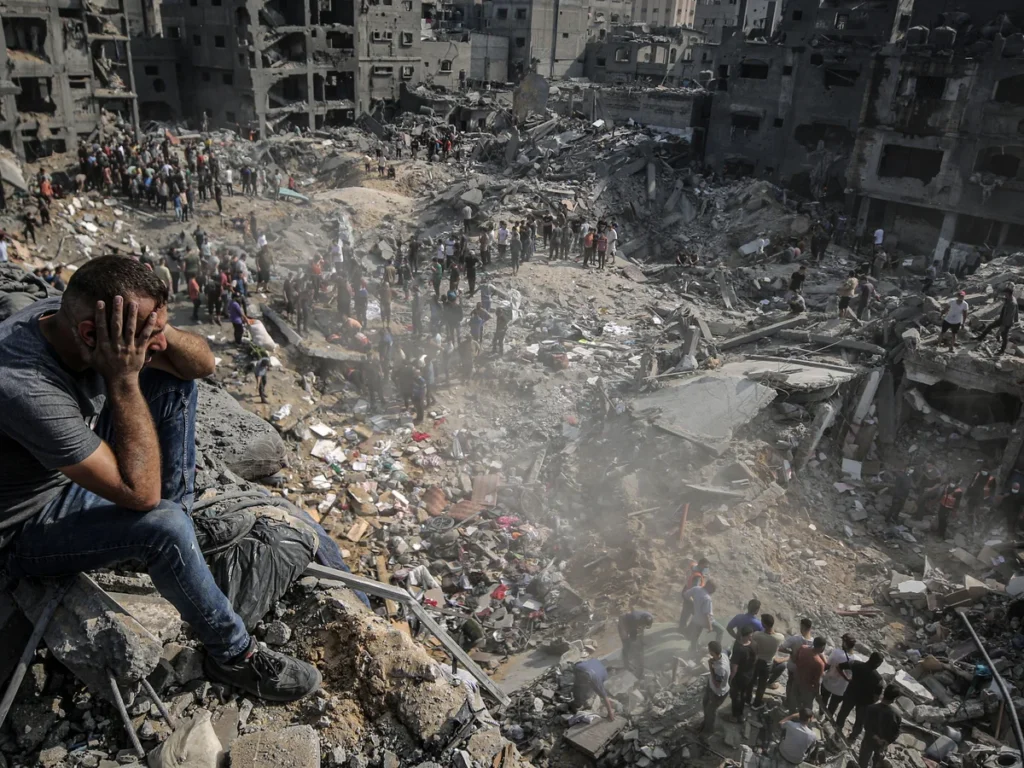
Gaza Herald-As the humanitarian crisis in the Gaza Strip intensifies, the Gaza Humanitarian Foundation (GHF) has come under increasing scrutiny. Originally launched with open U.S. backing and framed as a humanitarian initiative, the organization now faces serious accusations of contributing to the suffering of Gaza’s civilian population, raising concerns that its operations violate fundamental humanitarian principles.
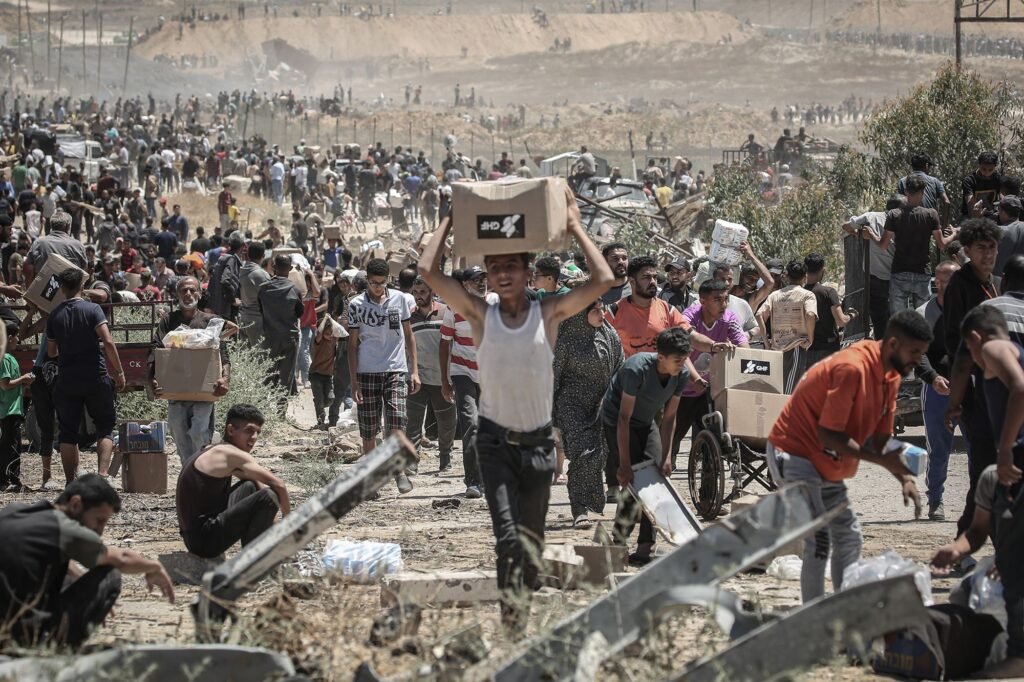
The Gaza Humanitarian Foundation (GHF) has become the sole provider of humanitarian aid in Gaza after closing several of its major distribution centers in southern and central Gaza, leaving only one operational hub in Rafah. Previously, each closed center served around 300,000 Palestinians, raising urgent concerns about how over 1.7 million residents in other parts of the Strip will access essential food and supplies.
The organization operates four distribution points, three in Rafah and the fourth in the Netzarim axis. All are under direct Israeli military guard. However, instead of providing relief to those in need, they have become overcrowded sniper fields, where Palestinians are killed while waiting to receive a food carton.
GHF states that these closures aim to streamline operations, but the impact on the ground has been devastating. One aid center is insufficient to meet the needs of a besieged population living under blockade and constant bombardment.
Thousands of Palestinians are forced to make perilous journeys—often walking up to 15 kilometers (9 miles) through dangerous, war-damaged terrain, to reach the southern tip of Gaza, only to face Israeli live fire at aid distribution points. Many return empty-handed after these arduous trips.
Increased desperation has driven more people to rely on independent charitable organizations for food aid. Tragically, several civilians were killed recently while waiting for food assistance from a charitable medical group in the Darbalah area, highlighting the failure of the current system to provide safe and reliable access to aid.
The GHF’s monopolized distribution system has drawn widespread international criticism. Observers and locals describe it as chaotic and uncoordinated, incapable of ensuring equitable delivery. Civil society groups urge a return to the more effective aid mechanisms previously managed by UN agencies such as UNRWA, the World Food Programme (WFP), and OCHA, which maintain transparent, data-driven networks capable of operating under Gaza’s complex conditions.
However, Israeli restrictions continue to hinder humanitarian operations. Despite the presence of these organizations, the number of aid trucks allowed into Gaza remains critically limited. The WFP reports that only about 1,200 trucks entered Gaza over six weeks—a figure far below the population’s actual needs.
Urgent Calls for Unconditional and Sustained Aid Flow
There are growing calls for an unconditional and sustained flow of aid, similar to arrangements seen during a ceasefire brokered three months ago. Without such measures, humanitarian conditions are expected to worsen, forcing families to compete for limited airdropped supplies and plunging the population into deeper despair.
Strategic analyst Mohammed Al-Masry characterized the situation in Gaza as a direct implementation of the strategy of using famine as a tool for forced displacement. He emphasized that the organization in question operates outside any internationally recognized humanitarian framework, noting that major global aid institutions — including Doctors Without Borders and the World Food Programme — have declined to collaborate with it.
Al-Masry further stated that Palestinian civilians are effectively forced to choose between dying from hunger or being shot by Israeli forces or exposed to American-supplied tear gas. He also pointed to verified media reports, including those from Israeli sources, indicating that even the organization’s own security personnel have been involved in firing on civilians.
Meanwhile, Israeli military operations have intensified. Since Wednesday, nearly 90 Palestinians, including many children, have been killed. Airstrikes have targeted so-called “safe zones” such as the displacement camps in Al-Mawassi in southern Gaza, repeatedly hitting shelters where displaced Palestinians have sought refuge.
UNRWA Commissioner-General Philippe Lazzarini has warned that the ongoing forced displacement of Palestinians towards the southern border risks creating “massive concentration camps,” severing people from their homes and futures. He stressed the urgent need to prevent complicity in this widespread displacement and called for immediate international action.
The ‘Systematic Transfer’ of Palestinians: A Historic and Ongoing Strategy
The displacement of Palestinians didn’t begin with the latest war, nor is it just a consequence of conflict. It’s part of a deeper, long-standing strategy — one that’s been unfolding for over 75 years. From the Nakba in 1948 to the current devastation in Gaza, the forced transfer of Palestinians has served as a key pillar in efforts to reshape the demographic and political landscape of historic Palestine.
Not Just History: The Nakba as a Blueprint
In 1948, more than 750,000 Palestinians were forced from their homes, entire villages were emptied, and families were scattered. What’s important to understand is that this wasn’t a spontaneous mass exodus. Historical records and testimonies show it was part of a coordinated plan to “create facts on the ground” and ensure a Jewish majority in the new Israeli state.
Laws passed in the aftermath, like the Absentees’ Property Law, legalized the theft of lands and homes left behind. Refugees were never allowed to return. That moment, what Palestinians call the Nakba or “catastrophe,” didn’t mark the end of the transfer strategy. It was only the beginning.
Occupation, Bureaucracy, and Silent Displacement
After Israel occupied the West Bank, Gaza, and East Jerusalem in 1967, a new phase of displacement began. This time, it wasn’t always through war. It happened through settlement building, home demolitions, residency revocations, and military orders that made life harder and more uncertain by the day.
Palestinians were pushed into tighter spaces, while Israeli settlers moved in often with full state support. Step by step, the land was taken, and the people were either forced out or locked into enclaves that looked more like open-air prisons than communities. The goal? To control the maximum amount of land with the minimum number of Palestinians.
Gaza: War as a Means of Transfer
In Gaza today, this strategy is being carried out under the eyes of the world. Repeated wars, a crippling blockade, and the destruction of infrastructure have displaced millions. In recent years, entire neighborhoods have been flattened. Families have been displaced multiple times within the same war. The lack of food, water, medicine, and safety is not incidental. It is being used as leverage.
Several international organizations, including UN agencies and rights groups like Oxfam and Human Rights Watch, have raised alarms. They point to statements from Israeli officials openly suggesting that Palestinians in Gaza should be “resettled” in Egypt or elsewhere. These are not random comments; they reflect an old idea dressed in new language: remove the people, reshape the map.
The Legal and Moral Void
Under international law, the forced displacement of civilians is forbidden. It’s considered a war crime. And when done on a large scale or as a matter of policy, it can even amount to a crime against humanity. But despite this, there’s been little real accountability.
That lack of consequences has allowed the strategy to evolve, sometimes in the shadows of bureaucracy, other times under the full glare of war.
A Struggle for Presence and Return
What’s happening to the Palestinian people is not just about occupation or siege. It’s about erasure — making it harder and harder for Palestinians to remain on their land, and even harder to come back to it. But despite all efforts, Palestinians continue to resist: by staying, by returning, by insisting on their history, and by holding on to their right to exist where they were born.
The strategy of systematic transfer is still alive, but so is the determination to confront it.
Starvation as a Weapon of War
Starvation as a weapon of war refers to the deliberate use of food deprivation, water denial, and the obstruction of essential resources as a means to subjugate, displace, or weaken a civilian population. Under international humanitarian law, including the Geneva Conventions and the Rome Statute of the International Criminal Court, this act is explicitly prohibited and classified as a war crime when used intentionally against civilians.
This tactic extends beyond merely cutting off food supplies. It often involves the destruction of agricultural land, water, and sanitation infrastructure, and the imposition of prolonged sieges that prevent humanitarian aid from reaching those in need. Additionally, aid distribution points may be turned into dangerous or deadly locations, further increasing the suffering of civilians. These measures aim to force populations into submission or displacement through systematic deprivation.
Multiple credible international organizations, including Oxfam, Human Rights Watch, and various UN bodies, have reported that starvation is being intentionally employed as a weapon in Gaza. This approach seems aimed at forcing Palestinians to move southward, breaking down community structures through severe hunger, and using aid distribution as a method of exerting control. Unfortunately, aid distribution centers have turned into lethal “death zones,” worsening an already dire food shortage crisis.
Overall, the situation in Gaza meets the criteria of starvation as a weapon of war a practice that is internationally banned, well-documented, and constitutes a war crime or crime against humanity. It demands urgent international investigation and accountability. No military objective can justify the use of starvation to kill or forcibly displace civilians; it is a violation of fundamental moral and legal boundaries.
International Law Violation
International law explicitly prohibits the use of starvation as a weapon of war. Article 54 of the Additional Protocol I to the Geneva Conventions (1977) states that it is forbidden to employ starvation of civilians as a method of warfare. The Rome Statute of the International Criminal Court (1998) classifies the deliberate deprivation of essential resources such as food and water to civilians as a war crime, especially when used to kill, punish, or forcibly displace populations. Furthermore, the Hague Convention (1907) prohibits the use of sieges or any means that cause unnecessary suffering to civilians, including the intentional starvation of populations. These legal frameworks collectively establish that targeting civilians by depriving them of food or essential supplies is a grave violation of international humanitarian law and constitutes a war crime.